

Stoichiometry of carbon, nitrogen and phosphorus (C,N,P ) in phytoplankton and fish in fish ponds during the growth phase.Stoichiometry of carbon, nitrogen and phosphorus (C,N,P ) in phytoplankton and fish in fish ponds during the growth phase.
Article Sidebar
Main Article Content
Abstract
The aim of this study was to determine the stoichiometry of phytoplankton and fish using industrial and local feeds.
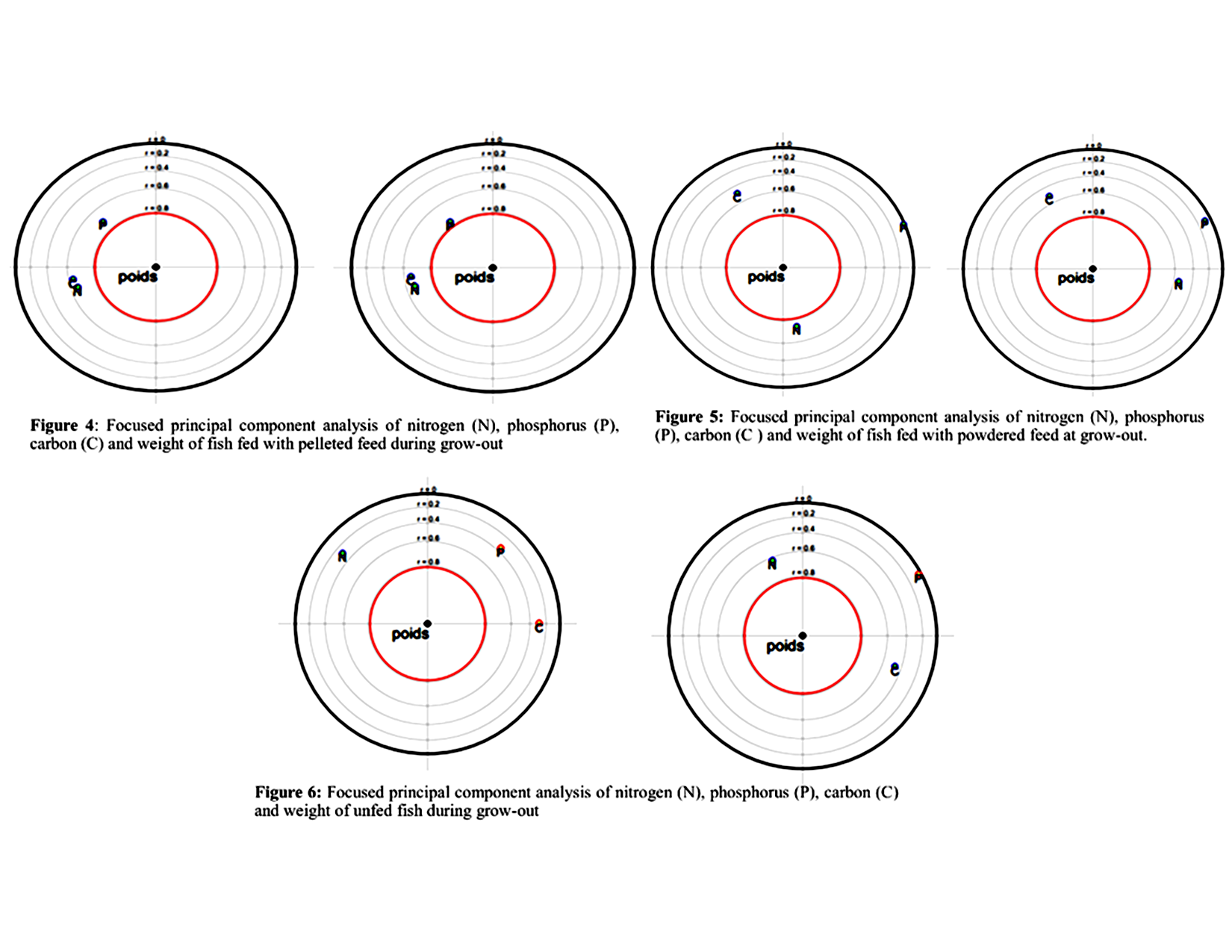
Samples of Oreochromis niloticus and phytoplankton were taken from six grow-out ponds. Carbon, nitrogen and phosphorus contents and ratios were determined and analysed to characterise the stoichiometry of phytoplankton and fish. The carbon/phosphorus, carbon/nitrogen and phosphorus/nitrogen stoichiometric ratios for phytoplankton ranged from 89.24 to 214.36, 5.05 to 8.87 and 21.97 to 31.63 respectively, while those for fish varied from 38.43 to 45.56, 3.60 to 4.05 and 9.71 to 18.66. The correlation shows that the weight of fish fed industrial feed is significantly correlated with phosphorus and nitrogen in those fed local feed and those not fed. The carbon/phosphorus, carbon/nitrogen and phosphorus/nitrogen stoichiometric ratios of phytoplankton in ponds receiving local feed and control ponds were higher than those in ponds fed industrial feed. The same trend was observed in fish. These analyses showed that the fish fed the industrial feed were higher in phosphorus than the fish fed the local feed and the control ponds, which were higher in nitrogen. These results show that fish have the same nutrient and carbon compositions as those present in their environment.
Downloads
Article Details

This work is licensed under a Creative Commons Attribution-NonCommercial-NoDerivatives 4.0 International License.
References
Angelier, E. (2000). Écologie des eaux courantes. Éditions Technique & Documentation.
Anougbo, A. B., Nobah, C., Etile N’doua, R., Atsé, B. C., & Goore, B. G. (2019). Effet de l’utilisation d’aliments composés locaux adaptés aux besoins de prégrossissement d’un silure (Clarias gariepinus (Burchell, 1822)) sur le peuplement zooplanctonique des étangs d’élevage. Agronomie Africaine, numéro spécial (8).
Benstead, J. P., Hood, J. M., Whelan, N. V., Kendrick, M. R., Nelson, D., Hanninen, A. F., & Demi, L. M. (2014). Couplage du phosphore alimentaire et de la croissance à travers divers taxons de poissons : une méta-analyse des études expérimentales en aquaculture. Ecology, 95, 2768–2777.
Brou, K. J., N’zue, K. R., Oswal, M., & Bamba, Y. (2020). Effets des régimes extrudés contenant du son de riz et du son de blé sur les performances de croissance du tilapia Oreochromis niloticus (Linnaeus, 1758) élevé en enclos. Afrique Science, 17(6), 264–281.
Burgess, S. (2018). Development in phytoplankton assemblages, ecological status and purification effect in Tegelverksdammen (Thèse de master). Environment and Natural Resources.
Elser, J. J., Fagan, W. F., Denno, R. F., Dobberfuhl, R. D., Folarin, A., Huberty, A., Interlandi, S., Kilham, S. S., McCauley, E., Schulz, K. L., Siemann, E. H., & Sterner, R. W. (2000). Nutritional constraints in terrestrial and freshwater food webs. Nature, 408.
FAO. (2016). La situation mondiale de la pêche et de l’aquaculture. Organisation des Nations Unies pour l’alimentation et l’agriculture.
Gbai, M., Ouattara, N., Bamba, Y., Ouattara, M., Ouattara, A., & Yao, K. (2018). Substitution of the fish meal by earthworm and maggot meal in the feed of Nile tilapia Oreochromis niloticus reared in freshwater. International Journal of Fisheries and Aquaculture, 10(6), 77–85.
Groga, N. (2012). Structure, fonctionnement et dynamique du phytoplancton dans le lac de Taabo (Côte d’Ivoire) (Thèse de doctorat, Université de Toulouse).
Guo, X.-T., Liu, F., & Wang, F. (2018). Stœchiométrie du carbone, de l’azote et du phosphore de trois poissons d’élevage d’eau douce en phase de croissance. Turkish Journal of Fisheries and Aquatic Sciences, 18, 239–245.
Higgins, K. A., Vanni, M. J., & González, M. J. (2006). Detritivory and the stoichiometry of nutrient cycling by a dominant fish species in lakes of varying productivity. Oikos, 114, 419–430.
Kaushik, S. J. (2005). Besoins et apports en phosphore chez les poissons. INRA Productions Animales, 18(3), 203–208.
Lazard, J., Lecomte, Y., Stomal, B., & Weigel, J. Y. (1991). Pisciculture en Afrique subsaharienne : Situation et projets dans les pays francophones. MCD.
Legendre, L., & Legendre, P. (1979). Écologie numérique : Tome 2, La structure des données écologiques. Masson.
Manning, D. W., Rosemond, A. D., Gulis, V., Benstead, J. P., Kominoski, J. S., & Maerz, J. C. (2016). La convergence de la stœchiométrie détritique prédit les seuils de décomposition stimulée par les nutriments dans les cours d’eau. Ecological Applications, 26, 1745–1757. https://doi.org/10.1890/15-1217.1
McIntyre, P. B., & Flecker, A. S. (2010). Ecological stoichiometry as an integrative framework in stream fish ecology. American Fisheries Society Symposium, 73, 539–558.
Mirah & Jica. (2019). Projet de relance de la production piscicole continentale en République de Côte d’Ivoire (PROPICO) : Rapport final.
Philippeau, G. (1992). Comment interpréter les résultats d’une analyse en composantes principales. ITCF.
Pinel-Alloul, B., Méthot, G., Verreault, G., & Vigneault, Y. (1990). Zooplankton species associations in Quebec lakes: Variation with abiotic factors, including natural and anthropogenic acidification. Canadian Journal of Fisheries and Aquatic Sciences, 47(1), 110–121.
Prater, C., Frost, P. C., Howell, E. T., Watson, S. B., Zastepa, A., King, S. S. E., Vogt, R. J., & Xenopoulos, M. A. (2017). Variation in particulate C:N:P stoichiometry across the Lake Erie watershed from tributaries to its outflow. Limnology and Oceanography, 62, S194–S206.
Rosemond, A. D., Benstead, J. P., Bumpers, P. M., Gulis, V., Kominoski, J. S., Manning, D. W., et al. (2015). Experimental nutrient additions accelerate the loss of terrestrial carbon from stream ecosystems. Science, 347, 1142–1145. https://doi.org/10.1126/science.aaa1958
Schlumberger, O., & Bouretz, N. (2002). Réseaux trophiques et production piscicole en étangs fertilisés (Dordogne, France). Revue des Sciences de l’Eau, 15(1), 177–192.
Stainton, M. P., Capel, M. J., & Armstrong, F. A. J. (1977). The chemical analysis of freshwater. Fisheries and Marine Service.
Sterner, R. W., Andersen, T., Elser, J. J., Hessen, D. O., Hood, J. M., McCauley, E., & Urabe, J. (2008). Scale-dependent carbon:nitrogen:phosphorus seston stoichiometry in marine and freshwaters. Limnology and Oceanography, 53, 1169–1180.
Sullam, K. E., Dalton, C. M., Russell, J. A., Kilham, S. S., El-Sabaawi, R., German, D. P., & Flecker, A. S. (2015). Changes in digestive traits and body nutritional composition accommodate a trophic niche shift in Trinidadian guppies. Oecologia, 177, 245–257.
Welti, N., Striebel, M., Ulseth, A. J., Cross, W. F., DeVilbiss, S., Glibert, P. M., & Hillebrand, H. (2017). Bridging food webs, ecosystem metabolism, and biogeochemistry using ecological stoichiometry theory. Frontiers in Microbiology, 8, 1298.
Yao, A. H., Koumi, A. R., Atsé, B. C., & Kouamélan, E. P. (2017). État des connaissances sur la pisciculture en Côte d’Ivoire. Agronomie Africaine, 29(3), 227–244.