

Biodegradation of Cypermethrin and its metabolic products by Bacillus flexus strain PC5 isolated from cypermethrin-treated agricultural soil Biodegradation of Cypermethrin and its metabolic products by Bacillus flexus
Article Sidebar
Main Article Content
Abstract
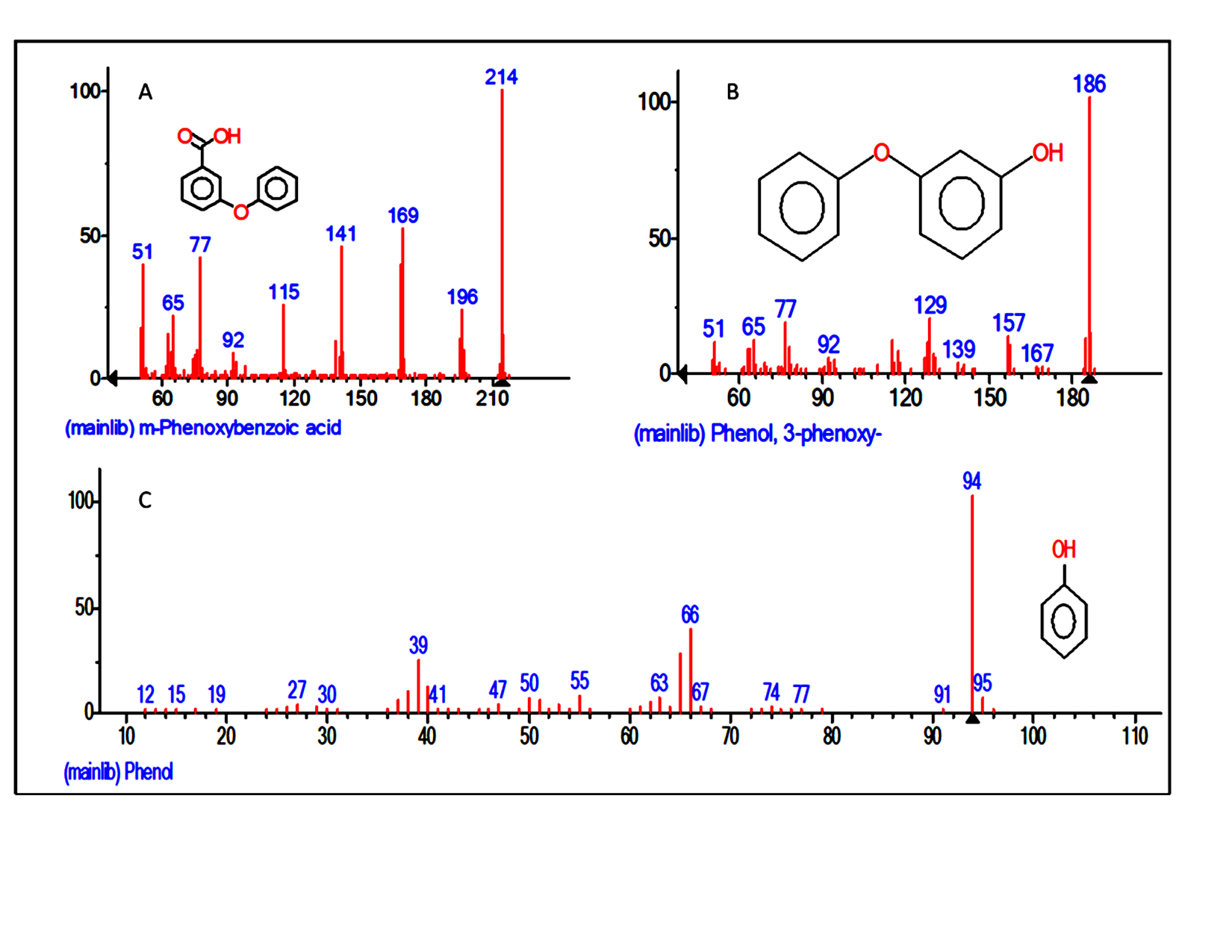
Cypermethrin (CPM) are frequently used in agricultural farmlands to control pest infestation in crops. However, its toxicity towards human and aquatic organisms requires its complete degradation in the environment. In this study, agricultural soil with extensive history of CPM application was used to prepare enrichment cultures using CPM as sole carbon source for isolation of CPM degraders. GC-MS method was used to detect the CPM degradation metabolites in the culture medium. Strain PC5 was found highly efficient in degradation of CPM and its metabolic products and was identified as Bacillus flexus (GenBank accession number LC218817) using 16S rRNA gene sequences. Strain PC5 degraded 75.74 % of CPM (100 mg L-1) within 6 days of incubation in CPM minimal salts medium (MSM) with utilization rate of 0.532 mg L-1h-1. Bacillus flexus strain PC5 had specific growth rate of 0.04 h-1 during exponential growth phase in MSM. GC-MS analysis of the culture extract showed presence of 3-Phenoxybenzaldehyde, 3-Phenoxybenzoic acid, 3-Phenoxyphenol and phenol as major metabolites. The optimal pH for CPM degradation by strain PC5 was 7.0, with degradation percentage of 75.74 % within 6 days. Degradation of CPM at different concentrations (150 mg L-1 and 200 mg L-1) by strain PC5 was 64.76 % and 34.13 % respectively after 6 days of growth. Decrease in CPM concentration (89.10 % degradation) over a period of 30 days was recorded in soil microcosms using strain PC5. Based on the metabolites detected in the culture extract, CPM degradation pathway was proposed for strain PC5. The efficient biodegradation potential and utilization of major metabolites of CPM suggests that strain PC5 can be a valuable strain for the development of bioremediation strategies for CPM polluted ecosystem.
Downloads
Article Details

This work is licensed under a Creative Commons Attribution-NonCommercial-NoDerivatives 4.0 International License.
References
Akbar, S. Sultan, S. and Kertesz, M. (2015a). Determination of cypermethrin degradation potential of soil bacteria along with plant growth-promoting characteristics. Current MicrobiologY. 70: 75-84. https://doi.org/10.1007/s00284-014-0684-7.
Anozie, P. C., Ilori, M. O., Amund, O. O. and Schmidt, S. (2017). Potential impact of cypermethrin on selected groups of soil microorganisms. Egyptian Academic Journal of Biological Science. 9(1), 39-50. https://doi.org/10.21608/eajbsg.2017.16342
Barrow, G.I. and Feltham, R.K.A. (1995). Cowan and Steel’s manual for identification of medical bacteria, third ed., Cambridge University, Cambridge.
Chen, S., Geng, P., Xiao, Y. and Hu, M. (2012a). Bioremediation of β- cypermethrin and 3-penoxybenzaldehyde contaminated soils using Streptomyces aureus HP-S-01, Applied Microbiology and Biotechnology. 94: 505-515. https://doi.org/10.1007/s00253-011-3640-5.
Chen, S., Hu, M., Luo, J., Weng, Q. and Lai, K. (2011a). Isolation and characterization of a fungus able to degrade pyrethroids and 3-phenoxybenzaldehyde, Bioresource Technology. 102: 8110-8116. https://doi.org/10.1016/j.biortech.2011.06.055.
Chen, S.H., Luo, J.J., Hu, M.Y., Lai, K.P., Geng, P., Huang, H.S. (2012). Enhancement of cypermethrin degradation by a coculture of Bacillus cereus ZH-3 and Streptomyces aureus HP-S-01, Bioresource Technology. 110: 97-104. https://doi.org/10.1016/j.biortech.2012.01.106.
Cycon, M. and Piotrowska-Seget, Z. (2016). Pyrethroid-degrading microorganisms and their potential for the bioremediation of contaminated soils, A review, Frontiers in Microbiology. 7: 1463. https://doi.org/10.3389/fmicb.2016.01463
Diegelmann, C., Weber, J., Heinzel-Wieland, R. and Kemme, M. (2015). Characterization of a cypermethrin-degrading Methylobacterium sp. Strain A-1 and molecular cloning of its carboxylesterase gene, Journal of Basic Microbiology. 55: 1245-1254. https://doi.org/10.1002/jobm.201500186.
Eneyi, E.E., Ochofie, E.C., Onifade, E.O. and Ohie, I.R. (2021). Evaluation of cypermethrin insecticide on the growth of some selected soil bacteria isolated from Makurdi, Middle Belt Nigeria, African Journal of Microbiology Research. 15: 75-81. https://doi.org/10.5897/AJMR2020.9278.
Gangola, S., Sharma, A., Bhatt, P., Khati, P. and Chaudhary, P. (2018). The presence of esterase and laccase in Bacillus subtilis facilitates biodegradation and detoxification of cypermethrin, Scientific Reports. 8: 1-11. https://doi.org/10.1038/s41598-018-31082-5
Gür Özdal, Ö. and Algur, Ö. F. (2020). Isolation and identification of the pyrethroid insecticide deltamethrin degrading bacteria from insects. Avrupa Bilim Ve Teknoloji Dergisi 18: 905-910. https://doi.org/10.31590/ejosat.677008
He, J., Zhang, K., Wang, L., Du, Y., Yang, Y. and Yuan, C. (2022). High efficient degradation of cypermethrin by a co-culture of Rhodococcus sp. JQ-L and Comamonas sp. A-3, Frontiers in Microbiology. 13: 2022. https://doi.org/10.3389/fmicb.2022.1003820.
Huang, Y., Xiao, L., Li, F., Xiao, M., Lin, D., Long, X. and Wu, Z. (2018). Microbial Degradation of Pesticide Residues and an Emphasis on the Degradation of Cypermethrin and 3-phenoxy Benzoic Acid: A Review. Molecules. 23(9): 2313. https://doi.org/10.3390/molecules23092313.
Indratin, I., Kurnia, A., and Wahyuni, S. (2019). Degradation of cypermethrin by indigenous bacteria from contaminated soil, Makara Journal of Science. 23: 210-216. https://doi.org/10.7454/mss.v23i4.7998
Jilani, S. (2013). Comparative assessment of growth and biodegradation potential of soil isolate in the presence of pesticides. Saudi Journal of Biological Sciences. 20(3): 257-264. https://doi.org/10.1016/j.sjbs.2013.02.007.
Kannan, P., Baskaran, H., Juliana Selvaraj, J. B., Saeid, A., and Kiruba Nester, J. M. (2024). Mycotransformation of Commercial Grade Cypermethrin Dispersion by Aspergillus terreus PDB-B Strain Isolated from Lake Sediments of Kulamangalam, Madurai. Molecules. 29(7), 1446. https://doi.org/10.3390/molecules29071446
Kansal, I., Kapoor, A., Solanki, S., and Singh, R. (2023). Cypermethrin toxicity in the environment: analytical insight into detection methods and microbial degradation pathways. Journal of Applied Microbiology. 134(6): 105. https://doi.org/10.1093/jambio/lxad105
Li, J., Hu, K., Hu, L., Hou, X., L,i Q., Liu, A., Chen, S., Ao, X., Hu, X., He, L., Tang, H., Huang, D., Yang, Y., Zou, L. and Liu, S. (2022). Adsorption Behavior of 3-phenoxybenzoic Acid by Lactobacillus Plantarum and Its Potential Application in Simulated Digestive Juices. International Journal of Molecular Sciences. 23(10): 5809. https://doi.org/10.3390/ijms23105809.
Lin, Q., Chen, S., Hu, M., Rizwan-ul-Haq, M., Yang, L. and Li, H. (2011). Biodegradation of cypermethrin by a newly isolated actinomycetes HU-S-01 from wastewater sludge. International Journal of Environmental Science and Technology. 8(1): 45-56. https://doi.org/10.1007/BF03326194.
Liu, F. F., Chi, Y. L., Wu, S., Jia, D. Y. and Yao, K. (2014). Simultaneous degradation of cypermethrin and its metabolite, 3-phenoxybenzoic acid, by the cooperation of Bacillus licheniformis B-1 and Sphingomonas sp. SC-1. Journal of Agricultural and Food Chemistry. 62: 8256-8262. https://doi.org/10.1021/jf502835n.
Malla, M. A., Dubey, A., Kumar, A., Vennapu, D. R., Upadhyay, N., Pradhan, D., Pradhan, R. C. and Yadav, S. (2022a). Process optimization of cypermethrin biodegradation by regression analysis and parametric modeling along with biochemical degradation pathway. Environmental Science and Pollution Research. 29(51): 77418 – 77427. https://doi.org/10.1007/s11356-022-21191-0
Malla, M. A., Dubey, A., Kumar, A. and Yadav, S. (2022b). Metagenomic analysis displays the potential predictive biodegradation pathways of the persistent pesticides in agricultural soil with a long record of pesticide usage. Microbiological Research. 261: 127081. https://doi.org/10.1016/j.micres.2022.127081.
Meeker, H. D., Barr, D. B. and Hauser, R. (2009). Pyrethroid insecticide metabolites are associated with serum hormone levels in adult men. Reproductive toxicology. 27: 155-160. https://doi.org/10.1016/j.reprotox.2008.12.012.
Moxley, K. and Schmidt, S. (2010). Preliminary characterization of an estuarine, benzoate-utilizing Vibrio sp. isolated from Durban, South Africa. Applied Microbiology and Microbial Biotechnology. 2: 1249-1254.
Panjak., Sharma, A. Gangola, S. Khati, P., Kumar, G. and Srivastava, A. (2016). Novel pathway of cypermethrin biodegradation in a Bacillus sp. strain SG2 isolated from cypermethrin-contaminated agriculture field. 3 Biotechnology. 6(1): 45. https://doi.org/10.1007/s13205-016-0372-3.
Raj, A., Kumar, A. and Dames, J. F. (2021). Tapping the role of microbial bio-surfactants in pesticide remediation: an eco-friendly approach for environmental sustainability. Frontiers in Microbiology. 12: 791723. https://doi. org/ 10. 3389/ fmicb. 2021. 791723k
Ruan, Z., Zhai, Y., Song, J., Shi, Y., Li, K., Zhao, B. and Yan, Y. (2013). Molecular cloning and characterization of a newly isolated pyrethroid-degrading esterase gene from a genomic library of Ochrobactrum anthropic YZ-1. PloS One. 8: e77329. https://doi.org/10.1371/journal.pone.0077329.
Shafer, T.J., Meyer, D.A. and Crofton, K.M. (2005). Developmental neurotoxicity of pyrethroid insecticides: critical review and future research needs. Environmental Health Perspective. 113: 123-136. https://doi.org/10.1289/ehp.7254.
Sharma, A., Kumar, V., Shahzad, B., Tanveer, M., Sidhu, G. P. S., Handa, N., Kohli, S. K., Yadav, P., Bali, A. S., Parihar, R. D., Dar, O. I., Singh, K., Jasrotia, S., Bakshi, P., Ramakrishnan, M., Kumar, S., Bhardwaj, R. and Thukral, A. K. (2019). Worldwide pesticide usage and its impacts on ecosystem. SN Applied Sciences. 1: 1446. https://doi.org/10.1007/s42452-019-1485-1.
Siddiqui, S. and Kamal, A. (2025), Microbial Biodegradation of Cypermethrin in Agricultural Soils of Uttar Pradesh: Characterization and Plasmid-Associated Degradative Potential. International Journal of Engineering Research and Technology (IJERT). 13(6): 1-3. https://doi.org/10.17577/ijertconv13IS06025
Sundaram, S., Das, M. T. and Thakur, L. S (2013). Biodegradation of cypermethrin by Bacillus sp. in soil microcosm and in vitro toxicity evaluation on human cell line, International Biodeterioration and Biodegradation. 77: 39-44 https://doi.org/10.1016/j.ibiod.2012.11.008.
Tallur, P.N., Mulla, S.I., Megadi, V.B., Talwar, M.P. and Ninnekar, H.Z. (2015).Biodegradation of cypermethrin by immobilized cells of Micrococcus sp. strain CPN 1. Brazilian Journal of Microbiology. 46(3): 667-72. https://doi.org/10.1590/S1517-838246320130557.
Tamura, K., Peterson, D., Peterson, N., Stecher, G., Nei, M. and Kumar, S. (2011). MEGA 5, molecular evolutionary genetics analysis using maximum likelihood, evolutionary distance and maximum parsimony methods. Molecular Biology and Evolution. 28: 2731-2739. https://doi.org/10.1093/molbev/msr121.
Tyagi, H. and Prashar, P. (2015). Isolation and identification of cypermethrin degrading Serratia nematodiphila from cauliflower rhizosphere. International Journal of PharmTech Research. 7: 64-71.
van der Woude, B.J., Gottschal, J.C. and Prins, R.A. (1995). Degradation of 2,5-dichlorobenzoic acid by Pseudomonas aeruginosa JB2 at low oxygen tensions. Biodegradation. 6: 39–46. https://doi.org/10.1007/BF00702297
Wang, B., Ma, Y., Zhou, W., Zheng, J., Zhu, J. He, J. and Li, S. (2011). Biodegradation of synthetic pyrethroids by Ochrobactrum tritici strain pyd-1. World Journal of Microbiology and Biotechnology. 27: 2315-2324. https://doi.org/10.1007/s11274-011-0698-2.
Xiao, Y., Chen, S., Gao, Y., Hu, M. and Zhong, G. (2015). Isolation of a novel beta-cypermethrin degrading strain Bacillus subtilis BSF01 and its biodegradation pathway. Applied Microbiology and Biotechnology. 99: 2849-2859. https://doi.org/10.1007/s00253-014-6164-y.
Yin, L., Li, X., Liu, Y., Zhang, D., Zhang, S. and Luo, X. (2012). Biodegradation of cypermethrin by Rhodopseudomonas palustris GJ-22 isolated from activated sludge, Fresenius Environmental Bulletin. 21: 397-405.
Zhan, H., Huang, Y. H., Lin, Z. Q., Bhatt, P. and Chen, S. H. (2020). New insights into the microbial degradation and catalytic mechanism of synthetic pyrethroids, Environmental Research. 182: 109-138. https://doi.org/10.1016/j.envres.2020.109138
Zhang, C., Jia, L., Wang, S. H., Qu, J., Xu, L.L., Shi, H.H., and Yan, Y.C. (2010). Biodegradation of beta-cypermethrin by two Serratia spp. with different cell surface hydrophobicity. Bioresource Technology. 101: 3423-3429. https://doi.org/10.1016/j.biortech.2009.12.083.
Zhao, H., Geng, Y., Chen, L., Tao, K. and Hou, T. (2013). Biodegradation of cypermethrin by a novel Catellibacterium sp. strain CC-5 isolated from contaminated soil. Canadian Journal of Microbiology. 59: 311–317. https://doi.org/10.1139/cjm-2012-0580
Zhao, J.Y., Chi, Y.L., Xu, Y.C., Jia, D.Y. and Yao, K. (2016). Co-metabolic degradation of ß-cypermethrin and 3-phenoxybenzoic acid by co-culture of Bacillus licheniformis B-1 and Aspergillus oryzae M-4. PloS One. 11: e0166796. https://doi.org/10.1371/journal.pone.0166796.