

Influence of Chemolithotrophic Bacteria on Corrosion Rates of Galvanised and Mild Steel in Sea and Tap Water
Article Sidebar
Main Article Content
Abstract
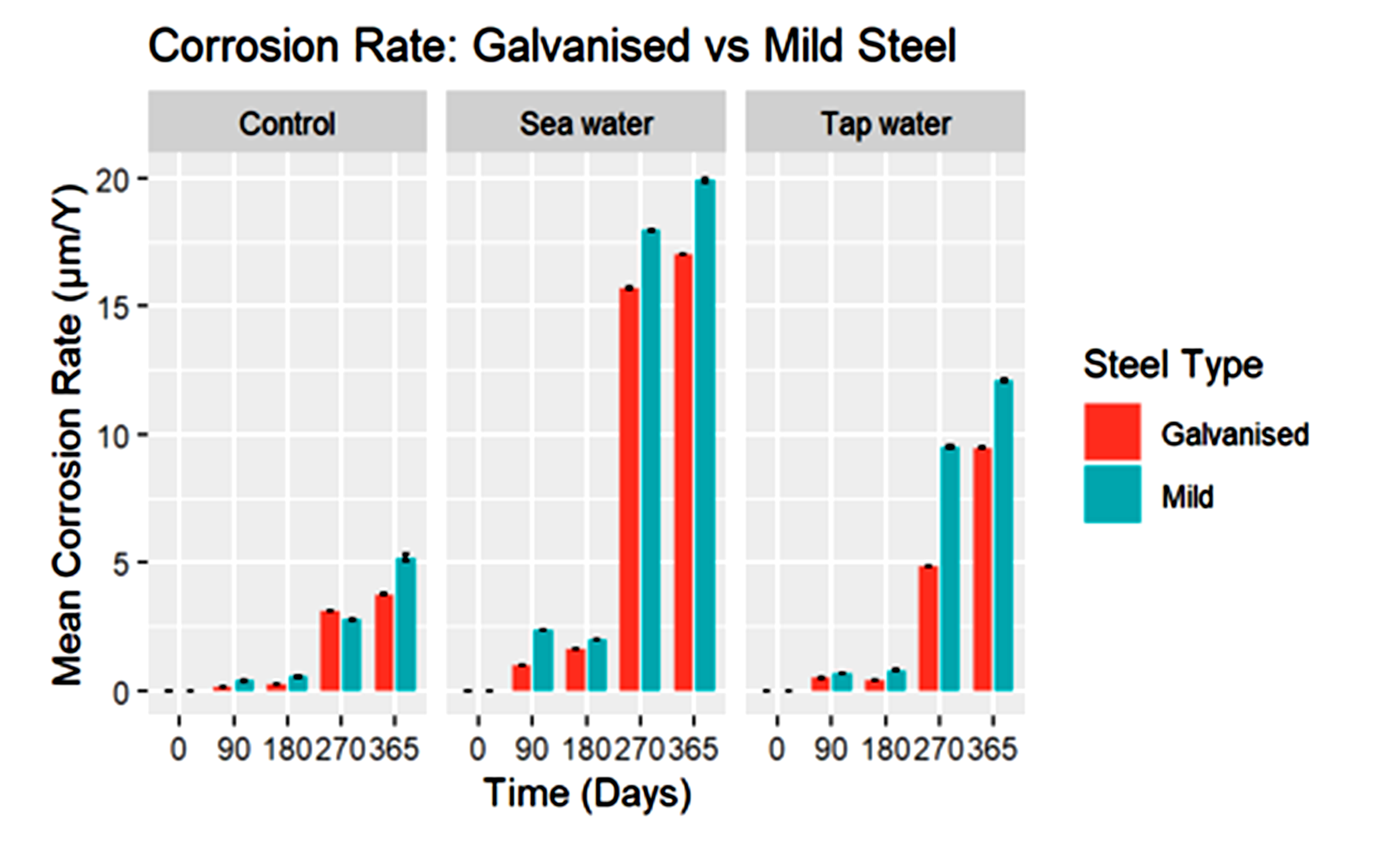
Microbiologically influenced corrosion (MIC) represents a complex interplay between microbial communities, their metabolic activities, and the physicochemical characteristics of the surrounding environment. This study investigated the roles of diverse bacterial isolates in the corrosion of mild and galvanised steel exposed to seawater and freshwater systems. Galvanised and mild steel bars were obtained, prepared and suspended in sea, tap, and sterile distilled water for 365 days. Physicochemical parameters and bacterial loads of the water samples were monitored at an interval of 90 days. Bacteria were isolated on Baar’s and 9K media. Corrosion rates of the steel samples were estimated across the different water samples. Isolated bacteria were identified by means of conventional biochemical and molecular methods using 16S rRNA gene. The identified bacterial isolates, Clostridium beijerinckii, Bacillus altitudinis, Alcaligenes faecalis, Stenotrophomonas maltophilia, Clostridium diolis and Neobacillus niacin, play mechanistically distinct yet synergistic roles in corrosion processes. Strict anaerobes such as Clostridium spp. contribute to MIC via biofilm formation and production of corrosive metabolites, including organic acids and sulphides, which destabilize metal surfaces. Facultative and aerobic organisms such as Alcaligenes and Bacillus spp. influence corrosion through biosurfactant production, oxygen depletion, and extracellular polymeric substance (EPS) synthesis. The corrosion rate was highest in mild steel, with 19.97 µm/Yr in sea water at day 365. The formation of multispecies biofilms was identified as a critical functional driver of corrosion, enabling metabolic cooperation between aerobic and anaerobic populations. The study accentuates the role of bacteria in supporting an increased rate of steel corrosion.
Downloads
Article Details

This work is licensed under a Creative Commons Attribution-NonCommercial-NoDerivatives 4.0 International License.
References
Adebesin, O., Martins, V., Olalere, A., Odukoya, O., & Adetuyi, T. (2026). Molecular Characterization of Plastic Bio-Degrading Bacteria Isolated from River Ethiope. J. Biol. Res. Biotech., 24(1), 473–485. DOI: 10.4314/br.v24i1.21.
Ali, N., & Fulazzaky, M. A. (2020). The empirical prediction of weight change and corrosion rate of low-carbon steel. Heliyon, 6(9): e05050. DOI:10.1016/j.heliyon.2020.e05050
Al-Eshaikh, M. A. and Kadachi, A. (2011). Elemental analysis of steel products using X-ray fluorescence (XRF) technique. J. King Saud Univers-Engin. Sci. 23(2):75-79. DOI:10.1016/j.jksues.2011.03.002?utm_source=chatgpt.com
Andrade, C. (2023). Steel corrosion rates in concrete in contact to sea water. Cem. Concr. Res. 165:107085. DOI:10.1016/j.cemconres.2022.107085
Aouniti, A., Elmsellem, H., Tighadouini, S., Elazzouzi, M., Radi, S., et al. (2016). Schiff’s base derived from 2-acetyl thiophene as corrosion inhibitor of steel in acidic medium. J. Taibah Uni. Med. Sci. 10: 774-785. DOI:10.1016/j.jtusci.2015.11.008
Aslan, C., Devianto, H., Wonoputri, V., Aulia, N. I., Pusparizkita, Y. M., Bayuseno, A. P., & Harimawan, A. (2024). Microbiologically influenced corrosion in B35 carbon steel storage tank: The influence of diesel blend sludge mixed culture in the oil-water interphase. Case Studies in Chem. Environ. Engin. 10, 101022. DOI:10.1016/j.cscee.2024.101022
Assad, H., Lone, I. A., Sharma, P. K., & Kumar, A. (2025). Corrosion in the Oil and Gas Industry. Industrial Corrosion: Fundamentals, Failure, Analysis and Prevention, 39-63. DOI:10.1002/9781394301560.ch3
Babar, Z., Khan, M., Chotana, G. A., Murtaza, G., & Shamim, S. (2021). Evaluation of the Potential Role of Bacillus altitudinis MT422188 in Nickel Bioremediation from Contaminated Industrial Effluents. Sustainability, 13(13), 7353. DOI:10.3390/su13137353
Csavina, J., Field, J., Taylor, M., Gao, S., Landázuri, A., Betterton, E., & Sáez, A. (2012). A Review on the Importance of Metals and Metalloids in Atmospheric Dust and Aerosol from Mining Operations. Sci. Total Environ. 433, 58–73. DOI:10.1016/j.scitotenv.2012.06.013
Diao, C., Ye, W., Yan, J., Hao, T., Huang, L., Chen, Y., Long, J., Xiao, T., & Zhang, H. (2023). Application of microbial sulfate-reduction process for sulfate-laden wastewater treatment: A review. Journal of Water Process Engineering, 52, 103537. DOI:10.1016/j.jwpe.2023.103537
Dobretsov, S., & Rittschof, D. (2023). “Omics" techniques used in marine biofouling studies. International Journal of Molecular Sciences, 24(10), 10518. DOI:10.3390/ijms241310518
Dong, Y., Song, G.-L., Zhang, J., Gao, Y., Wang, Z. M., & Zheng, D. (2022). Biocorrosion induced by red-tide alga-bacterium symbiosis and the biofouling induced by dissolved iron for carbon steel in marine environment. Journal of Materials Science & Technology, 128, 107–117. DOI:10.1016/j.jmst.2022.02.057
Dordevic, D., Jancíková, S., Vítězová, M., & Kushkevych, I. (2021). Hydrogen sulfide toxicity in the gut environment: Meta-analysis of sulfate-reducing and lactic acid bacteria in inflammatory processes. Journal of Advanced Research, 27, 55–69. DOI:10.1016/j.jare.2020.03.003
Ekene, N. K., Gift, I. A., Peter, A., Dennis, U. C., & Ele, O. C. (2024). Assessing microbial exoelectrogenicity for enhanced industrial waste water management and power generation. J. Biol. Res. Biotech., 22(1), 2264–2273. DOI: 10.4314/br.v22i1.5.
Emerson, D., Fleming, E. J. and McBeth, J. M (2010). Iron-oxidizing bacteria: an environmental and genomic perspective. Ann Rev Microbiol. 64: 561-583. DOI:10.1146/annurev.micro.112408.134208
Etim, I. I. N., Dong, J., Wei, J., Nan, C., Pokharel, D. B., Umoh, A. J., Xu, D., Su, M., & Ke, W. (2021). Effect of organic silicon quaternary ammonium salts on mitigating corrosion of reinforced steel induced by SRB in mild alkaline simulated concrete pore solution. Journal of Materials Science & Technology, 64, 126–140. DOI:10.1016/j.jmst.2019.10.006
Imefon, U. D., Udo, U.I. & Jimmy, U. S. (2024). Bacteriological load and antibiotic susceptibility patterns of bacterial isolates from aquatic resources harvested from Okwan Obolo estuary, Akwa Ibom State, Nigeria. J. Biol. Res. Biotech., 20(3), 1730–1739. DOI: 10.4314/br.v20i3.10.
Kalyuzhnaya, M. G., Beck, D. A. C., & Chistoserdova, L. (2011). Functional metagenomics of methylotrophs. In Methods in Enzymology (Vol. 495, pp. 81–98). Academic Press. DOI:10.1016/B978-0-12-386905-0.00006-1
Hedrich, S., Schlomann, M. and Johnson, D. B (2011). The iron-oxidizing proteobacteria. Microbiol. 157: 1551-1564. DOI:10.1099/mic.0.045344-0
Hu, M., Zhao, X., Gu, J., Qian, L., Wang, Z., Nie, Y., Han, X., An, L., & Jiang, H. (2024). Metals recovery from polymetallic sulfide tailings by bioleaching functional bacteria isolated with the improved 9K agar: Comparison between one-step and two-step processes. Environ. Res. 240, 117511. DOI:10.1016/j.envres.2023.117511
Ismail, M., Yahaya, N., Bakar, A., & Noor, N. (2014). Cultivation of sulphate reducing bacteria in different media. Malaysian J. Civ. Engin. 26, 456–465. DOI:10.11113/mjce.v26.15903
Jung, H., Kwon, K.-J., Lee, E., Kim, D.-G., & Kim, G. Y. (2011). Effectof dissolved oxygen on corrosion properties of reinforcingsteel. Cor. Engin. Sci. Technol. 46(2), 195–198. DOI:10.1179/1743278210Y.0000000008
Kikuchi, Y., Boku, S., and Nakahara, M. (2016). Thiobacillus and passivation. BioMetals, 29(6), 973-983.
Little, B. J., & Lee, J. S. (2015). Microbiologically Influenced Corrosion. In Oil and Gas Pipelines (pp. 387–398). John Wiley & Sons, Ltd. DOI:10.1002/9781119019213.ch27
Li, Y. and Ning, C (2019). Latest research progress of marine microbiological corrosion and biofouling, and new approaches of marine anti-corrosion and anti-fouling. Bioactive Material. 4: 189- 195. DOI:10.1016/j.bioactmat.2019.04.003
Liu, C., Li, Y., Cheng, X. and Li, X. (2022). Recent advances on the corrosion resistance of low-density steel: A review. Acta Metallurgica Sinica. 35:1055-1067. DOI:10.1007/s40195-021-01369-0
Lv, M., Du, M., Li, X., Yue, Y., & Chen, X. (2019). Mechanism ofmicrobiologically influenced corrosion of X65 steel in seawater containing sulfate-reducing bacteria and iron-oxidizing bacteria. J. Mat. Res. Technol. 8(5), 4066–4078. DOI:10.1016/j.jmrt.2019.07.016
Machuca, L. L. (2019). Understanding and addressing microbiologically influenced corrosion (MIC). Corrosion and Materials. 44(1):88-96
Napoleão, A., Furtado, A., Pereira, J., Quendera, R., Pellegrino, O., Cidade, M., & Oliveira, C. (2018). Salinity determinations by refractometry and oscillation-type densimetry as compatible methods: From salinity to pH. Journal of Physics: Conference Series, 1065. DOI:10.1088/1742-6596/1065/7/072037
Obidi, O.F.; Soyinka, O.O. and Kamoru, T.A. (2023). Morphological, Biochemical and Molecular Characterisations of Bacteria Isolated from Water and Submerged Painted Boat Hulls in Badagry Lagoon, Lagos State, Nigeria. J. Appl. Sci. Environ. Manage. 27(7): 1579-1589. DOI:10.4314/jasem.v27i7.34
Omar, S. H., Khalil, N. E., EL-Ahwany, A. M. D., El-Sayed, H. A. E. and Arafat, S. O. Y (2021). Mitigation of Microbiologically Induced Corrosion (MIC) and Preventive Strategies. Research Trends of Microbiology, MedDocs Publishers. Vol. 3, Chapter 1, pp. 1-11.
Pantaléon, V., Bouttier, S., Soavelomandroso, A. P., Janoir, C., & Candela, T. (2014). Biofilms of Clostridium species. Anaerobe, 30, 193–198. DOI:10.1016/j.anaerobe.2014.09.010
Qian, H., Zhang, J., Cui, T., Fan, L., Chen, X., Liu, W., Chang, W., Du, C., & Zhang, D. (2021). Influence of NaCl concentration on microbiologically influenced corrosion of carbon steel by halophilic archaeon Natronorubrum tibetense. Bioelectrochemistry, 140, 107746. DOI:10.1016/j.bioelechem.2021.107746
Shi, P., Du, M., & Wang, J. (2023). Effect of Alcaligenes sp. On corrosion behavior of X65 steel in simulated offshore oilfield-produced water. Front. Microbiol. 14:1127858. DOI:10.3389/fmicb.2023.1127858
Singh AK, Thakur S, Pani B, Ebenso EE, Quraishi MA, et al. (2018) Hydroxy-N′- ((Thiophene-2-yl) methylene) benzohydrazide: Ultra-sound-assisted synthesis and corrosion inhibition study. ACS Omega. 3: 4695-4705. DOI:10.1021/acsomega.8b00003
Soto-Varela, Z. E., Orozco-Sánchez, C. J., Bolívar-Anillo, H. J., Martínez, J. M., Rodríguez, N., Consuegra-Padilla, N., Robledo-Meza, A., & Amils, R. (2024). Halotolerant Endophytic Bacteria Priestia flexa 7BS3110 with Hg2+ Tolerance Isolated from Avicennia germinans in a Caribbean Mangrove from Colombia. Microorganisms, 12(9), 1857. DOI:10.3390/microorganisms12091857
Stancu, M. M. (2022). Role of Indigenous Bacteria in Corrosion of Two Types of Carbon Steel. Microorganisms, 10(12), 2451. DOI:10.3390/microorganisms10122451
Tanupabrungsun, T., Brown, B. and Srdjan N. (2013). Effect of pH on CO2 corrosion of mild steel at elevated temperatures. " Proceedings of the CORROSION 2013. CORROSION 2013. Orlando, FL. (pp. 1-11). AMPP. DOI:doi.org/10.5006/C2013-02348
Telegdi, J., Shaban, A., & Trif, L. (2017). Microbiologically influenced corrosion (MIC). In Trends in Oil and Gas Corrosion Research and Technologies (pp. 191–214). Elsevier. DOI:10.1016/B978-0-08-101105-8.00008-5
Videla, H. A. (2003). Biocorrosion and biofouling of metals and alloys of industrial usage. Present state of the art at the beginning of the new millennium. Revista de Metalurgia, 39(Extra), 256–264. DOI:10.3989/revmetalm.2003.v39.iExtra.1128
Wang, J., Shi, P., Du, M., Xu, T., Shan, X., & Tian, Z. (2024). Effects of Alcaligenes sp. On corrosion inhibition of sulfate-reducing bacteria in oilfield produced water. Corr. Sci. 227, 111771. DOI:10.1016/j.corsci.2023.111771
Wang, Y. S., Liu, L., Fu, Q., Sun, J., An, Z. Y., Ding, R., Li, Y., & Zhao, X. D. (2020). Effect of Bacillus subtilis on corrosion behavior of 10MnNiCrCu steel in marine environment. Sci. Rep. 10, 5744. DOI:10.1038/s41598-020-62809-y
Whitehead, T. R., Lawson, P. A., & Cotta, M. A. (2015). Hespellia. In Bergey’s Manual of Systematics of Archaea and Bacteria (pp. 1–5). John Wiley & Sons, Ltd. DOI:10.1002/9781118960608.gbm00644
Xu, Y., Zhang, Q., Chen, H., & Huang, Y. (2023). Understanding the interaction between erosion and corrosion of pipeline steel in acid solution of different pH. Journal of Materials Research and Technology, 25, 6550–6566. DOI:10.1016/j.jmrt.2023.07.109
Zehra, S., Aslam, R., Mobin, M., & Verma, C. (Eds.). (2025). Industrial Corrosion: Fundamentals, Failure, Analysis and Prevention. John Wiley & Sons. DOI:10.1002/9781394301560