

Antibacterial Activity and Metabolite Profile of Endophytic Bacteria from Azadirachta Indica and Khaya Senegalensis against Poultry-Associated Antibiotic-Resistance Escherichia Coli and Salmonella Spp
Article Sidebar
Main Article Content
Abstract
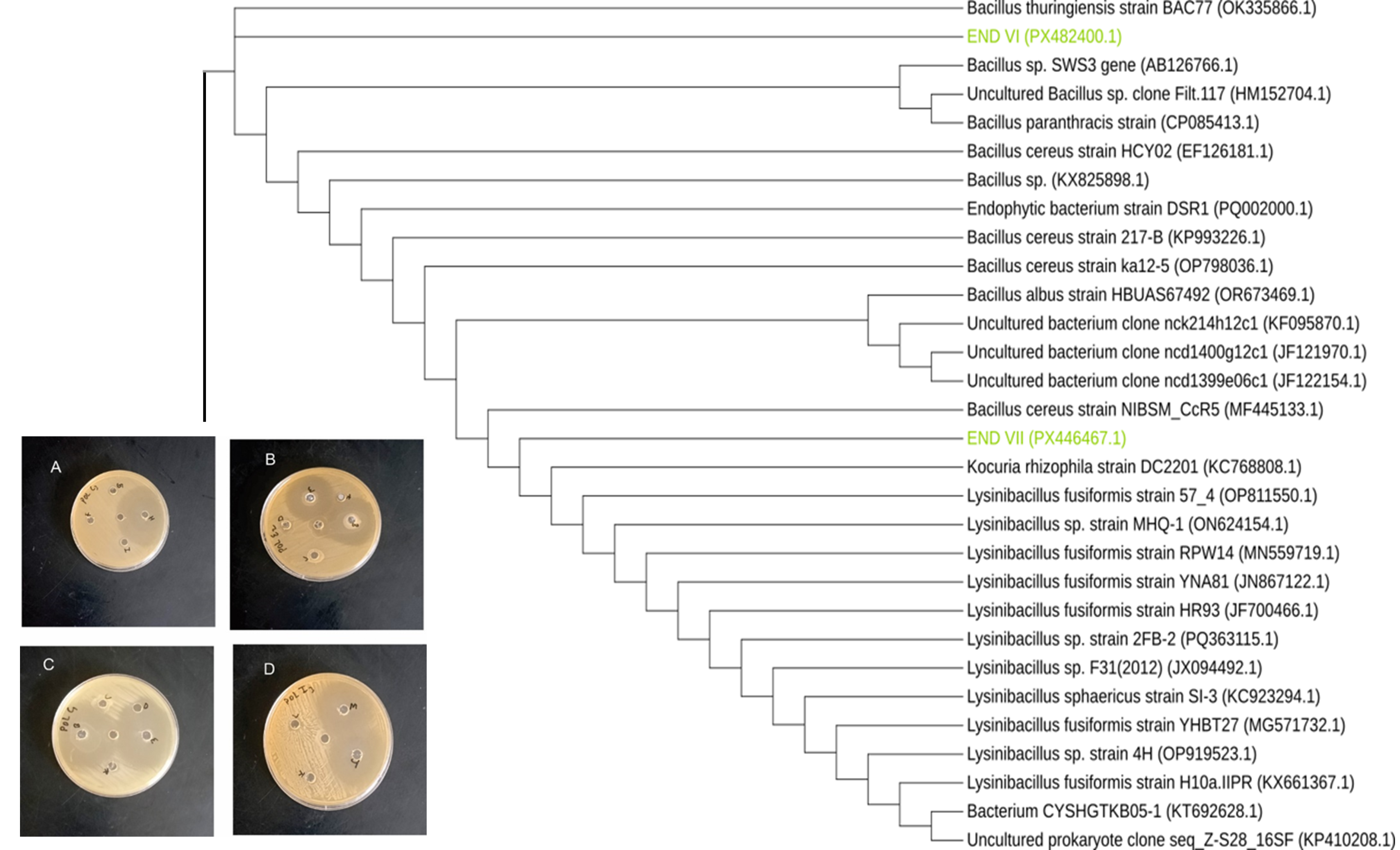
The escalating prevalence of multidrug-resistant bacteria in poultry production poses significant threats to both animal health and public safety through zoonotic transmission pathways. This study investigated the antimicrobial potential of endophytic bacteria isolated from two medicinal plants, Azadirachta indica (neem) and Khaya senegalensis (African mahogany), against multidrug-resistant Escherichia coli and Salmonella species obtained from poultry droppings in Kaduna State, Nigeria. Twenty endophytic bacteria were isolated from surface-sterilized roots and leaves of the medicinal plants using starch casein agar. Preliminary antimicrobial screening identified four isolates (ENDVI, ENDVII, ENDVIII, and ENDIX) exhibiting broad-spectrum activity against the multidrug-resistant poultry pathogens. These bioactive endophytes were subjected to fermentation, ethyl acetate extraction, and chromatographic purification. Secondary screening of purified fractions revealed substantial antimicrobial activity with inhibition zones ranging from 20.33±0.33 mm to 26.33±0.88 mm. Molecular identification using 16S rRNA gene sequencing identified the active endophytes as Bacillus cereus (ENDVI and ENDVIII, 92.96% and 98.72% identity respectively) and Lysinibacillus species (ENDVII as L. fusiformis, 98.85 % identity; ENDIX as L. cavernae, 88.00% identity). Liquid chromatography-mass spectrometry (LC-MS) analysis of active fractions revealed secondary metabolites such as Kaempferol, Vinclozolin, 2-Aminobenzimidazole, Tropicamide, and Docosapentaenoic acid in some of the fractions. Statistical analysis using one-way ANOVA confirmed significant antimicrobial activity (p < 0.05) of the partially purified fractions. The findings demonstrate that endophytic bacteria from A. indica and K. senegalensis are promising sources of antimicrobial compounds effective against multidrug-resistant poultry pathogens.
Downloads
Article Details

This work is licensed under a Creative Commons Attribution-NonCommercial-NoDerivatives 4.0 International License.
References
Abdelmohsen, U.R., Sayed, A.M., & Elmaidomy, A.H. (2022). Natural products’ extraction and isolation–between conventional and modern techniques. Frontiers in Natural Products, 1, 873808.
Adamu, I., Majiyebo, A. J., Alozieuwa, U. B., Lawal, A. A., Alawode, B. O. O. R. A., & Berinyuy, E. B. (2022). Ethnopharmacology, chemical constituents, and biological activities of Khaya senegalensis (Desr.) A. Juss a forest plant with multi-purpose applications. AROC. Natural Products Research, 2(2), 10-15.
Ahmadi, R., & Ebrahimzadeh, M.A. (2020). Resveratrol – a comprehensive review of recent advances in anticancer drug design and development. European Journal of Medicinal Chemistry, 200, 112356.
Alara, J. A., & Alara, O. R. (2024). An overview of the global alarming increase of multiple drug resistant: a major challenge in clinical diagnosis. Infectious Disorders-Drug Targets Disorders), 24(3), 26-42.
Anand, U., Pal, T., Yadav, N., Singh, V.K., Tripathi, V., Choudhary, K.K., Shukla, A.K., Sunita, K., Kumar, A., Bontempi, E., Ma, Y., Kolton, M., & Singh, A.K. (2023). Current scenario and future prospects of endophytic microbes: promising candidates for abiotic and biotic stress management for agricultural and environmental sustainability. Microbial Ecology, 86(3), 1455-1486.
Brishty, S.R., Hossain, M.J., Khandaker, M.U., Faruque, M.R.I., Osman, H., & Rahman, S.M.A. (2021). A comprehensive account on recent progress in pharmacological activities of benzimidazole derivatives. Frontiers in Pharmacology, 12, 762807.
Casillas-Vargas, G., Ocasio-Malavé, C., Medina, S., Morales-Guzmán, C., García Del Valle, R., Carballeira, N.M., & Sanabria-Ríos, D.J. (2021). Antibacterial fatty acids: an update of possible mechanisms of action and implications in the development of the next-generation of antibacterial agents. Progress in Lipid Research, 82, 101093.
Caulier, S., Nannan, C., Gillis, A., Licciardi, F., Bragard, C., & Mahillon, J. (2019). Overview of the antimicrobial compounds produced by members of the Bacillus subtilis group. Frontiers in Microbiology, 10: 302.
Chen, Z., & Jiang, S. (2026). Chemical Signaling and Metabolomic Crosstalk in Endophytic Fungi–Medicinal Plant Symbioses for Natural Product Discovery and Sustainable Bioproduction. Metabolites, 16(3), 164
Collignon, P., Beggs, J. J., Walsh, T. R., Gandra, S., & Laxminarayan, R. (2018). Anthropological and socioeconomic factors contributing to global antimicrobial resistance. The Lancet Planetary Health, 2(9), e398-e405.
De Simeis, D., & Serra, S. (2021). Actinomycetes: a never-ending source of bioactive compounds—an overview on antibiotics production. Antibiotics, 10(5), 483.
Donova, M.V. (2022). Microbial steroid production technologies: current trends and prospects. Microorganisms, 10(1), 53.
Ek-Ramos, M.J., Gomez-Flores, R., Orozco-Flores, A.A., Rodríguez-Padilla, C., González-Ochoa, G., & Tamez-Guerra, P. (2019). Bioactive products from plant-endophytic gram-positive bacteria. Frontiers in Microbiology, 10: 463.
Ezeobiora, C.E., Igbokwe, N.H., Stephen, C.M., Mendie, U.E., & Amin, D.H. (2024). Diversity, molecular phylogenetics, and antibiotic biosynthetic potential of endophytic Actinobacteria isolated from medicinal plants in Nigeria. Brazilian Journal of Microbiology. 55, 179-190.
Fernández-Cañón, J.M., & Chamizo-Ampudia, A. (2026). Toward sustainable testosterone manufacturing: green chemistry and microbial biotransformation approaches. International Journal of Molecular Sciences, 27(5), 2444.
Gajic, I., Kabic, J., Kekic, D., Jovicevic, M., Milenkovic, M., Mitic Culafic, D., Trudic, A., Ranin, L., & Opavski, N. (2022). Antimicrobial susceptibility testing: a comprehensive review of currently used methods. Antibiotics, 11(4), 427
Gakuubi, M.M., Munusamy, M., Liang, Z.-X., & Ng, S.B. (2021). Fungal endophytes: a promising frontier for discovery of novel bioactive compounds. Journal of Fungi, 7(10), 786.
Garba, Y., Bello, N. U., Bashir, M., & Mohammed, S. Y. (2023). In Vitro and in Vivo Analysis of the Antioxidant Potentials of Methanolic Extract of Tamarindus indica Leaves. Nigerian Journal of Biochemistry and Molecular Biology, 38(3), 104-111.
Guan, S., Zhong, L., Yu, H., Wang, L., Jin, Y., Liu, J., Xiang, H., Yu, H., Wang, L., & Wang, D. (2022). Molecular docking and proteomics reveals the synergistic antibacterial mechanism of theaflavin with β-lactam antibiotics against MRSA. Frontiers in Microbiology, 13, 993430.
Harirchi, S., Sar, T., Ramezani, M., Aliyu, H., Etemadifar, Z., Nojoumi, S.A., Yazdian, F., Awasthi, M.K., & Taherzadeh, M.J. (2022). Bacillales: from taxonomy to biotechnological and industrial perspectives. Microorganisms, 10(12), 2355.
Hashem, A.H., Attia, M.S., Kandil, E.K., Fawzi, M.M., Abdelrahman, A.S., Khader, M.S., Khodaira, M.A., Emam, A.E., Goma, M.A., & Abdelaziz, A.M. (2023). Bioactive compounds and biomedical applications of endophytic fungi: a recent review. Microbial Cell Factories, 22, 107.
Iacob, S., Stefan, C.-S., Nechita, A., Matei, M.-N., Lisa, E.-L., Tutunaru, D., Fulga, I., Fulga, A., Cristea (Hohota), A.-G., & Dragostin, O.-M. (2025). Hybrid molecules with purine and pyrimidine derivatives for antitumor therapy: news, perspectives, and future directions. Molecules, 30(13), 2707.
Jamal, Q.M.S., & Ahmad, V. (2022). Lysinibacilli: A Biological Factories Intended for Bio- Insecticidal, Bio-Control, and Bioremediation Activities. Journal of Fungi, 8(2), 1288
Kan, Y., Niu, X.K., Rao, M.P.N., Dong, Z.Y., Xie, Y.G., Kang, Y.Q., & Li, W.J. (2020). Lysinibacillus cavernae sp. nov., isolated from cave soil. Archives of Microbiology, 202(6), 1529-1534.
Kato, K., & Standley, D.M. (2013). MAFFT multiple sequence alignment software version 7: Improvements in performance and usability. Molecular Biology and Evolution, 30, 772- 780.
Mahdi, R.A., Bahrami, Y., & Kakaei, E. (2022). Identification and antibacterial evaluation of endophytic actinobacteria from Luffa cylindrica. Scientific Reports, 12, 18236.
Mak, P.H.W., Rehman, M.A., Kiarie, E.G., Topp, E., & Diarra, M.S. (2022). Production systems and important antimicrobial resistant-pathogenic bacteria in poultry: a review. Journal of Animal Science and Biotechnology, 13, 148.
Manganyi, M.C., & Ateba, C.N. (2020). Untapped potentials of endophytic fungi: a review of novel bioactive compounds with biological applications. Microorganisms, 8(12), 1934.
Minh, B.Q., Schmidt, H.A., Chernomor, O., Schrempf, D., Woodhams, M.D., von Haeseler, A., & Lanfear, R. (2020). IQ-TREE 2: new models and efficient methods for phylogenetic inference in the genomic era. Molecular Biology and Evolution, 37(5), 1530-1534.
Mohamad, O.A.A., Li, L., Ma, J.B., Hatab, S., Xu, L., Guo, J.W., Rasulov, B.A., Liu, Y.H., Hedlund, B.P., & Li, W.J. (2018). Evaluation of the antimicrobial activity of endophytic bacterial populations from Chinese traditional medicinal plant licorice and characterization of the bioactive secondary metabolites produced by Bacillus atrophaeus against Verticillium dahliae. Frontiers in Microbiology, 9: 924.
Muhammad, A.A., Bulus, T., & Zubairu, M. (2025). Antibiotic susceptibility profiles and multiple antibiotic resistance index of Salmonella spp and Escherichia coli from poultry droppings from selected farms in Samaru, Zaria. Nigerian Journal of Scientific Research, 24(1), 140-148.
Musa, Z., Ma, J., Egamberdieva, D., Abdelshafy Mohamad, O., Abaydulla, G., Liu, Y., Li, W.-J., & Li, L. (2020). Diversity and antimicrobial potential of cultivable endophytic actinobacteria associated with the medicinal plant Thymus roseus. Frontiers in Microbiology, 11, 191.
Newman, D.J., & Cragg, G.M. (2020). Natural products as sources of new drugs over the nearly four decades from 01/1981 to 09/2019. Journal of Natural Products, 83(3): 770-803.
Panigrahi, S., Dash, D., & Rath, C. C. (2018). Characterization Of Endophytic Bacteria with Plant Growth Promoting Activities Isolated from Six Medicinal Plants. Journal of ExperimentalBiology and Agricultural Sciences, 6(5), 782 – 791.
Passera, A., Rossato, M., Oliver, J.S., Battelli, G., Shahzad, G.-I.-R.., Cosentino, E., Sage, J.M., Toffolatti, S.L., Lopatriello, G., & Davis, J.R. (2020). Characterization of Lysinibacillus fusiformis strain S4C11: In vitro, in planta, and in silico analyses reveal a plant-beneficial microbe. Microbiological Research, 244, 126665,
Patience, A. C., Christiana, O. C., & Ukamaka, O. E. (2026). Biodegradation of cypermethrin and its metabolic products by Bacillus flexus strain PC5 isolated from cypermethrin-treated agricultural soil. Bio-Research, 24(1), 360–373.
Raihan, T., Azad, A.K., Ahmed, J., Shepon, M.R., Dey, P., Chowdhury, N., Aunkor, T.H., Ali, H., & Suhani, S. (2021). Extracellular metabolites of endophytic fungi from Azadirachta indica inhibit multidrug-resistant bacteria and phytopathogens. Future Microbiology, 16, 557-576.
Razzaq Meo, S., Van de Wiele, T., & Defoirdt, T. (2025). Indole signaling in Escherichia coli: a target for antivirulence therapy? Gut Microbes, 17(1), 2499573.
Reshma, A., & Brindha-Priyadarisini, V. (2021). Eco friendly antimicrobial finishing of textiles using bioactive metabolite from endophytic Streptomyces fradiae CQLW against bio deterioration. Journal of the Textile Institute, 112(6), 902-913.
Rutz, A., & Wolfender, J.-L. (2023). Automated composition assessment of natural extracts: untargeted mass spectrometry-based metabolite profiling integrating semiquantitative detection. Journal of Agricultural and Food Chemistry, 71(46), 18010-18023.
Shamsudin, N.F., Ahmed, Q.U., Mahmood, S., Ali Shah, S.A., Khatib, A., Mukhtar, S., Alsharif, M.A., Parveen, H., & Zakaria, Z.A. (2022). Antibacterial effects of flavonoids and their structure-activity relationship study: a comparative interpretation. Molecules, 27(4), 1149.
Singh, A., Singh, D.K., Kharwar, R.N., White, J.F., & Gond, S.K. (2021). Fungal endophytes as efficient sources of plant-derived bioactive compounds and their prospective applications in natural product drug discovery: insights, avenues, and challenges. Microorganisms, 9(1), 197.
Sreenivasan, A., Manikkam, R., & Manigundan, K. (2022). Isolation, characterization, and antimicrobial activity of endophytic actinobacterial from medicinal plant. Indian Journal of Pharmaceutical Science, 84(5), 1150-1160.
Song, Z., Hou, Y., Yang, Q., Li, X., & Wu, S. (2021). Structures and biological activities of diketopiperazines from marine organisms: a review. Marine Drugs, 19(8), 403.
Tan, Z., Deng, J., Ye, Q., & Zhang, Z. (2022). The antibacterial activity of natural-derived flavonoids. Current Topics in Medicinal Chemistry, 22(12), 1009-1019.
Tshikhudo, P.P., Ntushelo, K., & Mudau, F.N. (2023). Sustainable applications of endophytic bacteria and their physiological/biochemical roles on medicinal and herbal plants: review. Microorganisms, 11(2), 453.
Ujam, N.T., Ajaghaku, D.L., Okoye, F.B.C., & Esimone, C.O. (2021). Antioxidant and immunosuppressive activities of extracts of endophytic fungi isolated from Psidium guajava and Newbouldia laevis. Phytomedicine Plus, 1(2), 100028.
Usman, J., Gusau, M. A., Abubakar, I., & Hussaini, S. (2026). Mutation in the quinolone resistance-determining region (QRDR) of the gyrA gene in ciprofloxacin-resistant Salmonella typhi. Bio-Research, 24(1), 490–496
Vereshchagin, A.N., Frolov, N.A., Egorova, K.S., Seitkalieva, M.M., & Ananikov, V.P. (2021). Quaternary ammonium compounds (QACs) and ionic liquids (ILs) as biocides: from simple antiseptics to tunable antimicrobials. International Journal of Molecular Sciences, 22(13), 6793.
Witte, T.E., Villeneuve, N., Boddy, C.N., & Overy, D.P. (2021). Accessory Chromosome-Acquired Secondary Metabolism in Plant Pathogenic Fungi: The Evolution of Biotrophs Into Host-Specific Pathogens. Frontiers in Microbiology, 12, 664276.
WHO (World Health Organization). (2019). Global antimicrobial resistance surveillance system (GLASS) report: Early implementation 2016-2017. Geneva: World Health Organization.
Wylie, M.R., & Merrell, D.S. (2022). The antimicrobial potential of the neem tree Azadirachta indica. Frontiers in Pharmacology, 13, 891535.