

Antimicrobial Resistance Profile of Multi-Drug Resistant Gram-Negative Bacteria Associated with Hospital Wastewater in Niger State, Nigeria
Article Sidebar
Main Article Content
Abstract
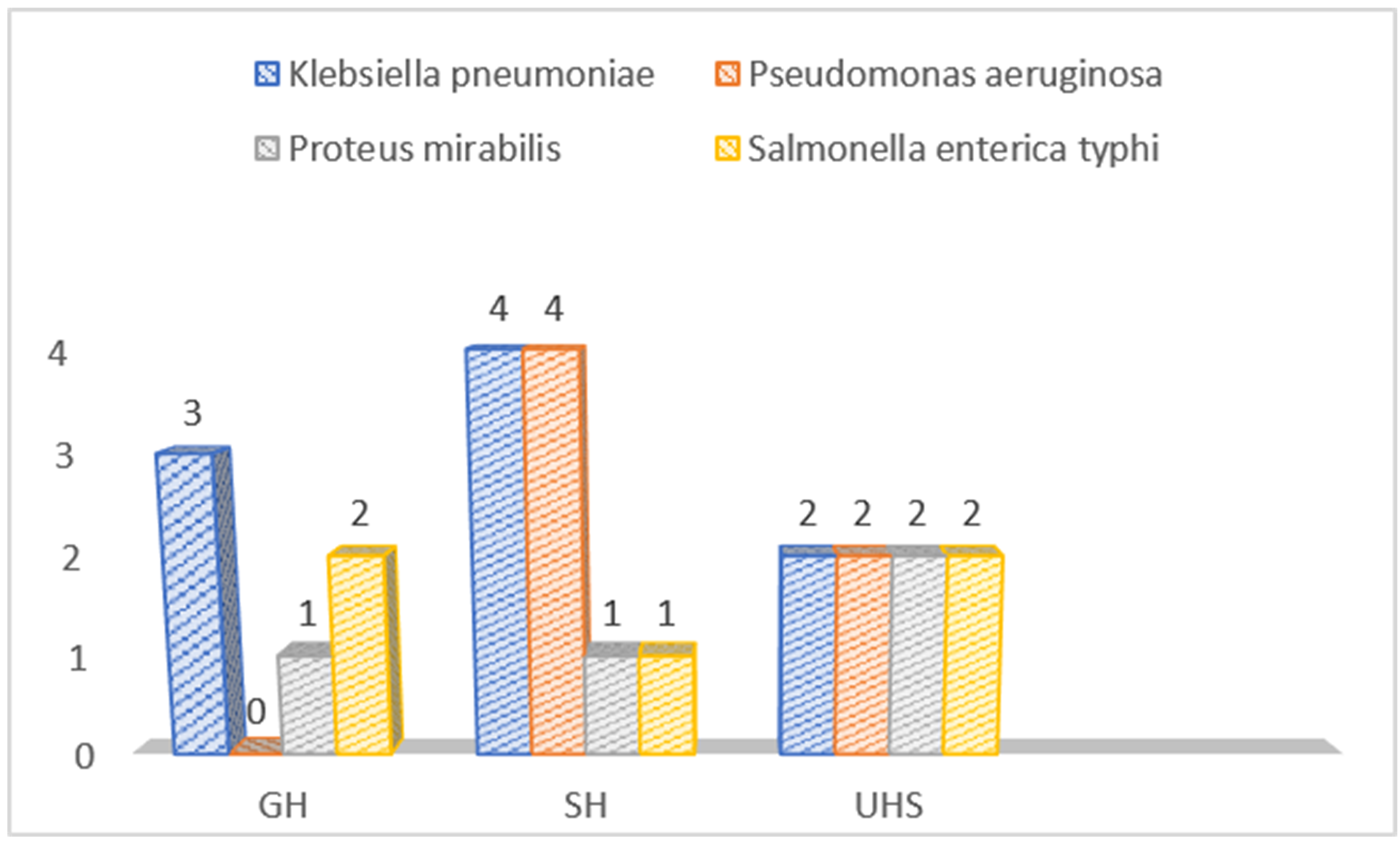
Antimicrobial resistance (AMR) is an increasingly urgent global issue, with multidrug-resistant (MDR) bacteria posing a significant threat to public health. This study evaluated the MDR patterns of the isolates from hospital wastewater. Samples were collected from three hospitals in Minna, and the samples were identified using the spread plate method. The isolates were then identified using Gram staining and other biochemical characteristics. Antibiotic sensitivity testing was conducted using the Kirby-Bauer disc diffusion method. The study identified a total of 24 bacteria of four different types of Gram-negative isolates, including Proteus mirabilis, Salmonella enterica, Pseudomonas aeruginosa, and Klebsiella pneumoniae. The result revealed that sample GH (2.15×10⁷) had the highest microbial count while sample SH (2.5×10⁶) had the least. All the isolates were found to be multi-drug resistant, with high Multiple Antibiotic Resistance (MAR) index for both isolated bacteria (0.61 to 0.70) and sampling sites (0.62 to 0.63). All bacterial isolates showed 100% resistance to Augmentin, Ampicillin and Chloramphenicol. The study concluded that hospital sewage serves as a hotspot for antibiotic-resistant bacteria, which are usually associated with infections difficult to control in the environment. Therefore, there is need for appropriate treatment of hospital wastewater to prevent the spread of MDR bacteria.
Downloads
Article Details

This work is licensed under a Creative Commons Attribution-NonCommercial-NoDerivatives 4.0 International License.
References
Adefisoye, M.A. & Okoh, A.I. (2017). Ecological and Public Health Implications of the Discharge of Multidrug-Resistant Bacteria and Physicochemical Contaminants from Treated Wastewater Effluents in the Eastern Cape, South Africa. Water;9,562. https://doi.org/10.3390/w9080562
Álvarez-Martínez, F. J., Barrajón-Catalán, E. & Micol, V. (2020). Tackling antibiotic resistance with compounds of natural origin: A Comprehensive Review Biomedicines, 8(10), 405. https://doi.org/10.3390/biomedicines8100405
Bapurao, C, Bhaurao, A, Rajendra., L & Solunke, S. (2022). Isolation and characterization of multidrug resistance bacteria from hospital sewage samples, Maharashtra, India. African Journal of Biotechnology, 21(1):16-25. doi: 10.5897/ajb2021.17394
Cheesbrough, M (2010). District Laboratory Practicein Tropical Countries, Part 2, 2nd Edition update. United Kingdom: Cambridge University Press, Cambridge, Pp 107-114.
Gautam, A. (2022). Antimicrobial Resistance: The Next Probable Pandemic. JNMA: Journal of the Nepal Medical Association, 60(246), 225. https://doi.org/10.31729/jnma.7174
Hutchings, M. I., Truman, A. W. & Wilkinson, B. (2019). Antibiotics: past, present and future. Current Opinion in Microbiology, 51, 72-80. https://doi.org/10.1016/j.mib.2019.10.008
Karungamye, P., Rugaika, A., Mtei, K., & Machunda, R. (2023). Antibiotic Resistance Patterns of Escherichia coli, Klebsiella pneumoniae, and Pseudomonas aeruginosa Isolated from Hospital Wastewater. Applied Microbiology, 3(3), 867-882. https://doi.org/10.3390/applmicrobiol3030060
Krumperman, PH. (1983). Multiple antibiotic resistance indexing of Escherichia coli to identify high risk sources of faecal contamination of foods. Appl. Environ. Microbiol. 46(1):165–170. https://doi.org/10.1128/aem.46.1.165-170.1983
Shetty, S.C., Gowda, L.S., Jacob, A.M., Shetty, K., Shetty, A.V. (2025). Surveillance of Multidrug-Resistant Genes in Clinically Significant Gram-Negative Bacteria Isolated from Hospital Wastewater. Antibiotics (Basel),14(6),607. https://doi.org/10.3390/antibiotics14060607
Tesfaye, H., Alemayehu, H., Desta, A. F. & Eguale, T. (2019). Antimicrobial susceptibility profile of selected Enterobacteriaceae in wastewater samples from health facilities, abattoir, downstream rivers and a WWTP in Addis Ababa, Ethiopia. Antimicrobial Resistance & Infection Control, 8(1), 1-11. https://doi.org/10.1186/s13756-019-0588-1
Uddin, T. M., Chakraborty, A. J., Khusro, A., Zidan, B. R. M., Mitra, S., Emran, T. B., Dhama, K., Ripon, M. K. H., Gajdács, M., Sahibzada, M. U. K., Hossain, M. J. & Koirala, N. (2021). Antibiotic resistance in microbes: History, mechanisms, therapeutic strategies and future prospects. Journal Of Infection and Public Health, 14(12), 1750–1766. https://doi.org/10.1016/j.jiph.2021.10.020
Verburg, I., Hernández Leal, L., Waar, K., Rossen, J.W.A., Schmitt, H. & García-Cobos, S. (2004). Klebsiella pneumoniae species complex: From wastewater to the environment. One Health, 17,19. https://doi.org/10.1016/j.onehlt.2024.100880
Wu, J., Thompson, T.P., O'Connell, N.H., McCracken, K., Powell, J., Gilmore, B.F., Dunne, C.P. & Kelly, S.A. (2025). Extended-spectrum β-lactamase-producing bacteria from hospital wastewater pipes: isolation, characterization and biofilm control using common disinfectants. Journal of Hospital Infection, 156, 34-49. https://doi.org/10.1016/j.jhin.2024.11.013
Zainab, S. M., Junaid, M., Xu, N. & Malik, R. N. (2020). Antibiotics and antibiotic resistant genes (ARGs) in groundwater: A global review on dissemination, sources, interactions, environmental and human health risks. Water Research, 187, 1. https://doi.org/10.1016/j.watres.2020.116455