

Comparative Toxicity of Synthetic and Botanical Gel Baits against Periplaneta americana (Blattodea: Blattidea)
Article Sidebar
Main Article Content
Abstract
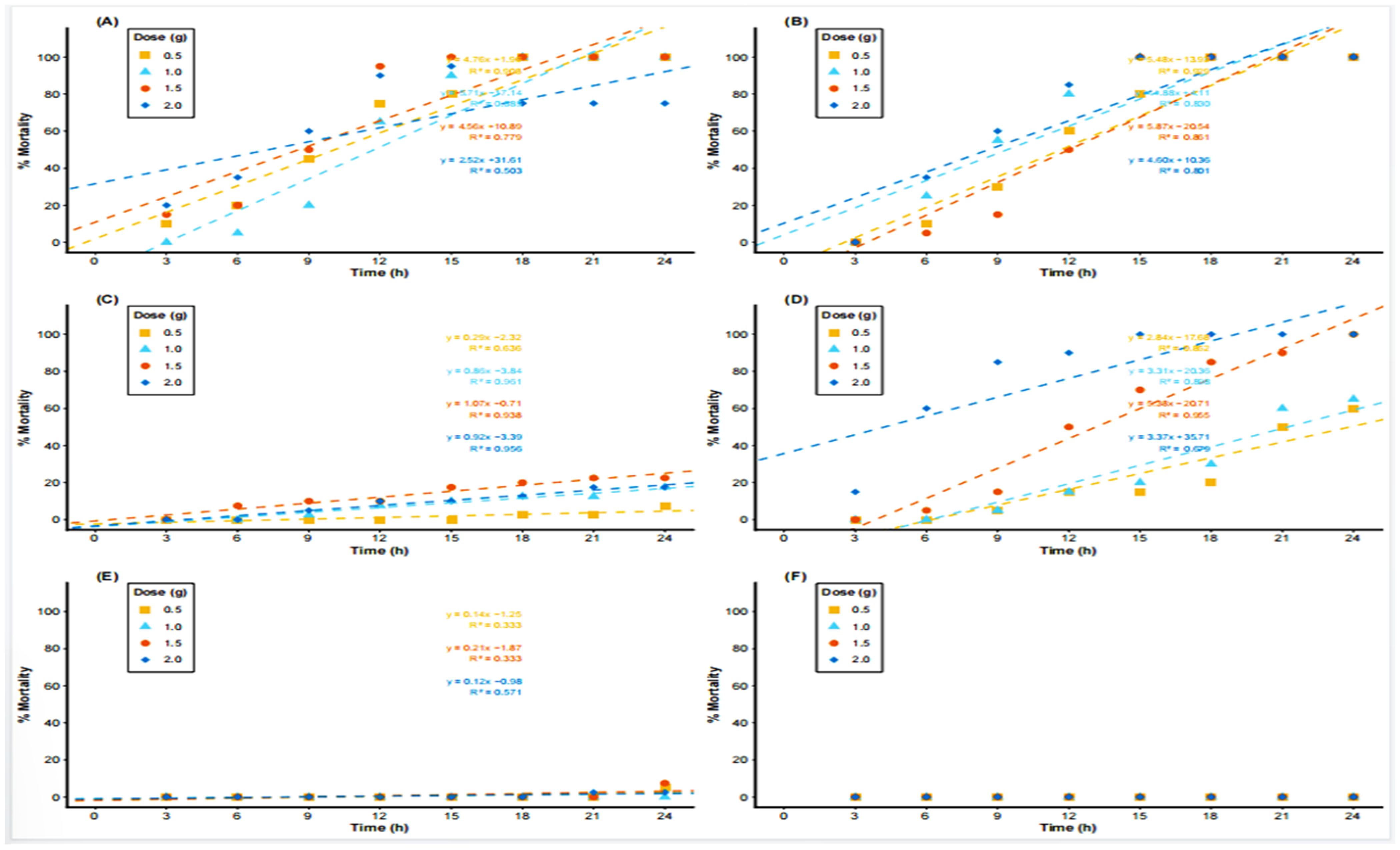
Cockroaches (Periplaneta americana L.) are ubiquitous pests implicated in disease transmission and allergies, making their control a public health priority. Synthetic gel baits are effective but raise environmental concerns, while botanical gels remain underexplored. This study compared the toxicity of two synthetic baits: fipronil and imidacloprid, and two botanical gel baits: sodom apple and neem-ginger gel baits against P. americana. Oils were extracted via hydrodistillation (ginger) and soxhlet procedures (neem and sodom apple), characterized by GC–MS, and formulated into peanut-based gels. Baits were tested at dosages of 0.5 g, 1.0 g, 1.5 g, and 2.0 g per treatment, with controls consisting of peanut gel and bait matrix, replicated four times with 10 cockroaches per container without active ingredients. Mortality data were analyzed using a one-way ANOVA regression analysis. Extracted oils showed neem’s dominance in fatty acids, ginger’s richness in terpenoids and phenolics, and sodom apple’s diverse ester composition. Laboratory assays demonstrated that imidacloprid (2%) and fipronil (0.05%) achieved 100% and 93.75% mortality in P. americana at 18 h, respectively, while the neem–ginger gel (20%) produced progressive, dose-dependent mortality up to 81.25% at 24 h. In contrast, sodom apple gel (20%) showed limited efficacy at 16.25% mortality. Probit analysis confirmed potency differences, with LC₅₀ at 24 h values of 0.028 g (fipronil), 0.836 g (neem–ginger), and 2.13 g (sodom apple). These findings provide the first evidence that neem–ginger gels can serve as ingestion-based, ecofriendly alternatives to synthetic cockroach baits, supporting their potential integration into sustainable pest management programs.
Downloads
Article Details

This work is licensed under a Creative Commons Attribution-NonCommercial-NoDerivatives 4.0 International License.
References
Abbott, W. S. (1925). A method of computing the effectiveness of an insecticide. Journal of Economic Entomology, 18(2): 265–267. https://doi.org/10.1093/jee/18.2.265.
Abdullah, N. & Majid, A. (2023). Efficacy and toxicity of cockroach gel bait (imidacloprid 2.5% and fipronil 0.05%) against American cockroach infestation in sewer system. Heliyon, 9:1, e12833. https://doi.org/10.1016/j.heliyon.2023.e12833.
Aboagye, I., Lartey, A., Anim, F. & Billah, M. (2025). Non-insecticidal control of domestic and peri-domestic species of cockroach. The Journal of Basic and Applied Zoology, 86:447. https://doi.org/10.1186/s41936-025-00447-4
Ahmad Nejhad, A., Alizadeh Behbahani, B., Hojjati, M., Vasiee, A. and Mehrnia, M. A. (2023). Identification of phytochemical, antioxidant, anticancer and antimicrobial potential of Calotropis procera leaf aqueous extract. Scientific Reports, 13(1): 14716. https://doi.org/10.1038/s41598-023-42086-1
Al-Rowaily, S. L., Abd-ElGawad, A. M., Assaeed, A. M., Elgamal, A. M., Gendy, A. E.-N. G. E., Mohamed, T. A., Dar, B. A., Mohamed, T. K. and Elshamy, A. I. (2020). Essential Oil of Calotropis procera: Comparative Chemical Profiles, Antimicrobial Activity, and Allelopathic Potential on Weeds. Molecules, 25(21): 5203. https://doi.org/10.3390/molecules25215203
Amadou, L., Abdoulaye, O., Baoua, I. B., Souleymane, A. S., Oumarou, M. N., Yarifou, R., Ibrahim, L., Lamine, S., Aminou, A. M. and Kpindou, O. K. D. (2025). Effect of neem seed-based biopesticides and hygienized human urine (HHU) on the main insect pests of cowpea [Vigna unguiculata (L.) Walp.] in Niger. American Journal of Plant Sciences, 16(2): 195–215. https://www.scirp.org/journal/ajps
Arruda LK, Vailes LD, Ferriani VP, et al. 2001. Cockroach allergens and asthma. J. Allergy Clin. Immunol., 107: 419–428. https://doi.org/10.1067/mai.2001.112854
Arruda LK. 2005. Cockroach allergens. Curr. Allergy Asthma Rep., 5: 411–416. https://doi.org/10.1007/s11882-005-0015-y
Arya, H., Singh, B. R. and Singh, K. (2010). Aphidicidal activity of Calotropis procera leaves against mustard aphid Lipaphis erysimi (Kalt) and its natural predator Coccinella septempunctata (Linn). World Applied Sciences Journal, 8(8): 1001–1005
Cabral, S., Silva, F., Rodrigues, P., Rambo, M., Santos, J., Chaves, M., and Pinto, B. (2023). Extraction and chemical characterization of neem seed oil (Azadirachta indica). Journal of Biotechnology and Biodiversity,11(4),170-181
. https://doi.org/10.20873/jbb.uft.cemaf.v11n4.16258
Chinnaperumal, K., Pachiyappan, R. G., Elango, G., Karthi, S., Chung, I.-M. and Rajakumar, G. (2018). Novel and environmental friendly approach: Impact of Neem (Azadirachta indica) gum nano formulation (NGNF) on Helicoverpa armigera (Hub.) and Spodoptera litura (Fab.). International Journal of Biological Macromolecules, 107(Part A): 59–69. https://doi.org/10.1016/j.ijbiomac.2017.08.145
Davari, B., Kashani, S., Nasirian, H., Nazari, M. and Salehzadeh, A. (2018). Efficacy of Maxforce and Avion gel baits containing fipronil, clothianidin, and indoxacarb against the German cockroach (Blattella germanica). Entomological Research, 48: 459 - 465. https://doi.org/10.1111/1748-5967.12282.
DeVries, Z. C., Santangelo, R. G., Crissman, J. R., Mick, R. and Schal, C. (2019). Exposure risks and ineffectiveness of total release foggers (TRFs) used for cockroach control in residential settings. BMC Public Health, 19(1): 32. https://doi.org/10.1186/s12889-018-6371-z
Dimetry, N. Z. (2020). Toxic Effect of Different Neem Formulations against Pests and Mammals. Journal of Botanical Research, 2(3), 6–19. https://doi.org/10.30564/jrb.v2i3.2032
El–khodary, S. & Ghanem, F. & Rakha, M. & Shoghy, Nourhan & Ueno, Takatoshi. (2020). Primary Screening of German Chamomile Oil as Insecticides, Baits, and Fumigants in Nanoformulations against the Health Pest Periplaneta americana (L.) (Dictyoptera: Blattidae). Journal of the Faculty of Agriculture, Kyushu University. 65. 103- 112.
https://doi.org/10.5109/2558902.
Fitriady, M., Sulaswatty, A., Agustian, E., S. and Aditama, D. (2017). Steam distillation extraction of ginger essential oil: Study of the Effect of Steam Flow Rate and Time Process, 1803: 020032. https://doi.org/10.1063/1.4973159.
Gondhalekar, A. D., Song, C., & Scharf, M. E. (2011). Development of strategies for monitoring indoxacarb and gel bait susceptibility in the German cockroach (Blattodea: Blattellidae). Pest management science, 67(3), 262–270.
https://doi.org/10.1002/ps.2057
Gordon, J. M., Sierras, A. J., Jackson, D. V., Principato, S. and DeVries, Z. C. (2025). Laboratory and in home evaluations of consumer and professional grade cockroach baits. Journal of Economic Entomology, 118(2): 826–837. https://doi.org/10.1093/jee/toae291
Gupta, I., Singh, R., Muthusamy, S., Sharma, M., Grewal, K., Singh, H. P. and Batish, D. R. (2023). Plant Essential Oils as Biopesticides: Applications, Mechanisms, Innovations, and Constraints. Plants (Basel, Switzerland): 12(16):2916. https://doi.org/10.3390/plants12162916
Hamada, H.M., Awad, M., El-Hefny, M. and Moustafa, M.A.M. (2018).Insecticidal Activity of Garlic (Allium sativum) and Ginger (Zingiber officinale) Oils on the Cotton Leafworm, Spodoptera littoralis (Boisd.) (Lepidoptera: Noctuidae). African Entomology, 26(1): 84–94.
https://doi.org/10.4001/003.026.0084
Hamilton, J. A., Wada-Katsumata, A. and Schal, C. (2023). Cockroaches as Trojan Horses for Control of Cockroach Aggregations with Baits. Journal of economic entomology, 116(2): 529–537. https://doi.org/10.1093/jee/toad018
Hu, I. H., Chen, S. M., Lee, C. Y., & Neoh, K. B. (2020). Insecticide Resistance, and Its Effects on Bait Performance in Field-Collected German Cockroaches (Blattodea: Ectobiidae) From Taiwan. Journal of economic entomology, 113(3), 1389–1398. https://doi.org/10.1093/jee/toaa053
Ismaila, S. S., Sani, Y., Sani, A. A., Yakasai, S. M., Momoh, H. and Mohammed, S. E. (2022). Determination of fatty acids and physicochemical properties of neem (Azadirachta indica L.) seed oil extracts. Dutse Journal of Pure and Applied Sciences, 8(1a): 149–160. https://doi.org/10.4314/dujopas.v8i1a.16
Khoobdel, M., Dehghan, H., Oshaghi, M., Saman, E., Asadi, A. and Yusuf, M. (2022). The different aspects of attractive toxic baits containing fipronil for control of the German cockroach (Blattella germanica). Environmental Analysis, Health and Toxicology, 37: Article e2022032. https://doi.org/10.5620/eaht.2022032
Kilani-Morakchi, S., Morakchi-Goudjil, H. and Sifi, K. (2021). Azadirachtin-based insecticide: Overview, risk assessments, and future directions. Frontiers in Agronomy, 3: 676208. https://doi.org/10.3389/fagro.2021.676208
Lee, S. H., Choe, D. H., Rust, M. K. and Lee, C. Y. (2022). Reduced Susceptibility Towards Commercial Bait Insecticides in Field German Cockroach (Blattodea: Ectobiidae) Populations From California. Journal of Economic Entomology, 115(1): 259–265. https://doi.org/10.1093/jee/toab244
Lee, Shao-Hung, Zhao, Man, Lee, Chow-Yang. (2025). Increase in insecticide susceptibility after sublethal exposure to deltamethrin in the German cockroach (Blattodea: Ectobiidae). Journal of Economic Entomology. 10.1093/jee/toaf124.
Loganathan, T., Barathinivas, A., Soorya, C., Balamurugan, S., Nagajothi, T. G. and Jayakumararaj, R. (2021). GCMS Profile of Bioactive Secondary Metabolites with Therapeutic Potential in the Ethanolic Leaf Extracts of Azadirachta indica¬: A Sacred Traditional Medicinal Plant of INDIA. Journal of Drug Delivery and Therapeutics, 11(4-S): 119-126. https://doi.org/10.22270/jddt.v11i4-S.4967
Liu, X.; Xi, K.; Wang, Y.; Ma, J.; Huang, X.; Liu, R.; Cai, X.; Zhu, Y.; Yin, J.; Jia, Q.; et al. (2022). Evaluation of the Contact Toxicity and Physiological Mechanisms of Ginger (Zingiber officinale) Shoot Extract and Selected Major Constituent Compounds against Melanaphis sorghi Theobald. Horticulturae, 8, 944. https:// doi.org/10.3390/horticulturae8100944
Lucero, I. M., Gaire, S., & DeVries, Z. C. (2025). Effects of age and environmental conditions on cockroach gel bait performance. Journal of Economic Entomology, 118(4), 1850–1867. https://doi.org/10.1093/jee/toaf130
Madreseh-Ghahfarokhi, S., Pirali, Y., Dehghani-Samani, A. and Dehghani-Samani, A. (2018). Annals of Parasitology, 64(4): 351–360. https://doi.org/10.17420/ap6404.171
Mettwally, W. S. A., Zahran, H. A., Khayyal, A. E., Ahmed, M. M. E., Allam, R. M. and Saleh, D. O. (2022). Calotropis procera (Aiton) seeds fixed oil: Physicochemical analysis, GC–MS profiling and evaluation of its in vivo anti inflammatory and in vitro antiparasitic activities. Arabian Journal of Chemistry, 15(9): 104085.
Michel, M. R., Aguilar-Zárate, M., Rojas Molina, R., Martínez-Ávila, G., and Aguilar-Zárate, P. (2023). The insecticidal activity of Azadirachta indica leaf extract: Optimization of the microencapsulation process by complex coacervation. Plants, 12(6), 1318. https://doi.org/10.3390/plants12061318
Miller, D. M., and E. P. Smith. 2020. Quantifying the efficacy of an assessment based pest management (APM) program for German cockroach (L.) (Blattodea: Blattellidae) control in low-income public housing units. J. Econ. Entomol., 113: 375–384 https://doi.org/10.1093/jee/toz302 .
Neupane, A., & Kafle, L. (2019). Efficacy of gel baits against American cockroaches (Dictyoptera: Blattellidae) under laboratory conditions. Journal of Entomological Research, 43(3), 409–413. https://doi.org/10.5958/0974-4576.2019.00071.9
Nour, A. H., Yap, S. S. and Nour, A. H. (2017). Extraction and chemical compositions of ginger (Zingiber officinale Roscoe) essential oils as cockroach repellent. Australian Journal of Basic and Applied Sciences, 11(1): 1–7.
Ogbinaka, E. J. A., Edema, I. O., Ehijie, O. H. and Onakpoma, S. O. (2025).Evaluation of neem products for their efficacy in the management of some major insect pests associated with cowpea in Asaba, Delta State, Nigeria. Journal of Entomology and Zoology Studies, 13(1): 137–141. https://doi.org/10.22271/j.ento.2025.v13.i1b.9459
Ogbonna, U. F. S., and Uchenna, O. (2023). Mediators of arrested development as attractive malaria vector control tools: The Azadirachta indica and azadirachtin routes. Journal of Biological Research and Biotechnology, 21(1), 1805–1817. https://doi.org/10.4314/br.v21i1.4
Padonou, G., Kpanou, C., Ossè, R., Salako, A., Yovogan, B., Sagbohan, H., Konkon, A., Zoungbédji, D., Akinro, B., Sina, H., Baba-Moussa, L. and Akogbéto, M. (2023). Evaluation of the efficacy of 2.15% imidacloprid (ROCO GEL) gel against Periplaneta americana under laboratory and field conditions in Benin. Acta Entomology and Zoology. 4(1):95-102 https://doi.org/10.33545/27080013.2023.v4.i1b.100.
Rahayu, R., Ahmad, I., Sinaga, M., Muslima, R. and Jannatan, R. (2025). Status and Mechanism of Insecticide Resistance in German Cockroach (Blatella germanica L.) Worldwide: A Literature Review. Tropical Life Sciences Research, 36:289-321. https://doi.org/10.21315/tlsr2025.36.3.15.
Ranjan, K., Shaikh, K., Pathan, T., Shaikh, W., & Shaikh, R. (2025). Evaluation of bio efficacy of Calotropis procera against juvenile stage of common household pest Periplaneta americana (American cockroach). Asian Journal of Biological and Life Sciences, 14(3), 1–6. https://doi.org/10.5530/ajbls.20250013
Sambo, D. L., Lucia, O. E., and Brains, O. O. (2024). Nematicidal effects of Azadirachta indica A. Juss (Neem) seeds on Meloidogyne species (root-knot nematodes). Journal of Biological Research and Biotechnology, 22(1), 2234–2241.
Schmutterer, H. (1990). Properties and potential of natural pesticides from the neem tree, Azadirachta indica. Annual Review of Entomology, 35(1): 271–297. https://doi.org/10.1146/annurev.en.35.010190.001415
Sharma, P.K., Singh, V. and Ali, M. (2016). Chemical composition and antimicrobial activity of fresh rhizome essential oil of Zingiber officinale Roscoe. Pharmacognosy Journal 8(3): 185–190
Sinha, N. and Ray, S. (2024). The potential of ginger (Zingiber officinale Rosc.) extracts as a bio-pesticide. Journal of Entomology and Zoology Studies, 12(3): 38–45. https://doi.org/10.22271/j.ento.2024.v12.i3a.9317
Umohata, I. A., Ubulom, P. M. E., Akpan, A. U., Thomas, P. S., & Eshiet, D. I. (2024).Knockdown and toxicity of essential oils from the rhizome of Zingiber officinale (L.) and the bud of Syzygium aromaticum (L.) to Periplaneta americana (L.).Nigeria Journal of Entomology 40(2), 15–29. https://doi.org/10.36108/NJE/4202/04.0220
Vigad, N., Tarachai, P., Chansakaow, S., Punyapornwithaya, V. and Chukiatsiri, K. (2025). Efficacy of citronella and ginger essential oil combinations against chicken lice (Menopon gallinae) and mites (Ornithonyssus bursa): Chemical characterization, contact toxicity, and in vivo validation. Veterinary World, 18: 1694-1702. https://doi.org/10.14202/vetworld.2025.1694-1702.
Wadhwani, B. D., Mali, D., Vyas, P., Nair, R., & Khandelwal, P. (2021). A review on phytochemical constituents and pharmacological potential of Calotropis procera. Royal Society of Chemistry Advances, 11(57), 35854–35878. https://doi.org/10.1039/D1RA06703F
Wang, C. and Scharf, M. E. (2022). Resistance to insecticidal baits in German cockroaches: Mechanisms, monitoring, and management. Pest Management Science, 78(12): 5071–5084. https://doi.org/10.1002/ps.6789
Wannigama, D. L., Dwivedi, R. and Zahraei-Ramazani, A. (2014). Prevalence and Antibiotic Resistance of Gram-Negative Pathogenic Bacteria Species Isolated from Periplaneta americana and Blattella germanica in Varanasi. India Journal of Arthropod-Borne Diseases, 8(1): 10–20