

EVALUATION OF THE ANTIVIRAL ACTIVITY OF ANDIROBA OIL (CARAPA GUIANENSIS AUBL.) IN AN IN VITRO MODEL OF HSV-1 INFECTION.
Article Sidebar
Main Article Content
Abstract
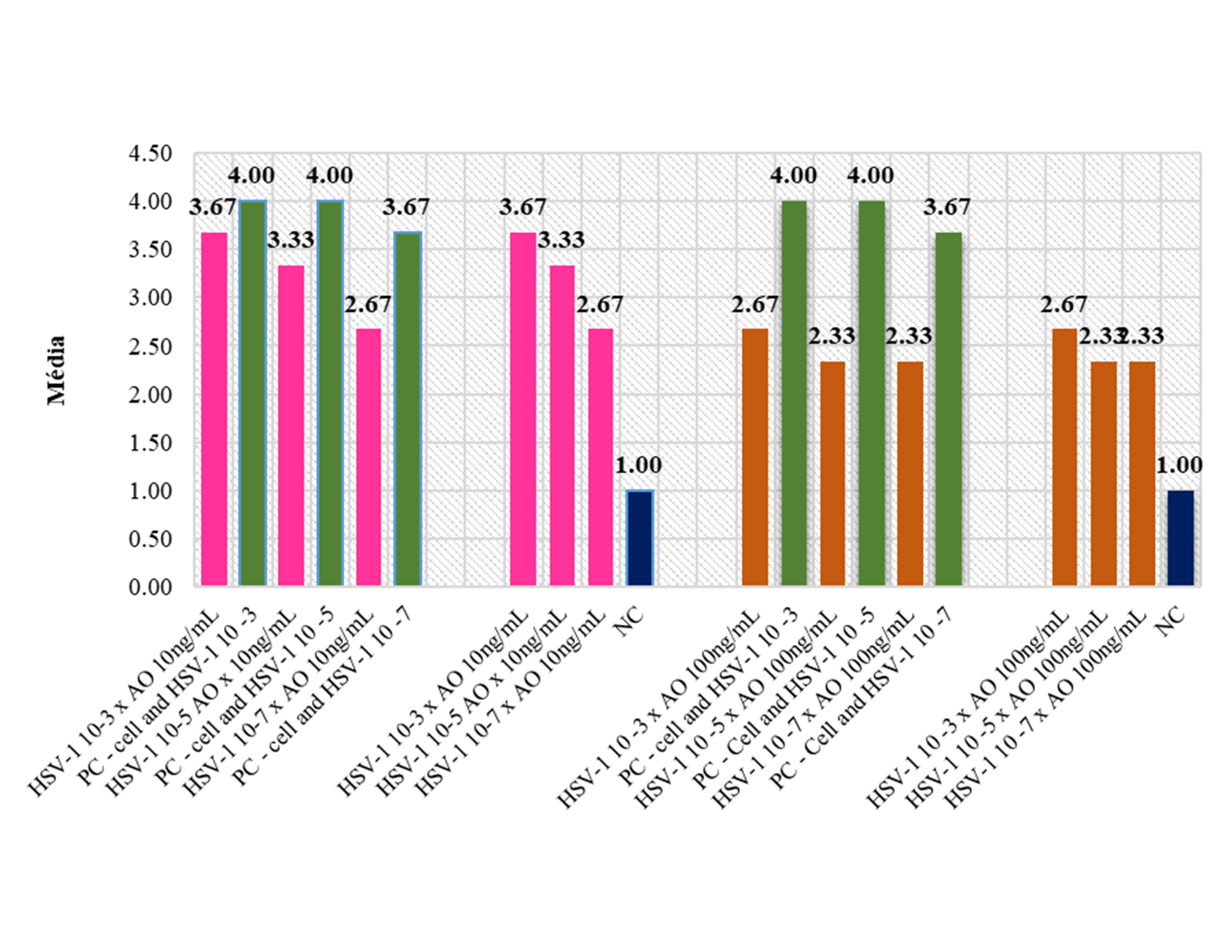
Infections caused by Herpes Simplex Virus type 1 (HSV-1) represent a serious global public health issue, affecting a significant portion of the population. The emergence of resistant strains highlights the urgent need for effective treatment alternatives. In this context, natural products emerge as promising therapeutic options. Within Brazil's rich biodiversity, Carapa guianensis Aubl. (andiroba), from the Meliaceae family, stands out as a medicinal plant of great importance in the Amazon. The oil extracted from its seeds possesses several recognized medicinal properties. This study proposes an in vitro evaluation of the antiviral activity of andiroba oil (AO) in HSV-1-infected Vero E6 cells. The oil was analyzed through gas chromatography (GC-MS), and its antiviral activity at different concentrations was assessed using a viral titration assay through the reduction of viral cytopathic effect (CPE). Data analysis was performed using the Statistical Package for the Social Sciences (SPSS) version 24.0. Results were calculated based on original values and expressed as means. Statistical analyses included the Student's t-test with Welch correction and ANOVA. The reduction in CPE after AO treatment suggests a potential antiviral effect, with a more pronounced antiviral response observed at higher HSV-1 dilutions treated with a higher andiroba oil dose (100 ng/mL). The dose-response curve analysis clearly demonstrates a correlation between increased AO concentration and decreased HSV-1 replication. These initial findings support further investigations into the use of andiroba oil as a therapeutic alternative against HSV-1.
Downloads
Article Details

This work is licensed under a Creative Commons Attribution-NonCommercial-NoDerivatives 4.0 International License.
References
Akram, M., Tahir, IM., Shah, SMA. (2018). Antiviral potential of medicinal plants against HIV, HSV, influenza, hepatitis, and coxsackievirus: a systematic review. Phytother Res. 32(5):811-822. doi: 10.1002/ptr.6024.
Almeida, MZ. (2011). Plantas medicinais: abordagem histórico-contemporânea. In: Plantas Medicinais [online]. 3rd ed. Salvador: EDUFBA, pp. 34-66. ISBN 978-85-232-1216-2. Available from SciELO Books .
Alves, LF. (2013) Simpósios de Plantas Medicinais do Brasil: 40 anos de História. Revista Fitos. 4(1):18-36. ISBN 2652-4775.
Amorim, MF, Almeida, WLS., Sousa, JC, Bandeira, JMA., Júnior, MRO., Andrade, SM, Taminato, RL, Oliveira, E.H. (2022). Ethnopharmacological study of medicinal plants used by the population of the state of Pará, Brazil. Brazilian Journal of Development. 8(1), 3033–3052. https://doi.org/10.34117/bjdv8n1-200
Araújo-Lima, CF, Fernandes, AS, Gomes, EM, Oliveira, LG, Macedo AF. (2018). Antioxidant activity and genotoxic assessment of crabwood (Andiroba, Carapa guianensis Aublet) seed oils. Oxid Med Cell Longev. doi: 10.1155/2018/3246719.
Diefenbach, RJ.; Fraefel, C. 2020. Herpes Simplex Virus: Methods and Protocols. 2. ed. New York: Springer.
Fritz, BN, Venturi, CR, Cargni, S, Schripsema, J, Roehe, PM, Montanha, JA, Von Poser, GL. (2007) Herpes vírus inhibitory substances from Hypericum connatum, a plant used in southern Brazil to treat oral lesions. Journal of Ethnopharmacology. 25(3):517-20. doi: 10.1016/j.jep.2007.07.013. 113:517-20.
Gabaglio S, Alvarenga N, Cantero-González G, Degen R, Ferro, EA, Langjahr P, Chnaiderman J, Sotelo PH. (2021). A quantitative PCR assay for antiviral activity screening of medicinal plants against Herpes simplex 1. Nat Prod Res. 35(17):2926-2930. doi: 10.1080/14786419.2019.1675064.
IBM. (2012). IBM SPSS Statistics for Windows, Version 28.0. Armonk, NY: IBM Corp.
IMAGEJ. (2024) Software de processamento de imagens. Bethesda, MD: National Institutes of Health. Disponível em: https://imagej.nih.gov/ij. Acesso em: [12.08.24].
Inque T, Ohmori S, Kikuchi T, Yamada T, Tanaka R. (2018). Carapanosins D-F from the seeds of andiroba (Carapa guianensis, Meliaceae) and their effects on LPS-activated NO production. Molecules. 23(7):1778. doi: 10.3390/molecules23071778.
Hussein, A, El-Anssary, A. (2019). Plantas metabólitos secundários: os principais motores das ações farmacológicas de plantas medicinais. In: Medicina Herbal. IntechOpen. DOI: 10.5772/intechopen.76139.
James C, Harfouche M, Welton NJ, Turner KM, Abu-Raddad LJ, Gottlieb SL, Looker K.J. (2020). Herpes simplex virus: global infection prevalence and incidence estimates, 2016. Bull World Health Organ. 98(5):315-329. doi: 10.2471/BLT.19.237149.
Jesus FLM, Almeida FB, Duarte J., Oliveira AEMFM, Cruz RAS. (2016). Preparation of a nanoemulsion with Carapa guianensis Aublet (Meliaceae) oil by a low-energy/solvent-free method and evaluation of its preliminary residual larvicidal activity. Biomed Res Int. 6756793. doi: 10.1155/2017/6756793.
Jiang YC, Feng H, Lin YC, Guo XR. (2016). New strategies against drug resistance to Herpes simplex virus. Int J Oral Sci. 8(1):1-6. doi: 10.1038/ijos.2016.3.
Kikuchi T, Akita K, Koike H, In Y, Yamada T, Tanaka R. (2020). Carapanins A-C: New limonoids from andiroba (Carapa guianensis) fruit oil. Org Biomol Chem. 8(45):9268-9274. doi: 10.1039/d0ob01872d.
Kuo JY, Yeh CS, Wang SM, et al. (2023). Acyclovir-resistant HSV-1 isolates among immunocompromised patients in southern Taiwan: low prevalence and novel mutations. J Med Virol. 95(8):e28985. doi: 10.1002/jmv.28985.
Li J, Cheng C, Lin T, Xue R, Liu X, Wu K. (2022). Efficacy of sodium polyanethol sulfonate on herpes simplex virus-1 infection in vitro. Mol Vis. 28:516-525. PMID: 37089702.
Looker KJ, Magaret AS, May MT, Turner KM, Vickerman P, Gottlieb SL, Newman LM. (2015). Global and regional estimates of prevalent and incident herpes simplex virus type 1 infections in 2012. PLoS One. 10(10). doi: 10.1371/journal.pone.0140765.
Lopez-Alvarez Y, et al. (2016). Methods for determining the antiviral activity of compounds in vitro. Journal of Virological Methods, 238: 196-204, 2016.
Madavarajau K, Koganti R, Volet Y, Yadavalli TE, Shukla D. (2020). Herpes simplex virus cell entry mechanisms: an update. Front Cell Infect Microbiol. 18(10):617578. doi: 10.3389/fcimb.2020.617578.
Meccia G, Quintero-Rincón P, Rojas L, Alfredo U, Velasco J, et al. (2013). Chemical composition of the essential oil from the leaves of Carapa guianensis collected from Venezuelan Guayana and the antimicrobial activity of the oil and crude extracts. Nat Prod Commun. 8:1641-1642. doi: 10.1177/1934578X1300801135.
Milhomem-Paixão SSR, Fascineli ML, Roll MM, Longo JPF, Azevedo RB, Pieczarka JC, Salgado HLC, Santos AS & Grisolia CK. (2016). The lipidome, genotoxicity, hematotoxicity and antioxidant properties of andiroba oil from the Brazilian Amazon. Genetics and Molecular Biology. 39(2):248-256. Disponível em: https://www.scielo.br/j/gmb/a/5p8rm5DBkTnC3B9cwCvg3GP/?lang=en
Moya S, Taha M, Makeen H, Alhazmi H, Bratty M, Sultana S, Ahsan W, Najmi A, Kalid A. (2020). Bioactive natural antivirals: an updated review of the available plants and isolated molecules. Molecules. 25:4878.
Mondal J, Das Mahapatra A, Mandal KC, Chattopadhyay D. (2021). An extract of Stephania hernandifolia, an ethnomedicinal plant, inhibits herpes simplex virus 1 entry. Arch Virol. 166(8):2187-2198. doi: 10.1007/s00705-021-05093-z.
Newman, DJ, Cragg, GM. (2016). Natural products as sources of new drugs from 1981 to 2014. Journal of Natural Products. 79(3):629-661. doi: 10.1021/acs.jnatprod.5b01055.
Oliveira IDSDS, Moragas Tellis CJ, Chagas MDSDS, Behrens MD, Calabrese KDS, Abreu-Silva AL, Almeida-Souza F. (2018). Carapa guianensis Aublet (Andiroba) Seed Oil: Chemical Composition and Antileishmanial Activity of Limonoid-Rich Fractions. Biomed Research International. doi: 10.1155/2018/5032816. Article ID 5032816.
Pavi CP, Pra ID, Cadamuro RD, Kanzaki I, Lacerda JWF, Sandjo LP, Bezerra RM, Segovia JFO, Fongaro G, Silva IT. (2023). Amazonian medicinal plants efficiently inactivate Herpes and Chikungunya viruses. Biomed Pharmacother. 167:115476. doi: 10.1016/j.biopha.2023.115476.
Pennisi R, Trischitta P, Tamburello MP, Barreca D, Mandalari G, Sciortino MT. (2023). Mechanistic Understanding of the Antiviral Properties of Pistachios and Zeaxanthin against HSV-1. Viruses, 15(8):1651. doi: 10.3390/v15081651.
Reis SRNI. Efeito imunomodulador e antiviral de plantas medicinais na infecção in vitro de monócitos humanos pelo vírus DENGUE-2. (2007). [Tese]: Fundação Oswaldo Cruz.
Ribeiro CDB, Costa PA, Lima SRV, Silva MT. (2021). The medicinal use of Carapa guianensis Abul. (Andiroba). Research, Society and Development, [S. l.], v. 10, n. 15, p. e391101522815, 2021. DOI: 10.33448/rsd-v10i15.22815.
Sen M, Eroğul Ö. (2024). Retinoic Acid Neutralizes the Effects of Herpes Simplex Virus Type 1-Infected Cell Protein 0 (ICP0) in Retinal Pigment Epithelial Cells. Cureus, 16(5). doi: 10.7759/cureus.61089.
Silva FRP, Almeida SSMS. (2014). Análise fitoquímica e microbiológica da atividade do extrato bruto etanólico da Andiroba, Carapa guianensis Aubl. Biota Amazônia, 4(4), 10-14. doi: 10.18561/2179-5746/biotaamazonia.v4n4p10-14.
Silva L. (2018). Propriedades físico-químicas e perfil dos ácidos graxos do óleo da andiroba. Nativa. 6:147. Doi:10.31413/nativa.v6i2.4729.
Soares ADS, Wanzeler AMV, Cavalcante GHS, Barros EMDS, Carneiro RCM, Tuji FM. (2021). Therapeutic effects of andiroba (Carapa guianensis Aubl) oil, compared to low power laser, on oral mucositis in children undergoing chemotherapy: A clinical study. Journal of Ethnopharmacology, 264, 113365. doi: 10.1016/j.jep.2020.113365.
Sousa RL, Silva SG, Costa JM, Costa WA, Maia AAB, Oliveira MS, Andrade EHA. (2022). Chemical profile of manually extracted andiroba oil (Carapa guianensis Aubl., Meliaceae) from Mamangal community, located in Igarapé-Miri, Pará, Brazil. Scientia Plena. 17. 10.14808/sci.plena.2021.127201.
Steiner I, Benninger F. (2018). Manifestations of Herpes Virus Infections in the Nervous System. Neurologic Clinics. 36(4):725-738. doi: 10.1016/j.ncl.2018.06.005.
Tognarelli E, Palomino T, Corrales N, Bueno S, Kaleris A, González P. (2019). Herpes simplex Virus evasion of early host antiviral responses. Frontiers in Cellular and Infection Microbiology. 30(9):127. doi: 10.3389/fcimb.2019.00127.
Zupin L, Caracciolo I, Tricarico PM, Ottaviani G, D'Agaro P, Crovella S. (2018). Propriedades antivirais do laser azul em um modelo in vitro de infecção por HSV-1. Microbiologia e Imunologia, 62:477-479. doi: 10.1111/1348-0421.12600
Watanabe H. et al. (2021). A high-throughput screening platform for the identification of antiviral compounds using a cell-based cytopathic effect assay. Antiviral Research. 190:105068, 2021.
Yin Y, Xu Y, Ou Z, Yang X, et al. (2019). Um sistema de triagem de medicamentos antivirais para enterovírus 71 com base em um ensaio de placa aprimorado: um método potencial de alto rendimento. J Med Virol. 91(8):1440–7. doi: 10.1002/jmv.25463.