

Modulatory Effects of Selected Medicinal Plant Extracts on Benzene-Induced Haematopoietic Dysfunction in Wistar Rats
Article Sidebar
Main Article Content
Abstract
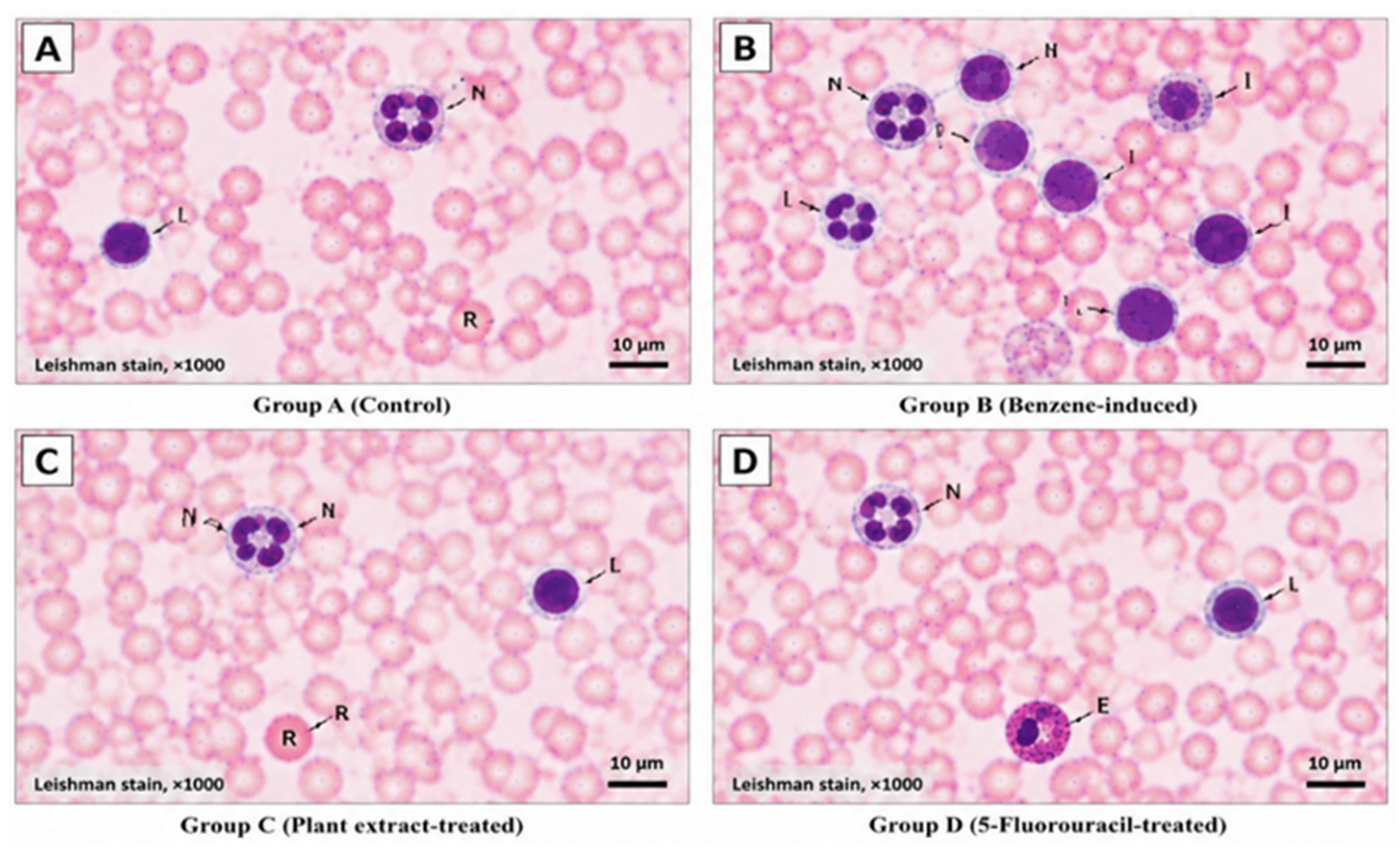
Benzene exposure has been linked to haematopoietic toxicity via generation of oxidative stress and DNA damage and breakdown of bone marrow function. Medicinal plants containing bioactive phytochemicals may offer protective effects against chemical-induced haematological alterations. This study evaluated the modulatory effects of selected medicinal plant extracts on benzene-induced haematopoietic dysfunction in Wistar rats. Forty-two male Wistar rats, weighng 80 -120g were used. They were randomly divided into 7 groups (n= 6). Group A (Normal control) received only normal saline, Group B (benzene group), Group C (benzene + Azadirachta indica , Psorospermum febrifugum, Ricinus communis and Rosy periwinkle from Groups C1-C4 respectively) while group D (benzene+ 5-fluorouracil). The haematological effects of animals were examined in terms of the change in parameters of full blood count and peripheral blood morphology. The results indicate benzene exposure produced significant alterations in haematological indices compared with the control group, including changes in white blood cell count, haemoglobin concentration, packed cell volume, and platelet parameters (p < 0.05). Treatment with the plant extracts partially restored altered haematological parameters, with some extracts showing effects comparable to the 5-fluorouracil-treated group. Selected medicinal plant extracts demonstrated potential modulatory effects against benzene-induced haematopoietic dysfunction in Wistar rats. These findings support further investigation of their phytochemical constituents and mechanisms of action.
Downloads
Article Details

This work is licensed under a Creative Commons Attribution-NonCommercial-NoDerivatives 4.0 International License.
References
Akanni, E. O., Olaniran, I. O., Akinbo, B. D., Iyiola, M., Ogunlade, A., Sanni, B., & Adejumo, T. (2017). Kigelia africana stem bark, fruit, and leaf extracts alleviate benzene-induced leukaemia in rats. Journal of Pharmaceutical Research International, 18(2), 1–10. https://doi.org/10.9734/JPRI/2017/28699
Atere, A. D., Alao, O. B., Ehiremen, S. E., & Emokpae, M. A. (2026). Biochemical and histological effects of cadmium-induced benign prostatic hyperplasia and the modulatory role of Azadirachta indica leaf extract in Wistar rats. Journal of Experimental and Clinical Anatomy, 23(2), 137–144. https://doi.org/10.4314/jeca.v23i2.6
Barmoudeh, Z., Ardakani, M. T., Doustimotlagh, A. H., & Bardania, H. (2022). Evaluation of the antioxidant and anticancer activities of hydroalcoholic extracts of Thymus daenensis Čelak and Stachys pilifera Benth. Journal of Toxicology, 2022, Article 1924265. https://doi.org/10.1155/2022/1924265
Bispo, J. A. B., Pinheiro, P. S., & Kobetz, E. K. (2020). Epidemiology and etiology of leukemia and lymphoma. Cold Spring Harbor Perspectives in Medicine, 10(6), a034819. https://doi.org/10.1101/cshperspect.a034819
Chaachouay, N., & Zidane, L. (2024). Plant-derived natural products: A source for drug discovery and development. Drugs and Drug Candidates, 3(1), 184–207. https://doi.org/10.3390/ddc3010011
Cordiano, R., Papa, V., Cicero, N., Spatari, G., Allegra, A., & Gangemi, S. (2022). Effects of benzene: Hematological and hypersensitivity manifestations in residents living in oil refinery areas. Toxics, 10(11), 678. https://doi.org/10.3390/toxics10110678
Didehban, S., Jafari, E., Hosseini, A., & Khorasani, P. (2024). Evaluation of the findings of peripheral blood smear, bone marrow aspiration and biopsy, iron storage, and immunophenotype in patients with chronic lymphocytic leukemia. Iranian Journal of Pathology, 19(2), 152–159. https://doi.org/10.30699/IJP.2024.2011275.3170
Falini, B., & Martelli, M. P. (2023). Comparison of the International Consensus and 5th WHO edition classifications of adult myelodysplastic syndromes and acute myeloid leukemia. American Journal of Hematology, 98(3), 481–492. https://doi.org/10.1002/ajh.26812
He, J., Peng, C., Yang, X., Li, P., Bai, J., Jia, Q., & Bo, C. (2024). Identification of critical genes associated with oxidative stress pathways in benzene-induced hematotoxicity. Heliyon, 10(15), e35427. https://doi.org/10.1016/j.heliyon.2024.e35427
Huang, J., Chan, S. C., Ngai, C. H., Lok, V., Zhang, L., Lucero-Prisno, D. E., III, Xu, W., Zheng, Z. J., Elcarte, E., Withers, M., & Wong, M. C. S. (2022). Disease burden, risk factors, and trends of leukaemia: A global analysis. Frontiers in Oncology, 12, 904292. https://doi.org/10.3389/fonc.2022.904292
Huff, J. (2007). Benzene-induced cancers: Abridged history and occupational health impact. International Journal of Occupational and Environmental Health, 13(2), 213–221. https://doi.org/10.1179/oeh.2007.13.2.213
Khy, J. D., Solary, E., Abla, O., Akkari, Y., Alaggio, R., Apperley, J. F., Bader, P., et al. (2022). The 5th edition of the World Health Organization classification of haematolymphoid tumours: Myeloid and histiocytic/dendritic neoplasms. Leukemia, 36(7), 1703–1719. https://doi.org/10.1038/s41375-022-01613-1
Kooti, W., Servatyari, K., Behzadifar, M., Asadi-Samani, M., Sadeghi, F., Nouri, B., & Zare Marzouni, H. (2017). Effective medicinal plants in cancer treatment, Part 2: Review study. Journal of Evidence-Based Complementary & Alternative Medicine, 22(4), 982–995. https://doi.org/10.1177/2156587217696927
Kumar, V. (2018). Study of changes in peripheral blood film and bone marrow in patients with leukemias and lymphomas. IOSR Journal of Dental and Medical Sciences, 17(4), 58–61. https://doi.org/10.9790/0853-1704115861
McHale, C. M., Zhang, L., & Smith, M. T. (2012). Current understanding of the mechanism of benzene-induced leukemia in humans: Implications for risk assessment. Carcinogenesis, 33(2), 240–252. https://doi.org/10.1093/carcin/bgs019
Mokwenye, I., Chidinma, C., & Okoye, N. F. (2023). Evaluation of the haemostatic potentials of aqueous extract of Hyptis suaveolens leaves in Wistar rats. Journal of Biological Research and Biotechnology, 21(1), 1818–1827. https://doi.org/10.4314/br.v21i1.5
Obazelu, P. A., & Omoregie, A. P. (2024). Antioxidant effects of aqueous leaf extract of Launaea taraxacifolia in benzene-induced haematotoxicity in albino Wistar rats. Sokoto Journal of Medical Laboratory Science, 9(1), 68–77. https://doi.org/10.4314/sokjmls.v9i1.15
Obazelu, P. A., & Wasa, F. E. (2024). Proinflammatory effects of Launaea taraxacifolia aqueous leaf extract in benzene-induced haematotoxicity in albino male Wistar rats. Nigerian Journal of Pharmaceutical and Applied Science Research, 12(4), 34–40. https://doi.org/10.60787/nijophasr-v12-i4-528
Olubodun, S. O., Henry, E. U., Edafewhare, M., Fawole, D. O., & Okolie-Odega, N. B. (2024). The effect of Acalypha wilkesiana leaf extract on the haematology, amylase and lipase activities in Wistar rats exposed to 1,2-dimethylhydrazine. Journal of Biological Research and Biotechnology, 22(3), 2532–2541. https://doi.org/10.4314/br.v22i3.4
Otu-Boakye, S. A., Boakye-Gyasi, E., Oppong-Kyekyeku, J., Yeboah, K. O., Okyere, P. D., & Osafo, N. (2024). The crude alkaloidal extract of Picralima nitida seeds alleviates TNBS-induced inflammatory bowel disease through reduced serum expression of TNF-α, IL-1β and p38 MAPK. Nutrire, 50, Article 3. https://doi.org/10.1186/s41110-024-00309-z
Palhares, R. M., Gonçalves Drummond, M., Dos Santos Alves Figueiredo Brasil, B., Pereira Cosenza, G., das Graças Lins Brandão, M., & Oliveira, G. (2015). Medicinal plants recommended by the World Health Organization: DNA barcode identification associated with chemical analyses guarantees their quality. PLoS ONE, 10(5), e0127866. https://doi.org/10.1371/journal.pone.0127866
Percival, M. E., Lai, C., Estey, E., & Higan, C. S. (2017). Bone marrow evaluation for diagnosis and monitoring of acute myeloid leukemia. Blood Reviews, 31(4), 185–192. https://doi.org/10.1016/j.blre.2017.01.003
Rasool, H. B. (2012). Medicinal plants: Importance and uses. Pharmaceutical Analytical Acta, 3, e139. https://doi.org/10.4172/2153-2435.1000e139
Rehan, T., Tahir, A., Sultan, A., Alabbosh, K. F., Waseem, S., Ul-Islam, M., Khan, K. A., Ibrahim, E. H., Ullah, M. W., & Shah, N. (2023). Mitigation of benzene-induced haematotoxicity in Sprague Dawley rats through plant-extract-loaded silica nanobeads. Toxics, 11(10), 865. https://doi.org/10.3390/toxics11100865
Wang, J., Han, L., Liu, Z., Zhang, W., Zhang, L., Jing, J., & Gao, A. (2024). Targeting IGF2BP1 alleviated benzene hematotoxicity by reprogramming BCAA metabolism and fatty acid oxidation. Chemico-Biological Interactions, 398, 111107. https://doi.org/10.1016/j.cbi.2024.111107
Zhang, L., Liu, Z., Zhang, W., Wang, J., Kang, H., Jing, J., Han, L., & Gao, A. (2024). Gut microbiota–palmitoleic acid–interleukin-5 axis orchestrates benzene-induced hematopoietic toxicity. Gut Microbes, 16(1), 2323227. https://doi.org/10.1080/19490976.2024.2323227