

Comparative Investigation on Wound Healing Potential of Gel Diffusion and Liquid Application of Adansonia digitata Active MoleculesComparative Investigation on Wound Healing Potential of Gel Diffusion and Liquid Application of Adansonia digitata Active Molecul
Article Sidebar
Main Article Content
Abstract
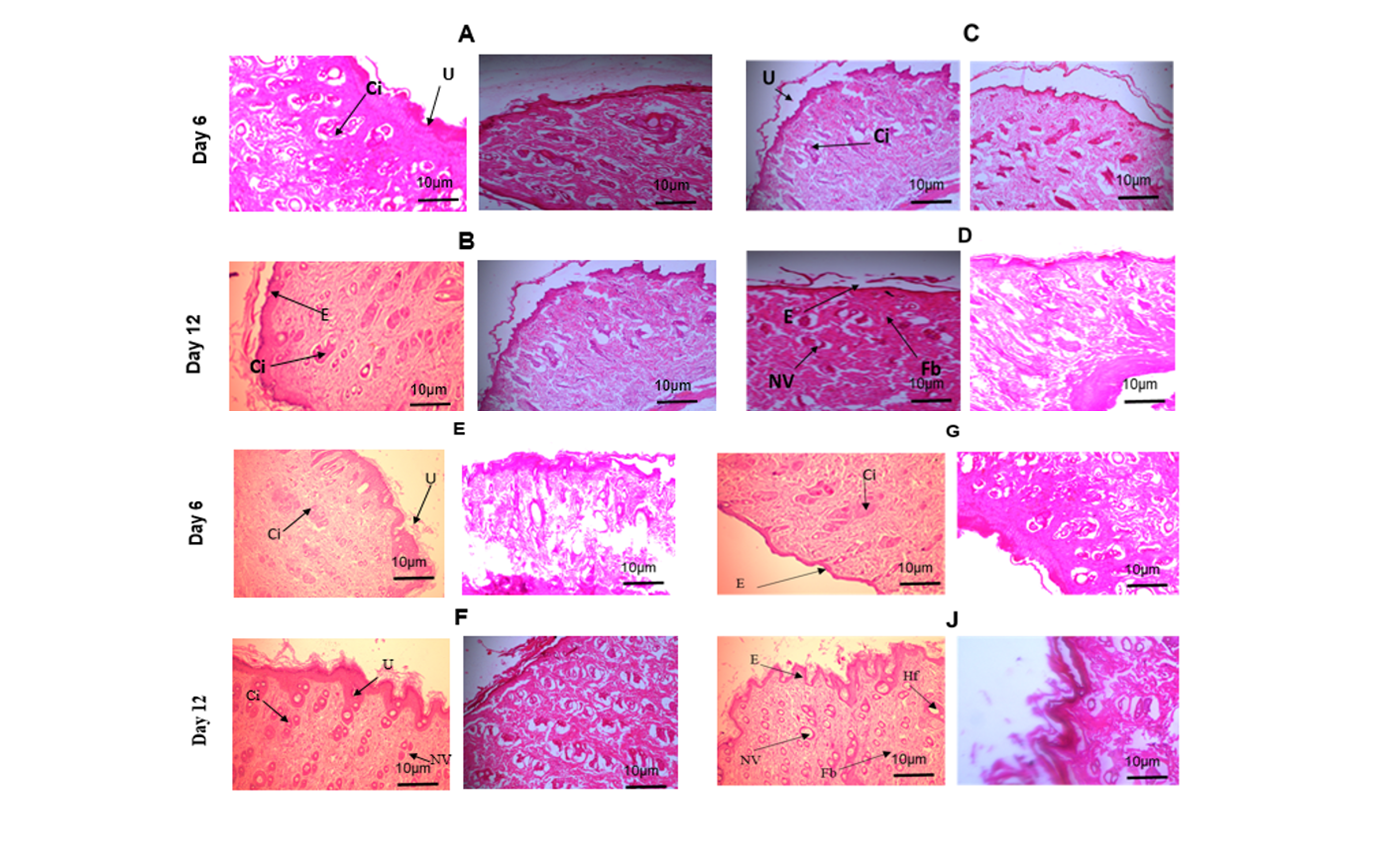
Innovation in wound care is increasingly focused on the development of active dressings such as hydrogels. In this study, a poly(acrylic acid)-based hydrogel biomaterial, enriched with a hydroalcoholic extract (80:20) from the stem bark of Adansonia digitata (R1) was synthesized in two formulations: gelled in the presence of KOH (Gel+/R1) and non-gelled in the absence of KOH (Gel−/R1). The aim of this work is to compare the wound healing potential by Adansonia digitata extract active molecules diffusion of a gelled formulation and the wound healing potential by those active molecules by direct application of a non-gelled formulation on cutaneous injuries induced in Sprague Dawley rats. To attempt this aim, (a) the hydroalcoholic extract (80:20) was characterized using thin-layer chromatography (TLC); (b) a poly(acrylic acid 3000)-based hydrogel incorporating the plant extract (Gel+/R1) and the non-gelled biomaterial (Gel−/R1) were formulated; (c) wound healing performance by macroscopic observation of the wounds was evaluated and surface areas (contraction rate) in Sprague Dawley rats were analyzed; (d) hydroxyproline content on Day 12 of wound healing was quantified and finally, (e) microscopic histological analysis on Days 6 and 12 post-induction were conducted. TLC analysis revealed major phytochemical constituents, including flavonoids (catechin), tannins (tannic acid), and phenolic acids (gallic acid). Rats treated with Gel+/R1 showed significantly higher wound contraction rates compared to the control groups with a wound contraction rate of approximately 97.08 ± 0.6% after 12 days, compared to 92 ± 4.2% in the Gel/KOH-treated group and 93.43 ± 2.3% in the non-gelled biomaterial containing the extract. Hydroxyproline quantification indicated better collagen production for rats treated with Gel+/R1; histological examination revealed complete re-epithelialization, better organized granulation tissue, fibroblast proliferation, and neovascularization with Gel+/R1. The Gel+/R1 hydrogel, with its viscous and translucent texture, provides a favorable diffusion environment for accelerated wound healing and skin regeneration. It represents a promising candidate for the development of bioactive wound dressings. Further studies will investigate its applications in tissue engineering.
Downloads
Article Details

This work is licensed under a Creative Commons Attribution-NonCommercial-NoDerivatives 4.0 International License.
References
Ahmed, K. A. A., Jabbar, A. A., Galali, Y., M. Al‐Qaaneh, A., Akçakavak, G., Salehen, N. A., & Hawwal, M. F. (2024). Cumin (Cuminum cyminum L.) seeds accelerates wound healing in rats: possible molecular mechanisms. Skin Research and Technology, 30(5), e13727. DOI: 10.1111/srt.13727.
Albahri, G., Badran, A., Hijazi, A., Daou, A., Baydoun, E., Nasser, M., & Merah, O. (2023). The therapeutic wound healing bioactivities of various medicinal plants. Life, 13(2), 317. DOI: 10.3390/life13020317
Akpalo, A. E., Saloufou, I. K., Eloh, K., & Kpegba, K. (2020). Wound healing biomolecules present in four proposed soft aqueous extractions of Ageratum conyzoides Linn. International Journal of Biological and Chemical Sciences, 14(2), 638-651. DOI: https://dx.doi.org/10.4314/ijbcs.v14i2.26
Amégbor, K., Metowogo, K., Eklu-Gadegbeku, K., Agbonon, A., Aklikokou, K. A., Napo-Koura, G., & Gbeassor, M. (2012). Preliminary evaluation of the wound healing effect of Vitex doniana sweet (Verbenaceae) in mice. African Journal of Traditional, Complementary and Alternative Medicines, 9(4), 584-590. DOI: 10.4314/ajtcam.v9i4.16
Anigboro, A. and Otabor, C. (2024). Evaluation of Antioxidant and Anti-Lipase Activities of Centrosema Pubescens Benth Aqueous and Ethanolic Leaf Extracts. Bio-Research 22 (3): 2455–65. DOI:10.4314/br.v22i3.4
Arabpour, Z.; Abedi, F.; Salehi, M.; Baharnoori, S. M.; Soleimani, M.; Djalilian, A. R. (2024). Hydrogel-Based Skin Regeneration. Int. J. Mol. Sci. 6;25(4):1982. DOI: 10.3390/ijms25041982
Bouchicha, M., Bounamis, S., & Kebsa, W. E. (2018). Evaluation de l’effet gastroprotecteur et anti-inflammatoire de l’acide gallique et de l’écorce de grenade (Punica granatum) contre l’ulcère induit par le Diclofénac chez le rat albinos wistar (Doctoral dissertation, Université de Jijel).
Chang, C., Zhang, L., Zhou, J., Zhang, L., & Kennedy, J. F. (2010). Structure and properties of hydrogels prepared from cellulose in NaOH/urea aqueous solutions. Carbohydrate Polymers, 82(1), 122-127. https://doi.org/10.1016/j.carbpol.2010.04.033
Chen, X.; Peng, L.-H.; Shan, Y.-H.; Li, N.; Wei, W.; Yu, L.; Li, Q.-M.; Liang, W.-Q.; Gao, J.-Q. (2013). Astragaloside IV-loaded nanoparticle-enriched hydrogel induces wound healing and anti-scar activity through topical delivery. Int. J. Pharm. 2013, 447 (1–2), 171–81. DOI: 10.1016/j.ijpharm.2013.02.054
Chummun, I.; Bekah, D.; Goonoo, N.; Bhaw-Luximon, A. (2021). Assessing the mechanisms of action of natural molecules/extracts for phase-directed wound healing in hydrogel scaffolds. RSC Med Chem., 12 (9), 1476–90. doi: 10.1039/d1md00100k
Darré, T., Metowogo, K., Lawson-Evi, P., Eklu-Gadegbeku, K., Aklikokou, K. A., Napo-Koura, G., & Gbeassor, M. (2014). Effet topique de l'extrait hydroethanolique de l'acacia nilotica sur la cicatrisation cutanée des brûlures de second degré. European Scientific Journal, 10(30). DOI: https://doi.org/10.19044/esj.2014.v10n30p%25p
Gaffo, A. R., Kantati, Y. E. T., Koukoura, K. K., Akpalo, A. E., Djiwa, T., Darre, T., Metowogo, K., & Kwashie, E. G. (2022). Hydroalcoholic extract of Adansonia digitatas trunk bark, in topical application, possess in vivo wound healing and in vitro anti-inflammatory and antioxidant activities. Journal of Pharmacognosy and Phytotherapy, 14(2), 8-19. DOI: https://doi.org/10.5897/JPP2022.0620
Gaffo, A., Akpalo, . A. E., Saloufou, . K. I., Routaboul, . C., Eklu-gadegbeku, . K. & Simalou, . O. (2026). Formation of a new wound-healing hydrogel: biochemical interactions within a poly(acrylic acid) gel containing Adansonia digitata plant extract. Equity Journal of Science and Technology, Online First: 12 Apr, 2026.
Haneefa, M. K., Abraham, A., Saraswathi, R., Mohanta, G. P., & Nayar, C. (2012). Formulation and evaluation of herbal gel of Basella alba for wound healing activity. Journal of Pharmaceutical Sciences and Research, 4(1), 1642.
Hendi, A.; Umair Hassan, M.; Elsherif, M.; Alqattan, B.; Park, S.; Yetisen, A. K.; Butt, H. (2020). Healthcare Applications of pH-Sensitive Hydrogel-Based Devices: A Review. Int J Nanomedicine, 15:3887–3901. DOI: 10.2147/IJN.S245743
Kamoun, E. A., Kenawy, E. R. S., & Chen, X. (2017). A review on polymeric hydrogel membranes for wound dressing applications: PVA-based hydrogel dressings. Journal of advanced research, 8(3), 217-233. DOI: 10.1016/j.jare.2017.01.005
Kumar, C. M. K., Yugandhar, P., Suhrulatha, D., & Savithramma, N. (2015). Synthesis, characterization and antimicrobial studies of stem bark mediated synthesis of silver nanoparticles from Adansonia digitata (L.). Journal of Pharmaceutical Sciences and Research, 7(2), 76.
Khanlari, S., & Dubé, M. A. (2015). Effect of pH on Poly (acrylic acid) Solution Polymerization. Journal of Macromolecular Science, Part A, 52(8), 587-592. DOI:10.1080/10601325.2015.1050628
Liu, H., Wang, C., Li, C., Qin, Y., Wang, Z., Yang, F., Li, Z., & Wang, J. (2018). A functional chitosan-based hydrogel as a wound dressing and drug delivery system in the treatment of wound healing. RSC advances, 8(14), 7533-7549. DOI: 10.1039/c7ra13510f
Iyyam Pillai, S., Palsamy, P., Subramanian, S., & Kandaswamy, M. (2010). Wound healing properties of Indian propolis studied on excision wound-induced rats. Pharmaceutical Biology, 48(11), 1198-1206. doi: 10.3109/13880200903578754.
Luca, A., Nacu, I., Tanasache, S., Peptu, C. A., Butnaru, M., & Verestiuc, L. (2023). New methacrylated biopolymer-based hydrogels as localized drug delivery systems in skin cancer therapy. Gels, 9(5), 371.
DOI: 10.3390/gels9050371
Meza-Valle, K. Z., Saucedo-Acuña, R. A., Tovar-Carrillo, K. L., Cuevas-González, J. C., Zaragoza-Contreras, E. A., & Melgoza-Lozano, J. (2021). Characterization and topical study of Aloe vera hydrogel on wound-healing process. Polymers, 13(22), 3958. doi: 10.3390/polym13223958.
Mokwenye, I., Ikewuchi, C., Okoye, N.F., (2023). Evaluation of the Haemostatic Potentials of Aqueous Extract of Hyptis Suaveolens Leaves in Wistar Rats. Bio-Research 21 (1): 1818–27. DOI:10.4314/br.v21i1.5
Nacu, I., Bercea, M., Niță, L. E., Peptu, C. A., Butnaru, M., & Vereștiuc, L. (2023). 3D bioprinted scaffolds based on functionalized gelatin for soft tissue engineering. Reactive and Functional Polymers, 190, 105636 DOI: 10.1016/j.ijbiomac.2019.12.127
Nishikawa, M.; Onuki, Y.; Isowa, K.; Takayama, K. (2008). Formulation Optimization of an Indomethacin-Containing Photocrosslinked Polyacrylic Acid Hydrogel as an Anti-Inflammatory Patch. AAPS PharmSciTech, 9 (3), 1038–45.
DOI: 10.1208/s12249-008-9141-x
Nuutila, K.; Eriksson, E. (2021). Moist Wound Healing with Commonly Available Dressings. Adv. Wound Care 10 (12), 685–698. doi: 10.1089/wound.2020.1232
Patrulea, V., Ostafe, V., Borchard, G., & Jordan, O. (2015). Chitosan as a starting material for wound healing applications. European Journal of Pharmaceutics and Biopharmaceutics, 97, 417-426. DOI: 10.1016/j.ejpb.2015.08.004
• Peng, L.-H.; Chen, X.; Chen, L.; Li, N.; Liang, W.-Q.; Gao, J.-Q. (2012). Topical Astragaloside IV-Releasing Hydrogel Improves Healing of Skin Wounds in Vivo. Biol. Pharm. Bull., 35 (6), 881–8. DOI: 10.1248/bpb.35.881
Saberian, M., Seyedjafari, E., Zargar, S. J., Mahdavi, F. S., & Sanaei‐rad, P. (2021). Fabrication and characterization of alginate/chitosan hydrogel combined with honey and aloe vera for wound dressing applications. Journal of Applied Polymer Science, 138(47), 51398. DOI:10.1002/app.51398
Tamburic, S., & Craig, D. Q. (1995). Rheological evaluation of polyacrylic acid hydrogels. Pharmacy and Pharmacology Communications, 1(3), 107-109. DOI:10.1111/j.2042-7158.1995.tb00403.x
Xiang, J., Shen, L., & Hong, Y. (2020). Status and future scope of hydrogels in wound healing: Synthesis, materials and evaluation. European Polymer Journal, 130, 109609. https://doi.org/10.1016/j.eurpolymj.2020.109609
Xu, Z., Dong, M., Yin, S., Dong, J., Zhang, M., Tian, R., Min, W., & Chen, J. (2023). Why traditional herbal medicine promotes wound healing: Research from immune response, wound microbiome to controlled delivery. Advanced Drug Delivery Reviews, 195, 114764. DOI: 10.1016/j.addr.2023.114764
Yu, R.; Zhang, H.; Guo, B. (2022) Conductive Biomaterials as Bioactive Wound Dressing for Wound Healing and Skin Tissue Engineering. Nanomicro Lett., 14(1), 1. DOI: 10.1007/s40820-021-00751-y
Zheng, Y.; Liang, Y.; Zhang, D.; Sun, X.; Liang, L.; Li, J.; Liu, Y.-N. (2018). Gelatin-Based Hydrogels Blended with Gellan as an Injectable Wound Dressing. ACS Omega, 3 (5), 4766–4775. https://doi.org/10.1021/acsomega.8b00308