

Endocrine Disrupting Chemicals and their Ecological Effects on Reproduction and Development: A Review
Article Sidebar
Main Article Content
Abstract
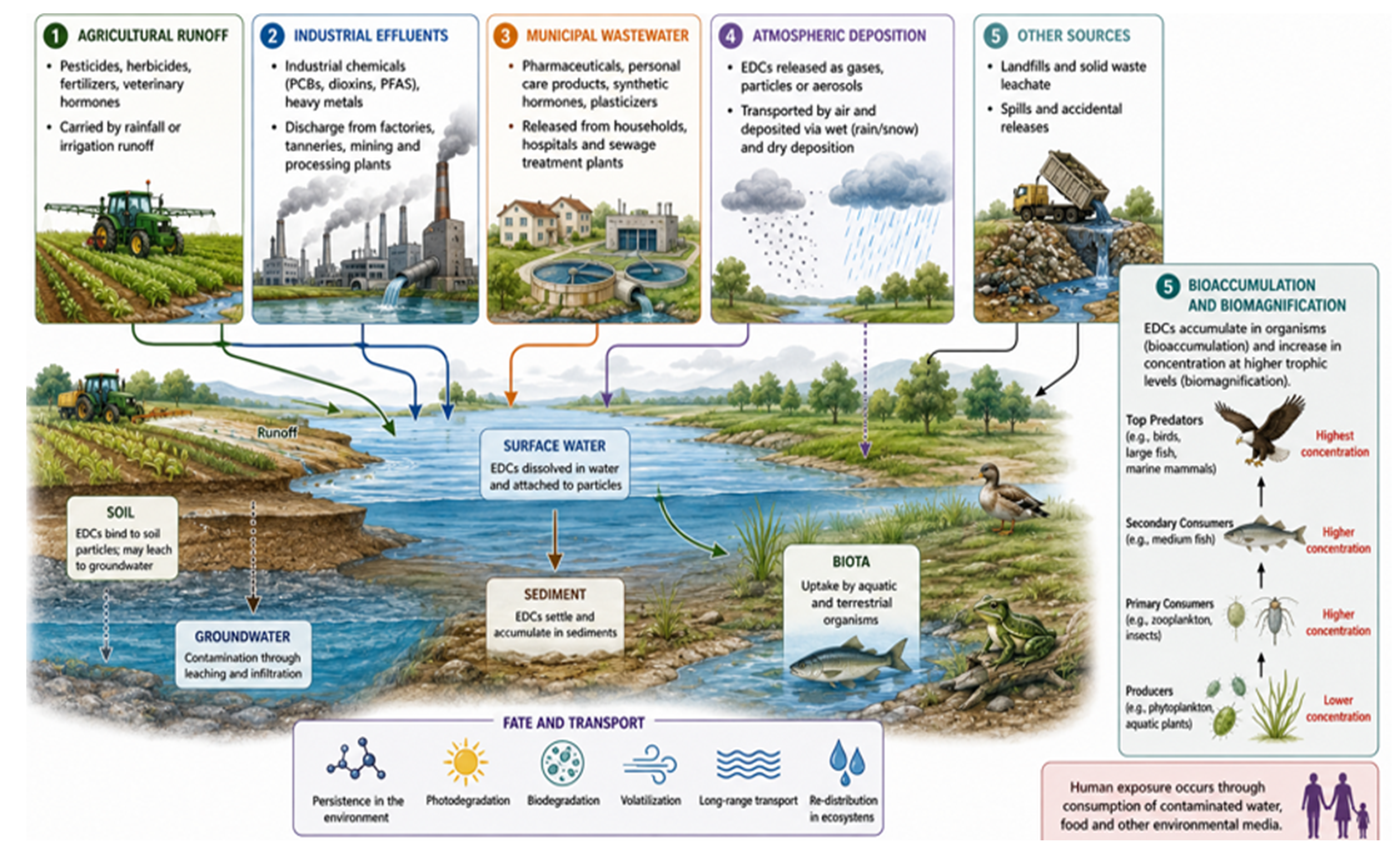
Endocrine disrupting chemicals (EDCs) are exogenous substances capable of interfering with the normal functioning of the endocrine system, thereby causing adverse effects on reproduction, development, metabolism, and other physiological processes in humans and wildlife. The widespread use of these chemicals in agriculture, industry, pharmaceuticals, plastics, and personal care products has led to their ubiquitous presence in terrestrial and aquatic environments, raising significant ecological and public health concerns. This study examined endocrine disrupting chemicals and their ecological effects on reproduction and development. Specifically, the study discussed the concept, characteristics, historical development, classification, sources, and types of endocrine disrupting chemicals. It also reviewed the mechanisms through which endocrine disrupting chemicals disrupt endocrine functions, including hormone mimicry, receptor blocking, alteration of hormone synthesis and metabolism, epigenetic modifications, and transgenerational effects. Environmental pathways such as agricultural runoff, industrial effluents, municipal wastewater, atmospheric deposition, bioaccumulation, and biomagnification were highlighted. The study further examined the ecological impacts of endocrine disrupting chemicals on aquatic organisms, amphibians, reptiles, birds, and mammals, as well as their implications for human health, including reproductive disorders, hormone-dependent cancers, neurodevelopmental abnormalities, metabolic diseases, and thyroid dysfunction. Methods employed in the detection and monitoring of endocrine disrupting chemicals, control and management strategies, and emerging research issues were also discussed. The study concluded that endocrine disrupting chemicals pose substantial threats to biodiversity, ecosystem stability, and human wellbeing, necessitating strengthened regulatory frameworks, improved environmental monitoring, sustainable chemical management practices, and continued research to mitigate their adverse effects.
Downloads
Article Details

This work is licensed under a Creative Commons Attribution-NonCommercial-NoDerivatives 4.0 International License.
References
Anozie, C. P., Obi, C. C., & Ofor, E. U. (2026). Biodegradation of cypermethrin and its metabolic products by Bacillus flexus strain PC5 isolated from cypermethrin-treated agricultural soil. Journal of Biological Research and Biotechnology, 24(1), 360–373. https://doi.org/10.4314/br.v24i1.10
Bornman, R., Aneck-Hahn, N., de Jager, C., Wagenaar, G., & Bornman, M. (2019). Endocrine disruptors and reproductive health effects in developing countries. International Journal of Environmental Research and Public Health, 16(20), 3962. https://doi.org/10.3390/ijerph16203962
Bourguignon, J. P., Juul, A., Franssen, D., Fudvoye, J., Pinson, A., Parent, A. S., & Rasier, G. (2018). Contribution of endocrine-disrupting chemicals to neurodevelopmental disorders and decreased fertility in humans. Nature Reviews Endocrinology, 14(3), 133–152. https://doi.org/10.1038/nrendo.2017.157
Demeneix, B. A., Slama, R., Philippat, C., Heude, B., & Charles, M. A. (2021). Endocrine disruptors and human health: New insights from epidemiological studies. Comptes Rendus Biologies, 344(1), 27–44. https://doi.org/10.5802/crbiol.44
European Environment Agency. (2020). The European environment—State and outlook 2020: Knowledge for transition to a sustainable Europe. Publications Office of the European Union.
Flaws, J. A., Patisaul, H. B., & Mahoney, M. M. (2020). Endocrine-disrupting chemicals and reproductive health. Current Opinion in Toxicology, 19, 1–5. https://doi.org/10.1016/j.cotox.2019.11.001
Gore, A. C., Chappell, V. A., Fenton, S. E., Flaws, J. A., Nadal, A., Prins, G. S., Toppari, J., & Zoeller, R. T. (2019). EDC-2: The endocrine society's second scientific statement on endocrine-disrupting chemicals. Endocrine Reviews, 40(2), 293–342. https://doi.org/10.1210/er.2018-10104
Gore, A. C., Chappell, V. A., Fenton, S. E., Flaws, J. A., Nadal, A., Prins, G. S., Toppari, J., & Zoeller, R. T. (2015). EDC-2: The Endocrine Society’s second scientific statement on endocrine-disrupting chemicals. Endocrine Reviews, 36(6), E1–E150. https://doi.org/10.1210/er.2015-1010
Heindel, J. J., Blumberg, B., Cave, M., Machtinger, R., Mantovani, A., Mendez, M. A., Nadal, A., Palanza, P., Panzica, G., Sargis, R., Vandenberg, L. N., & Vom Saal, F. (2020). Metabolism disrupting chemicals and metabolic disorders. Reproductive Toxicology, 98, 3–33. https://doi.org/10.1016/j.reprotox.2020.04.001
Hunt, P. A., Sathyanarayana, S., Fowler, P. A., & Trasande, L. (2017). Female reproductive disorders, diseases, and costs of exposure to endocrine disrupting chemicals in the European Union. Journal of Clinical Endocrinology and Metabolism, 102(4), 1082–1095. https://doi.org/10.1210/jc.2016-3185
Liang, Y., Lu, Q., Chen, M., Zhao, X., Chu, C., Zhang, C., Yuan, J., Liu, H., & Lash, G. E. (2025). Impact of endocrine disrupting chemicals (EDCs) on epigenetic regulation in the uterus: A narrative review. Reproductive Biology and Endocrinology, 23, 80. https://doi.org/10.1186/s12958-025-01413-z
Mohajer, N., & Culty, M. (2025). Impact of real-life environmental exposures on reproduction: Impact of human-relevant doses of endocrine-disrupting chemical and drug mixtures on testis development and function. Reproduction, 169(1), e240155. https://doi.org/10.1530/REP-24-0155
Nadal, A., Quesada, I., Tudurí, E., Nogueiras, R., & Alonso-Magdalena, P. (2017). Endocrine-disrupting chemicals and the regulation of energy balance. Nature Reviews Endocrinology, 13(9), 536–546. https://doi.org/10.1038/nrendo.2017.51
Nagel, S. C., Bromfield, J. J., & McWhorter, K. (2020). Endocrine disruptors and developmental programming. Reproduction, 159(6), R197–R215. https://doi.org/10.1530/REP-19-0496
OECD. (2021). Revised guidance document on standardised test guidelines for evaluating chemicals for endocrine disruption. OECD Publishing. Paris.
Olea, N., Fernández, M. F., Mustieles, V., Prada, R., & Fernández, M. I. (2020). Human exposure to endocrine disrupting chemicals and prenatal consequences. International Journal of Environmental Research and Public Health, 17(18), 6712. https://doi.org/10.3390/ijerph17186712
Olugbenga, O. S., Olamilekan, I. J., Kayode, A. O., Opeyem, S. B., Toluwan, O. D., Omorowa, V. T., et al. (2023). Cissampelos pareira ethanolic extract modulates hormonal indices, lipid profile, and oxidative parameters in transient infertility-induced female albino rats. Journal of Biological Research and Biotechnology, 21(2), 1961–1972. DOI: 10.4314/br.v21i2.4.
Pan, J., Liu, P., Yu, X., Zhang, Z., & Liu, J. (2024). The adverse role of endocrine disrupting chemicals in the reproductive system. Frontiers in Endocrinology, 14, 1324993. https://doi.org/10.3389/fendo.2023.1324993
Parent, A.-S., Damdimopoulou, P., Johansson, H. K. L., Bouftas, N., Draskau, M. K., Franssen, D., Fudvoye, J., van Duursen, M., & Svingen, T. (2025). Endocrine- disrupting chemicals and female reproductive health: A growing concern. Nature Reviews Endocrinology, 21(10), 593–607. https://doi.org/10.1038/s41574-025-01131-x
Payne, W., & Pool, K. R. (2026). Ecological and reproductive consequences of endocrine- disrupting chemicals in agricultural systems. Reproduction & Fertility, 7(1), RAF250178. https://doi.org/10.1530/RAF-25-0178
Soto, A. M., Sonnenschein, C., & Rubin, B. S. (2017). Endocrine-disrupting chemicals and the developmental origins of disease. Molecular and Cellular Endocrinology, 457, 85–96. https://doi.org/10.1016/j.mce.2016.12.006
Swan, S. H., Colino, S., & Skakkebaek, N. E. (2021). Countdown: How our modern world is threatening sperm counts, altering male and female reproductive development, and imperiling the future of the human race. Environmental Research, 194, 110694. https://doi.org/10.1016/j.envres.2020.110694
United Nations Environment Programme, & World Health Organization. (2022). State of the science of endocrine disrupting chemicals 2022. Geneva: WHO Press.
Vandenberg, L. N., Hunt, P. A., Myers, J. P., & Vom Saal, F. S. (2017). Human exposures to bisphenol A: Mismatches between data and assumptions. Reviews on Environmental Health, 32(1–2), 37–58. https://doi.org/10.1515/reveh-2016-0064
Vela-Soria, A. M., Ballesteros, O., Rodríguez, I., Cela, R., & Fernández, M. F. (2021). Analytical methods for determination of endocrine disrupting chemicals in environmental samples. TrAC Trends in Analytical Chemistry, 143, 116390. https://doi.org/10.1016/j.trac.2021.116390
World Health Organization. (2022). Global assessment of endocrine disrupting chemicals and human health. Geneva: WHO.
Zoeller, R. T., Brown, T. R., Doan, L. L., Gore, A. C., Skakkebaek, N. E., Soto, A. M., Woodruff, T. J., & Vom Saal, F. S. (2018). Endocrine-disrupting chemicals and public health protection. Endocrinology, 159(3), 1181–1184. https://doi.org/10.1210/en.2017-03093
Zoeller, R. T., Vandenberg, L. N., & Gore, A. C. (2020). Endocrine-disrupting chemicals: Scientific evidence and policy implications. Lancet Diabetes & Endocrinology, 8(8), 629–631. https://doi.org/10.1016/S2213-8587(20)30129-2