

Simultaneous Adsorption of Nickel, Cadmium, Nitrate and Phosphate from Abattoir Wastewater Using Biowaste Biochars Adsorption of Nickel, Cadmium, Nitrate and Phosphate from Abattoir Wastewater
Article Sidebar
Main Article Content
Abstract
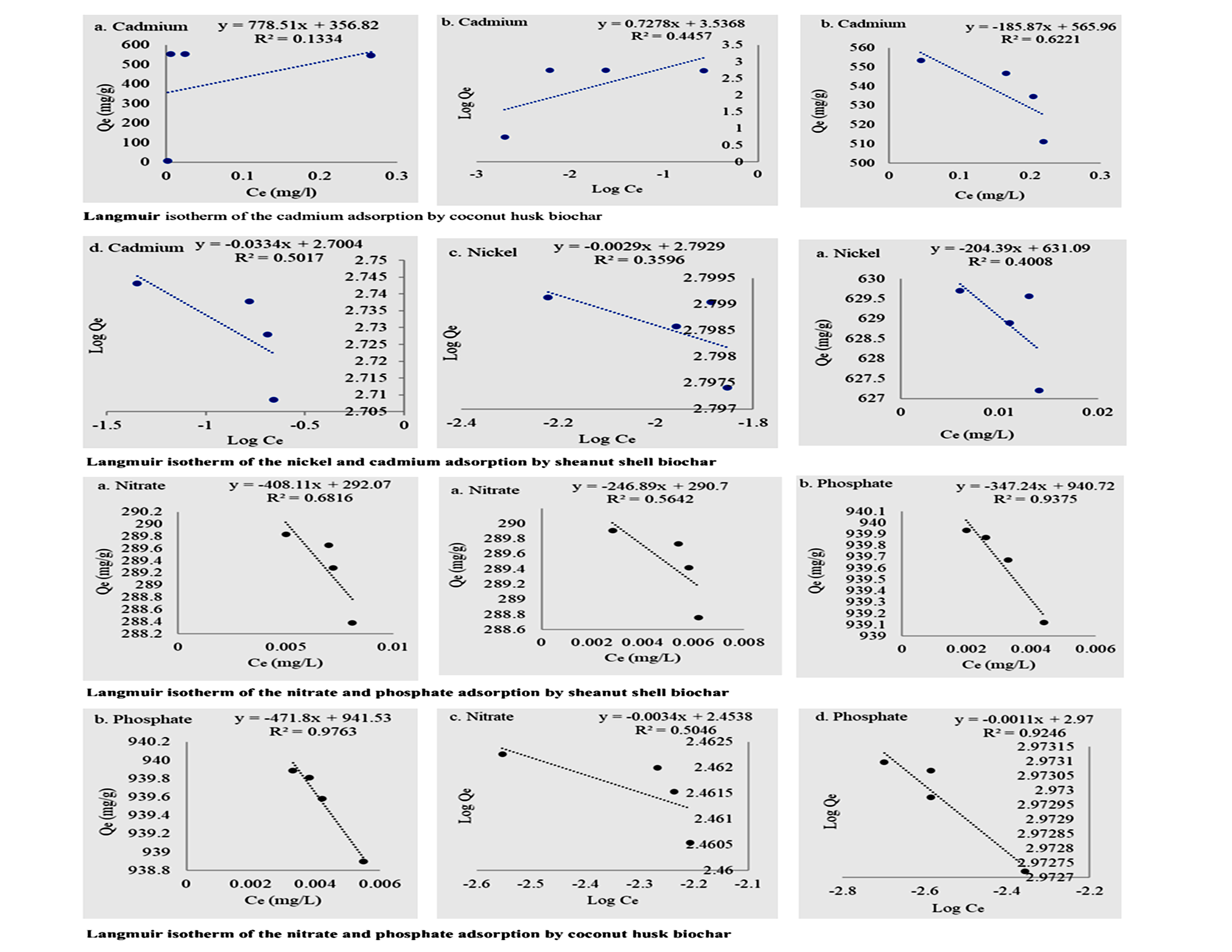
Adsorption can be one of the most effective methods of simultaneous elimination of nickel (Ni), cadmium (Cd), phosphate (PO4), and nitrate (NO3) from an environment. It is also the easiest, cheapest, and most environmentally friendly method. The study evaluated the adsorption of nickel, cadmium, nitrate, and phosphate from abattoir effluent using coconut husk biochar and sheanut shell biochar. The study employed different dosages of 100 mL of abattoir wastewater with a 60-minute contact time and a fixed rotatory speed. Coconut husk biochar and sheanut shell biochar efficiencies in nickel removal were 100% and ranged from 99.77% to 99.98%, respectively, and in cadmium removal were 95.21% to 99.96% and 96.05% to 99.19%, respectively, of abattoir effluent. Coconut husk and sheanut shell biochar adsorbed nitrate and phosphate with efficiencies of 99.72% to 99.83% and 99.79% to 99.90%, and 99.94% to 99.96% and 99.95% to 99.98%, respectively. The sheanut shell biochar and coconut husk biochar in abattoir wastewater at varied grams (0.5, 1.0, 2.0, and 3.0 g) showed effective removal efficiency. The Freundlich model best describes the Cd, Ni, NO3, and PO4 adsorption on biochars from the KF, n, and R2 values. This indicates the pollutants adsorption is efficient, chemical in character, and the biochars are structurally heterogeneous and have high affinity to Cd, Ni, NO3 and PO4 ions that exist in the abattoir wastewater. Coconut husks and sheanut shells can be efficient and affordable adsorbents for harmful metals and nutrients from wastewater from abattoirs and other sources.
Downloads
Article Details

This work is licensed under a Creative Commons Attribution-NonCommercial-NoDerivatives 4.0 International License.
References
Attia, A. A., Khedr, S. A. & Elkholy, S. A. (2010). Adsorption of chromium ion (VI) by acid activated carbon. Brazilian Journal of Chemical Engineering, 27, 183 - 193.
Azimi, A., Azari, A., Rezakazemi, M., & Ansarpour, M. (2017). Removal of heavy metals from industrial wastewaters: a review. Chem Bio Eng Reviews, 4(1), 37 - 59.
Ajiboye, T. O., Oyewo, O. A., & Onwudiwe, D. C. (2021). Simultaneous removal of organics and heavy metals from industrial wastewater: A review. Chemosphere, 262, 128379.
Ayawei, N., Angaye, S. S., & Wankasi, D. (2017). Mg/Fe Layered Double Hydroxide as a Novel Adsorbent for the Removal of Congo red. International Journal of Applied, 7(2).
AWWA. (1998). Standard methods for the examination of water and wastewater. Washington, DC Standard Methods for the Examination of Water and Wastewater, 20.
Ajmal, Z., Muhmood, A., Dong, R., & Wu, S. (2020). Probing the efficiency of magnetically modified biomass-derived biochar for effective phosphate removal. Journal of Environmental Management, 253, 109730.
Bansal, P., Morgat, A., Axelsen, K. B., Muthukrishnan, V., Coudert, E., Aimo, L., Hyka-Nouspikel, N., Gasteiger, E., Kerhornou, A., Neto, T. B., & Pozzato, M. (2022). Rhea, the reaction knowledgebase in 2022. Nucleic Acids Research, 50(D1), D693-700.
Batool, F., Qadir, R., Adeeb, F., Kanwal, S., Abdelrahman, E. A., Noreen, S., Albalawi, B. F., Mustaqeem, M., Imtiaz, M., Ditta, A., & Gondal, H. Y. (2023). Biosorption Potential of Arachis hypogaea-Derived Biochar for Cd and Ni, as Evidenced through Kinetic, Isothermal, and Thermodynamics Modeling. Acs Omega, 8(43), 40128-40139.
Berkessa, Y. W., Mereta, S. T., & Feyisa, F. F. (2019). Simultaneous removal of nitrate and phosphate from wastewater using solid waste from factory. Applied Water Science, 9, 1-0.
Binti Naihi, H., Binti Baini, R., Bin Yakub, I., & Lai, J. (2022). Cadmium adsorption from aqueous solution using alkali modified oil palm empty fruit bunch. Biocatalysis and Agricultural Biotechnology, 102480.
Dada, A. O., Olalekan, A. P., Olatunya, A. M., & Dada, O. (2012). Langmuir, Freundlich, Temkin and Dubinin–Radushkevich isotherms studies of equilibrium sorption of Zn2+ unto phosphoric acid modified rice husk. IOSR Journal of Applied Chemistry, 3(1), 38–45.
Duwiejuah, A. B., Imoro, Z. A., & Alhassan, E. H. (2024). Biowaste biochar as a green technology for adsorption of heavy metals in wastewater. InBio-organic Amendments for Heavy Metal Remediation 2024; (pp. 107-120). Elsevier.
El-Desouky, M. G., Shahat, A., El-Bindary, A. A., & El-Bindary, M. A. (2021). Description, kinetic and equilibrium studies of the adsorption of carbon dioxide in mesoporous iron oxide nanospheres. Biointerface Resarch in Applied Chemistry, 12, 3034–3054.
European Commission. (1991). Council Directive 91/271/EEC concerning urban wastewater treatment. Official Journal of the European Communities.
Gierak, A., & Łazarska, I. (2017). Adsorption of nitrate, nitrite, and ammonium ions on carbon adsorbents. Adsorption Science & Technology, 35(7–8), 721–727.
Gupta, S., Sireesha, S., Sreedhar, I., Patel, C. M., & Anitha, K. L. (2020). Latest trends in heavy metal removal from wastewater by biochar based sorbents. Journal of Water Process Engineering, 38, 101561.
Hafshejani, L. D., Hooshmand, A., Naseri, A. A., Mohammadi, A. S., Abbasi, F., & Bhatnagar, A. (2016). Removal of nitrate from aqueous solution by modified sugarcane bagasse biochar. Ecological Engineering, 95, 101–111.
Jellali, S., Khiari, B., Usman, M., Hamdi, H., Charabi, Y., & Jeguirim, M. (2021). Sludge-derived biochars: A review on the influence of synthesis conditions on pollutants removal efficiency from wastewaters. Renewable and Sustainable Energy Reviews, 144, 111068.
Kharrazi, S. M., Mirghaffari, N., Dastgerdi, M. M., & Soleimani, M. (2020). A novel post-modification of powdered activated carbon prepared from lignocellulosic waste through thermal tension treatment to enhance the porosity and heavy metals adsorption. Powder Technology, 366, 358–368.
Khorshidi, P., Shirazi, R. H. S. M., Miralinaghi, M., Moniri, E., & Saadi, S. (2020). Adsorptive removal of mercury (II), copper (II), and lead (II) ions from aqueous solutions using glutathione-functionalized NiFe2O4/graphene oxide composite. Research on Chemical Intermediates, 46(7), 3607–3627.
Konneh, M., Wandera, S. M., Murunga, S. I., & Raude, J. M. (2021). Adsorption and desorption of nutrients from abattoir wastewater: modelling and comparison of rice, coconut and coffee husk biochar. Heliyon, 7(11), e08458.
Krika, F., Azzouz, N., & Ncibi, M. C. (2016). Adsorptive removal of cadmium from aqueous solution by cork biomass: Equilibrium, dynamic and thermodynamic studies. Arabian Journal of Chemistry, 9, S1077–S1083.
Malik, R., & Dahiya, S. (2017). An experimental and quantum chemical study of removal of utmostly quantified heavy metals in wastewater using coconut husk: A novel approach to mechanism. International Journal of Biological Macromolecules, 98, 139–149.
Mushtaq, N., Bhat, R. A., Dervash, M. A., & Hameed, O. (2020). Fresh water pollution dynamics and remediation. Fresh Water Pollution Dynamics and Remediation, January. https://doi.org/10.1007/978-981-13-8277-2
Liang, P., Yu, H., Huang, J., Zhang, Y., & Cao, H. (2016). The review on adsorption and removal of ammonia nitrogen with biochar on its mechanism. MATEC Web Conf ,67, 07006.
Li, J., Li, B., Huang, H., Lv, X., Zhao, N., Guo, G., & Zhang, D. (2019). Removal of phosphate from aqueous solution by dolomite-modified biochar derived from urban dewatered sewage sludge. Science of the Total Environment, 687, 460 - 469.
Liu, R., Chi, L., Wang, X., Sui, Y., Wang, Y., & Arandiyan, H. (2018). Review of metal (hydr) oxide and other adsorptive materials for phosphate removal from water. Journal of Environmental Chemical Engineering, 6(4), 5269-86.
Shukla, P., Mishra, A., Manivannan, S., Melo, J. S., & Mandal, D. (2020). Parametric optimization for adsorption of mercury (II) using self assembled bio-hybrid. Journal of Environmental Chemical Engineering, 8(3), 103725.
Tran, T. H., Okabe, H., Hidaka, Y., & Hara, K. (2019). Equilibrium and kinetic studies for silver removal from aqueous solution by hybrid hydrogels. Journal of Hazardous Material, 365, 237–244. https://doi.org/10. 1016/j.jhazmat.2018.11.08
Zhang, A., Li, X., Xing, J., & Xu, G. (2020). Adsorption of potentially toxic elements in water by modified biochar: A review. Journal of Environmental Chemical Engineering, 8(4), 104196.
Zhao, H. T., Ma, S., Zheng, S. Y., Han, S. W., Yao, F. X., Wang, X. Z., Wang, S. S., & Feng K. (2019). β–cyclodextrin functionalized biochars as novel sorbents for high-performance of Pb2+ removal. Journal of Hazardous Materials, 362, 206-13.
Shrestha, R., Ban, S., Devkota, S., Sharma, S., Joshi, R., Tiwari, A. P., Kim, H. Y., & Joshi, M. K. (2021). Technological trends in heavy metals removal from industrial wastewater: A review. Journal of Environmental Chemical Engineering, 9(4), 105688.
Rathi, B. S., Kumar, P. S., Ponprasath, R., Rohan, K., & Jahnavi, N. (2021). An effective separation of toxic arsenic from aquatic environment using electrochemical ion exchange process. Journal of Hazardous Materials, 412, 125240.
Rachmat, D., Mawarani, L. J., & Risanti, D. D. (2018). Utilization of cacao pod husk (Theobroma cacao L.) as activated carbon and catalyst in biodiesel production process from waste cooking oil. IOP Conference Series: Materials Science and Engineering, 299(1), 12093.
United States Environmental Protection Agency (USEPA). (2022). Nitrate and Nitrite Rule: Maximum Contaminant Level (MCL) Public Notification Template.
Zheng, H., Wang, Z., Deng, X., Zhao, J., Luo, Y., Novak, J., Herbert, S., & Xing, B. (2013). Characteristics and nutrient values of biochars produced from giant reed at different temperatures. Bioresource Technology, 130, 463–471.
Zhang, Y., Zhang, Z., Xie, Y., Wang, S., Qiu, Q., Zhou, Y., & Zeng, G. (2015). Toxicity of nickel ions and comprehensive analysis of nickel ion‑associated gene expression profiles in THP‑1 cells. Molecular Medicine Reports, 12(3), 3273–3278.