

Physicochemical Properties of Thiaminase from Cassava Tubers (Manihot esculenta)
Article Sidebar
Main Article Content
Abstract
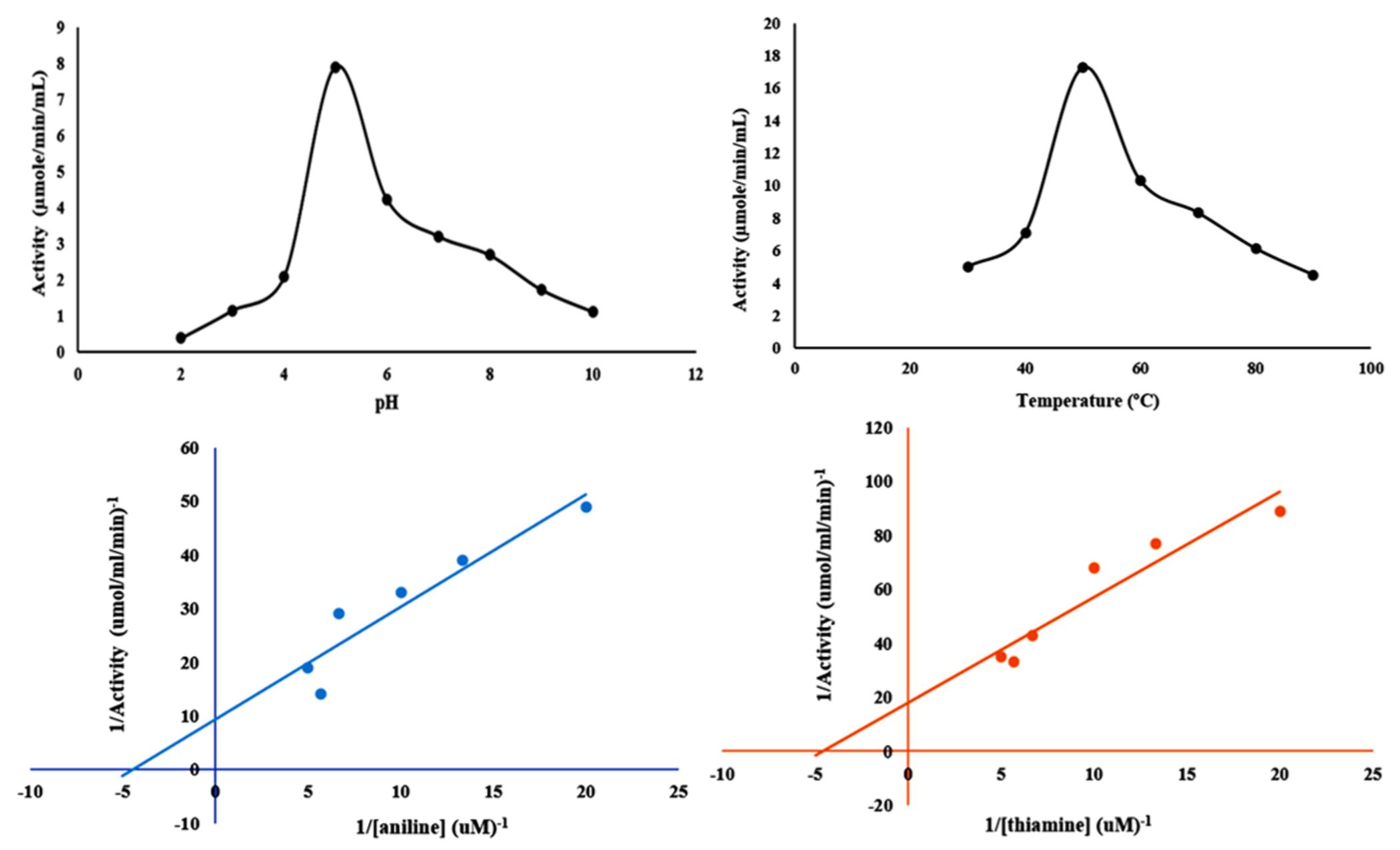
Thiaminase (EC 2.5.1.2) is an antinutritional enzyme that is responsible for thiamine (vitamin B1) degradation, causing severe neurological and metabolic disorders in mammals. Cassava tubers were used for the extraction and purification of thiaminase using ammonium sulphate precipitation to 85 % and the CM-Sephadex C-25 chromatography. The purification process gave a specific activity of was 0.511 U/mg, 6.59 % yield and 7.61 fold-purification. The apparent Michaelis-Menten constant (Km) values were 0.20 μM for thiamine and 0.23 μM for the co-substrate aniline, showing a much greater affinity for thiamine. The maximum velocities for both substrates were 0.0556 ± 0.01 μmol/min/mL and 0.107 ± 0.05 μmol/min/mL respectively. The optimum temperature and pH of the enzyme were 50 °C and 5.0 respectively. The enzyme activity was activated by low concentrations (0.1 mM and 1.0 mM) of Fe2+, Hg2+, Mn2+ and Na+ and also, a remarkable enhancement of the enzyme activity was exhibited with 10 mM concentration of all these cations indicating adaptation to the metallic profile of the soil. The enzyme was found to be stable at 40 °C to 60 °C. The findings of this study confirmed the presence of thiaminase in cassava tubers, suggesting that its activity may contribute to thiamine deficiency among populations that depend on cassava as a staple food, particularly when it is consumed raw or inadequately processed.
Downloads
Article Details

This work is licensed under a Creative Commons Attribution-NonCommercial-NoDerivatives 4.0 International License.
References
Agboola O. S. & Okonji R. E. (2014). Comparative study of some enzymes in different varieties of fruits. Int. J. Biol. Chem. Sci. 8(2): 419-425. https://doi.org/10.4314/ijbc.v8i2.1
Adeoye, B. O., Nwachukwu, I. D., Olanrewaju, O. O., & Omobude-Aisagbonhi, E. (2024). Enzyme thiaminase: A known anti-nutritional enzyme with unknown therapeutic potentials in cancer treatment. Cross Current International Journal of Medical and Biosciences, 6(6), 114–119. https//:doi.org/10.36344/ccijmb.2024.v06i06.001
Banjoko, O.S, Agunbiode. J.A, Awojobi, H.A, Adeyemi, O.A, & Adebajo, M.O (2008). “Nutritional Evaluation of Layers Diets based on cassava products and soya beans as 74 influenced by protein supplementation and processing” Proc. 33rd Annual Conf. of NSAP, Ayetoro, Ogun State Nigeria 373-376.
Boyd, J.W. (1985). Studies on thiaminase I activity in ruminant faeces and rumen bacteria. J. Agri. Sci., 104: 637-642. https://doi.org/10.1017/S0021859600044427
Bradford, M.M. (1976). A rapid and sensitive method for the quantification of microgram quantities of protein, utilizing the principle of protein dye binding. Anal. Biochem., 72: 248-254. https://doi.org/10.1016/0003-2697 (76)90527-3
Cheryl A. Kreinbring, Stephen P. Remillard, Paul Hubbard, Heather R. Brodkin, Finian J. Leeperc, Dan Hawksley, Elaine Y. Lai, Chandler Fulton, Gregory A. Petsko, & Dagmar Ringe. (2012) Structure of a eukaryotic thiaminase I. PNAS. 111(1): 137–142.
Edwards, K. A., Randall, E. A., Wolfe, P. C., Angert, E. R., & Kraft, C. E. (2023). Dietary factors potentially impacting thiaminase I-mediated thiamine deficiency. Scientific Reports, 13(1), 7008. https://doi.org/10.1038/s41598-023-34063-5
Ehigie, L, Okonji R. E., Adeola F. , Ehigie A. A. & Falode J. A. Properties of thiaminase in freshwater prawn Machrobrachium rosenbergii. Impact Journals. 3(4): 37-48.
mortality syndrome in Great Lakes salmonines. J Aquat Anim Health, 17: 1–3.
Kreinbring, C. A., Remillard, S. P., Hubbard, P., Brodkin, H. R., Leeper, F. J., Hawksley, D., Lai, E. Y., Fulton, C., Petsko, G. A., & Ringe, D. (2013). Structure of a eukaryotic thiaminase I. Proceedings of the National Academy of Sciences, 111(1), 137-142. https://doi.org/10.1073/pnas.1315882110
Edwards, K. A., Randall, E. A., Wolfe, P. C., Angert, E. R., & Kraft, C. E. (2023). Dietary factors potentially impacting thiaminase I-mediated thiamine deficiency. Scientific Reports, 13(1), 7008. https://doi.org/10.1038/s41598-023-34063-5
Rowland, F. E., Richter, C. A., Tillitt, D. E., & Walters, D. M. (2023). Evolutionary and ecological correlates of thiaminase in fishes. Scientific Reports, 13, 18147. https://doi.org/10.1038/s41598-023-44654-x
Mrowicka, M., Mrowicki, J., Dragan, G., & Majsterek, I. (2023). The importance of thiamine (vitamin B1) in humans .Bioscience Reports, 43(10), BSR20230374. https://doi.org/10.1042/BSR20230374
Jackson, C., Furnes, M., Rød-Eriksen, L., Yap, K. N., Davey, M., Fossøy, F., Flagstad, Ø., Eide, N. E., Mjøen, T., & Ulvund, K. (2024). Subclinical thiamine deficiency results in failed reproduction in Arctic foxes. Veterinary Medicine and Science, 10(2),e1358. https://doi.org/10.1002/vms3.1358
Jackson, C., Furnes, M., Rød-Eriksen, L., Yap, K. N., Davey, M., Fossøy, F., Flagstad, Ø., Eide, N. E., Mjøen, T., & Ulvund, K. (2024). Subclinical thiamine deficiency results in failed reproduction in Arctic foxes. Veterinary Medicine and Science, 10(2), e1358. https://doi.org/10.1002/vms3.1358
Malgorzata, Bos Andrzej (2000). Some Molecular and Enzymatic Properties of a Homogeneous Preparation of Thiaminase I Purified from Carp Liver. Article in Journal of Protein Chemistry 19(2): 75-84. https://doi.org/10.1023/A:1007043530616
McCleary, B.V., Chick, B.F. (1977). The purification and properties of a thiaminase I enzyme from Nardoo (Marsilea drummondii). Phytochem., 16: 207-213. https://doi.org/10.1016/s0031-9422 (00)86787-4
Mrowicka, M., Mrowicki, J., Dragan, G., & Majsterek, I. (2023). The importance of thiamine (vitamin B1) in humans. Bioscience Reports, 43(10), BSR20230374. https://doi.org/10.1042/BSR20230374
Nishimune, T., Watanabe, Y., Okazaki, H. & Akai, H. (2000). Thiamin is decomposed due to Anaphe spp. entomophagy in seasonal ataxia patients in Nigeria. J. Nutr., 130: 1625-1628. https://doi.org/jn/130.6.1625
Porter, D., & Pinger, C. (2025). Measuring thiaminase activity in fish extracts using fluorescence spectrophotometry. ACS MeasurementScienceAu.https://doi.org/10.1021/acsmeasuresciau.5c00091
Rapala-Kozik M, Kowalski E, & Ostrowska K. (2008) Modulation of thiamine metabolism in Zea mays seedlings under conditions of abiotic stress. Journal of experimental botany. 59(15):4133-43. https://doi.org/10.1093/jxb/ern253
Romanenko A. V, Gnatenko V. M, & Vladimirova I. A. (1994). Effect of thiamine on neuromuscular transmission in smooth muscles. Neurophysiology. 26(6): 370-6. https://doi.org/10.1007/BF01053581
Rowland, F. E., Richter, C. A., Tillitt, D. E., & Walters, D. M. (2023). Evolutionary and ecological correlates of thiaminase in fishes. Scientific Reports, 13, 18147. https://doi.org/10.1038/s41598-023-44654-x
Wolfe, P. C., Tuske, A. M., Tillitt, D. E., Allen, F., & Edwards, K. A. (2023). Some molecular and enzymatic properties of a homogeneous preparation of thiaminase I purified from carp liver. Current Research in Food Science, 6, Article 100502. https://doi.org/10.1016/j.crfs.2023.100502