

Nematodes Assessment in Cucumber and Melon farms in Rivers State, Nigeria
Article Sidebar
Main Article Content
Abstract
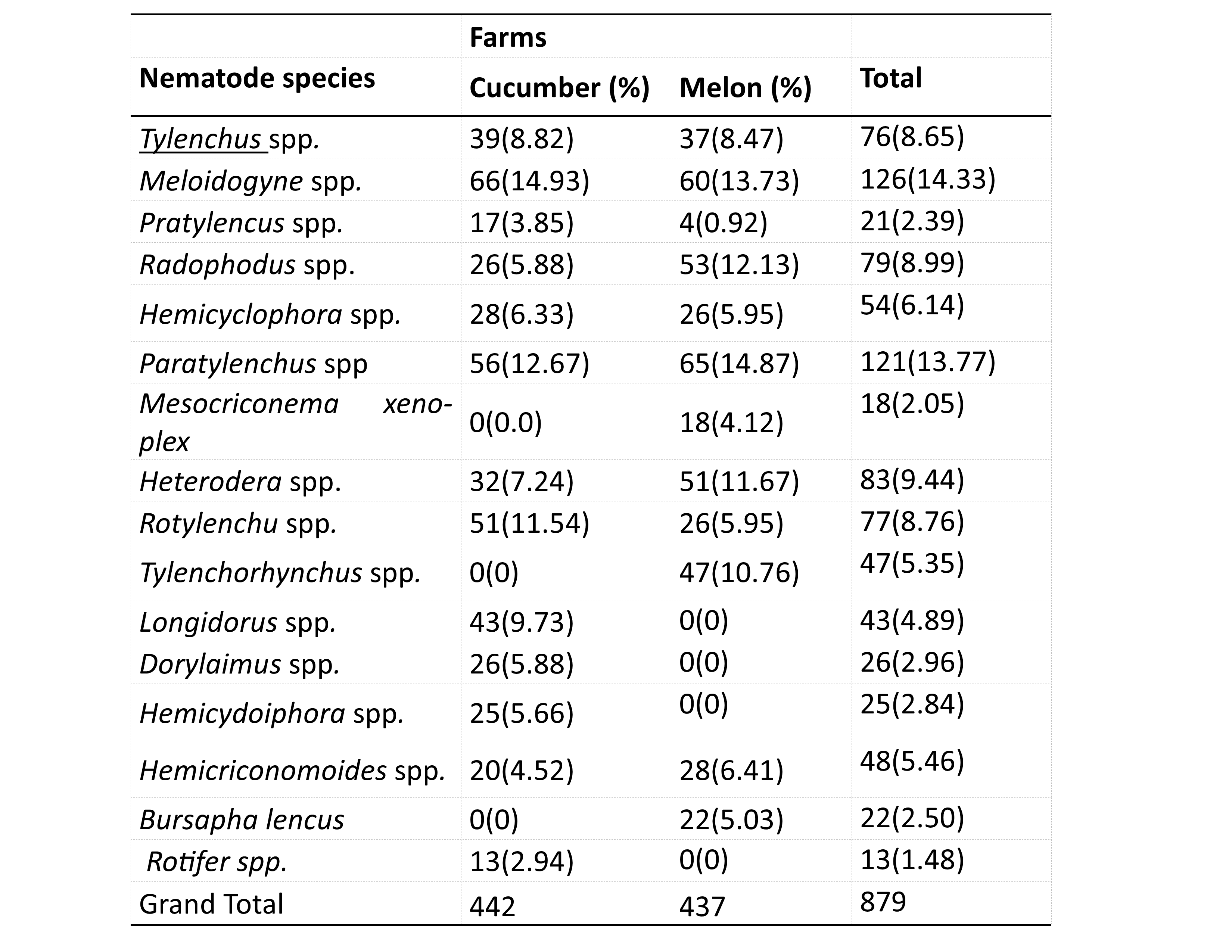
Plant parasitic nematodes are of agricultural importance, causing loss of crop fields, poor yield and the subsequent impact on livelihood of the farmers. The aim of this study was to evaluate the abundance of parasitic nematodes on selected crop fields in the study area. Soil samples were collected from cucumber, cassava, melon and maize farms, using a soil auger into a black cellophane bag and transported to the laboratory for parasitological analysis using Baermann’s method. Soil physico-chemical parameters were measured using standard methods. A total of 879 plant parasitic nematodes from 16 species were extracted from cucumber and melon farms during the study, out of which 442 (50.28) and 437(49.72%) were extracted from the cucumber and melon farms respectively. Of the 442 plant parasitic nematodes recovered from the cucumber farm, Meloidogyne spp., 66(14.93%) recorded the highest abundance followed by Paratylenchus spp., 56(12.67%), Rotylenchu spp., 51(11.54%) while Pratylencus spp., 17(3.85%) recorded the abundance. In the melon farm, 12 species of PPNs were extracted comprising of Tylenchus spp., 37(8.47), Meloidogyne spp., 60(13.73%), Pratylencus spp., 4(0.92%), Radophodus spp., 53(12.13%), Hemicyclophora spp., 26(5.95%), Paratylenchus spp., 65(14.87%), Mesocriconema xenoplex, 18(4.12), Heterodera spp., 51(11.67%), Rotylenchus spp., 26(5.95%), Tylenchorhynchus spp.,47(10.76), Hemicriconomoides spp., and 28(6.41%). Physico-chemical parameters recorded insignificant negative correlation with nematode abundance (p>0.05). Farms in the study area are infested with various plant parasitic nematodes. Farmers should be encouraged to carry crop rotation which helps in nematode control.
Downloads
Article Details

This work is licensed under a Creative Commons Attribution-NonCommercial-NoDerivatives 4.0 International License.
References
Akubor, P. I., & Ogbadu, G. H. (2003). Physicochemical properties and functional attributes of melon (Colocynthis citrullus L.) protein isolate. Journal of Food Science and Technology, 40(6), 597–602.
Amulu, L.U., Oyedele, D.J., Adekunle, O.K. (2024). Plant Parasitic Nematodes Associated with Three African Indigenous Vegetables in Southwest Nigeria. Trends in Agricultural Sciences, 3(2), 69-82. https://doi.org/10.17311/tas.2024.69.82
Brasier, C. M. (2008). Rapid emergence of forest pathogens: History and prospects. Plant Disease, 92(6), 637–646.
Coffi, E. N., Affokpon, A., Souna, D. A., De Troij, A., Adanmaho, A. S., & Sero, S. (2025). Distribution of plant-parasitic nematode genera in relation to host vegetable crops and ecological regions in Benin, West Africa. Tropical Agriculture-London then Trinidad-, 102(4), 516-536. https://journals.sta.uwi.edu/ojs/index.php/ta/article/view/9632
Dunn, B. W., Harris, P., & Clarke, M. (2024). Soil physico-chemical convergence across agricultural landscapes. Geoderma, 445, 116546. https://doi.org/10.1016/j.geoderma.2024.116546
Goodey, J. B. (1963). Soil and freshwater nematodes. Butterworths.
Ikoyi, I., Grange, G., Finn, J. A., & Brennan, F. P. (2023). Plant diversity enhanced nematode-based soil quality indices and changed soil nematode community structure in intensively-managed agricultural grasslands. European Journal of Soil Biology, 118, 103542. https://doi.org/10.1016/j.ejsobi.2023.103542
Kaur, R., Singh, H., & Kaur, M. (2025). Influence of land-use patterns on soil properties and nutrient cycling. Environmental Monitoring and Assessment, 197(2), 118. https://doi.org/10.1007/s10661-025-11834-2
Khan, M. R. (2012). Plant-parasitic nematodes: Biology, pathogenicity and management strategies. International Journal of Nematology, 22(1), 1–18.
Liu, Q., Wang, T., & Zhao, L. (2025). Environmental drivers of soil nematode diversity in agroecosystems. Soil Systems, 9(1), 12. https://doi.org/10.3390/soilsystems9010012
Ma, T., Pan, X., Wang, T., Li, X., & Luo, Y. (2023). Toxicity of per- and polyfluoroalkyl substances to nematodes. Toxics, 11(7), 593. https://doi.org/10.3390/toxics11070593
Maina, S., Karuri, H., & Mugweru, J. (2022). Nematode diversity and its association with soil properties in monocrop pigeon pea. Journal of Agriculture and Food Research 9: 100336.
Ndlovu, T., Moyo, L., & Zulu, D. (2024). Contribution of staple crops to food security in sub-Saharan Africa. African Journal of Agricultural Research, 19(2), 101–115.
Nicol, J. M., Turner, S. J., Coyne, D. L., Den Nijs, L., Hockland, S., & Maafi, Z. T. (2011). Current nematode threats to world agriculture. In R. N. Perry & M. Moens (Eds.), Plant nematology (2nd ed., pp. 21–43). CABI.
Nkwonta, C. N., Chukwuemeka, H. P., & Onyeka, A. O. (2023). Role of rice, maize, potatoes, cassava, cucumber and melon in ensuring food security and nutrition: A review. Journal of Food Security and Nutrition, 11(3), 55–68.
Nzeako, U. D., Eze, C. C., & Obi, M. A. (2013). A modified Baermann technique for efficient extraction of plant-parasitic nematodes from soil. Nigerian Journal of Nematology, 14(1), 45–52.
Okpani, E. O., Ibezim, U. J., & Nnadi, F. O. (2024). Introduction and spread of cucumber (Cucumis sativus L.) in West Africa: Historical perspectives. Horticultural History and Economics, 5(1), 45–53.
Oseni, T. O., Akinyemi, J. T., & Adewale, O. E. (2020). Diversity and distribution of plant-parasitic nematodes in Nigerian agroecosystems. Nigerian Journal of Nematology, 23(2), 75–88.
Rossi, G., Bianchi, L., & Conti, F. (2024). Soil mineral weathering and nutrient cycling in cultivated fields. Catena, 233, 107412. https://doi.org/10.1016/j.catena.2024.107412
Schumacher, L. A., Grabau, Z. J., Wright, D. L., Small, I. M., & Liao, H. L. (2022). Effects of grass-based crop rotation, nematicide, and irrigation on the nematode community in cotton. Journal of Nematology, 54(1), 20220046.
Solomon, A. O., & Taiwo, K. O. (2020). Egusi melon (Colocynthis citrullus L.) oil as a sustainable alternative for vegetable oils and biofuels. Renewable Agriculture and Food Systems, 35(3), 234–242.
Tanaka, H., & Sato, K. (2024). Mineral composition and soil texture relationships in agricultural soils. Soil Science and Plant Nutrition, 70(2), 134–143. https://doi.org/10.1080/00380768.2024.2345678
Wang, Y., Liu, T., Zhang, W., & Li, Q. (2023). Responses of soil nematode communities to environmental gradients including pH in agroecosystems. Ecological Indicators, 154, 110755. https://doi.org/10.1016/j.ecolind.2023.110755
Xue, Y., Xie, Y., Cao, X., et al. (2024). The marine environmental microbiome mediates physiological outcomes in host nematodes. BMC Biology, 22, 224. https://doi.org/10.1186/s12915-024-02021-w
Zhang, W., Li, J., & Sun, Q. (2024). Biotic and abiotic factors shaping soil nematode communities. Applied Soil Ecology, 193, 104982. https://doi.org/10.1016/j.apsoil.2024.104982
Zhang, X., Johnston, E. R., Barberán, A., Ren, Y., & Zhou, J. (2023). Effect of soil pH on nematode community structure and diversity in agricultural ecosystems. Soil Biology and Biochemistry, 180, 108990. https://doi.org/10.1016/j.soilbio.2023.108990
Zhu, Z., Dai, D., Zheng, M., Shi, Y., Siddique, S., Wang, F., … Zheng, J. (2024). Root-knot nematodes exploit catalase-like effectors to manipulate plant reactive oxygen species levels. Molecular Plant Pathology, 25(9), e70000. https://doi.org/10.1111/mpp.70000