

Trimester-Specific Patterns of Maternal Serum Alpha-Fetoprotein Among Pregnant Women Attending a Tertiary Hospital in Southeast Nigeria Serum Alpha-Fetoprotein Among Pregnant Women
Article Sidebar
Main Article Content
Abstract
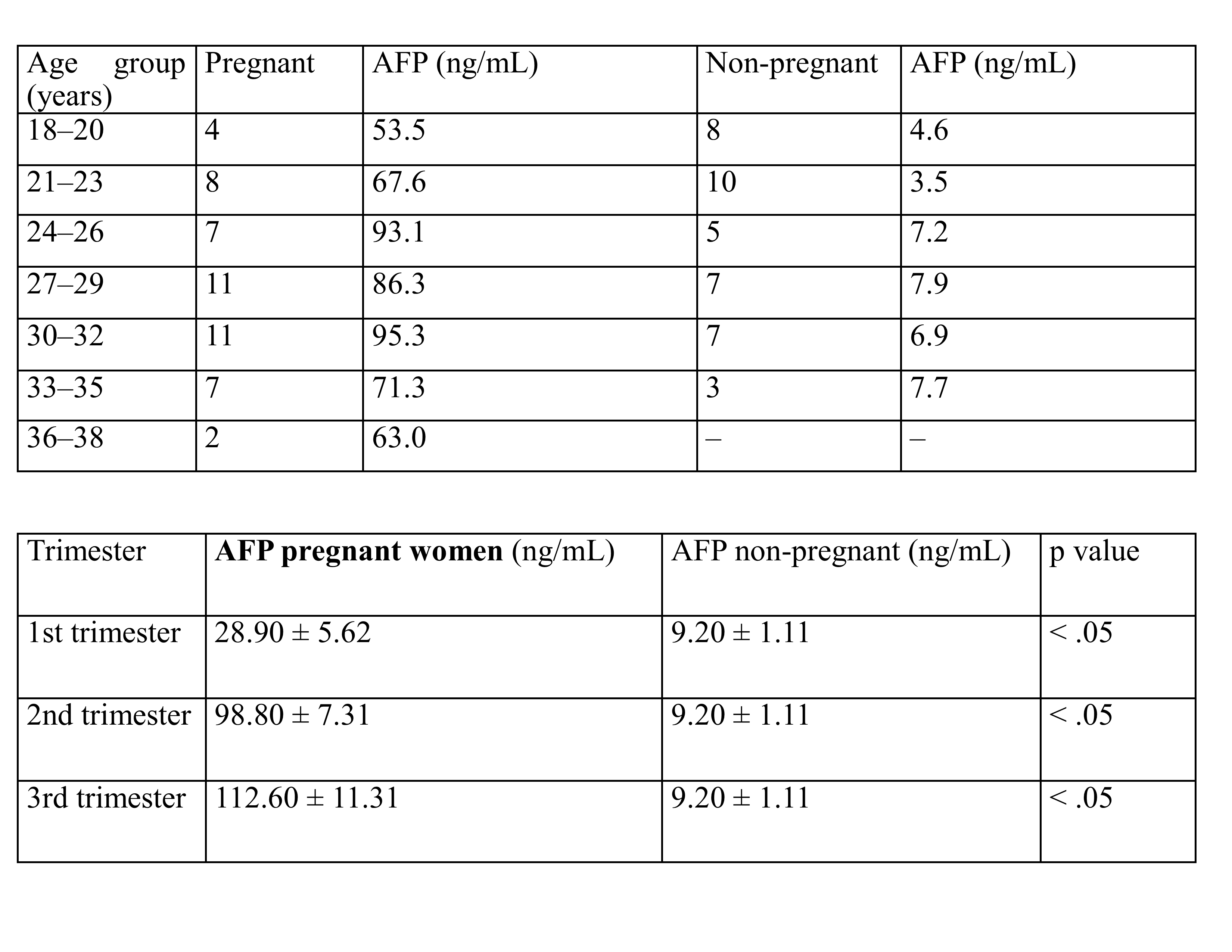
Alpha-fetoprotein (AFP) is a fetal-derived glycoprotein widely utilized in prenatal screening and increasingly recognized as a biomarker of placental integrity and fetal well-being. Despite its established clinical value, locally derived trimester-specific reference data remain limited in Nigeria. This study evaluated maternal serum AFP concentrations across different trimesters among pregnant women attending antenatal care at a tertiary hospital. A hospital-based cross-sectional study design was employed, involving 50 healthy pregnant women and 40 healthy non-pregnant women of reproductive age. Venous blood samples were collected, and serum AFP concentrations were measured using a standard immunoassay method. Gestational trimester was determined clinically using ultrasound scanning, and pregnant women were categorized into first, second, and third trimesters. AFP values were compared using one-way ANOVA with a significance threshold of p < 0.05. Serum AFP levels were markedly higher in pregnant women than in non-pregnant controls across all age categories (p < 0.05), while AFP values in controls remained low and relatively uniform. The concentrations of AFP increased gradually across the trimesters (28.90 ± 5.62 ng/mL in the first trimester, to 98.80 ± 7.31 ng/mL in the second trimester, and rose to 112.60 ± 11.31 ng/mL in the third trimester, (p < 0.05). The AFP levels in this study rose significantly with gestational age and are substantially elevated in pregnancy compared with non-pregnant women. These findings provide baseline trimester-specific AFP data for pregnant women at various trimesters and support the potential use of AFP as a locally interpretable biochemical marker for risk-stratification and screening during antenatal visits.
Downloads
Article Details

This work is licensed under a Creative Commons Attribution-NonCommercial-NoDerivatives 4.0 International License.
References
Aghaamoo, S., Lotfi, M., Mirmohammadkhani, M., & Hemmatian, M. N. (2021). Evaluation of second-trimester maternal serum AFP value in the detection of congenital heart defects. Middle East Journal of Rehabilitation and Health Studies, 8(4), e111917. https://doi.org/10.5812/mejrh.111917
Chen, Y., Chen, Y., Wang, X., Chu, X., Ning, W., Gu, L., Li, L., Xie, Z., & Wen, C. (2021). Second-trimester maternal serum D-dimer combined with alpha-fetoprotein and free β-subunit of human chorionic gonadotropin predict hypertensive disorders of pregnancy: A systematic review and retrospective case–control study. Journal of Translational Medicine, 19(1), 94. https://doi.org/10.1186/s12967-021-02718-4
Chen, Y., Ning, W., Wen, C., Gu, L., & Chu, X. (2025). Predictive value of the maternal alpha-fetoprotein variant, L2, during the first trimester of pregnancy screening for fetal trisomy 21, trisomy 18, and neural tube defects. BMC Pregnancy and Childbirth, 25(1), 844. https://doi.org/10.1186/s12884-025-07893-6
Dai, X., Zhang, H., Wu, B., Ning, W., Chen, Y., & Chen, Y. (2023). Correlation between elevated maternal serum alpha-fetoprotein and ischemic placental disease: A retrospective cohort study. Clinical and Experimental Hypertension, 45(1), 2175848. https://doi.org/10.1080/10641963.2023.2175848
Głowska-Ciemny, J., Szmyt, K., Kuszerska, A., Rzepka, R., von Kaisenberg, C., & Kocyłowski, R. (2024). Fetal and placental causes of elevated serum alpha-fetoprotein levels in pregnant women. Journal of Clinical Medicine, 13(2), 466. https://doi.org/10.3390/jcm13020466
Głowska-Ciemny, J., Szymański, M., Pankiewicz, J., Malewski, Z., von Kaisenberg, C., & Kocyłowski, R. (2023). Influence of selected factors on serum AFP levels in pregnant women in terms of prenatal screening accuracy: Literature review. Ginekologia Polska, 94(2), 158-166. https://doi.org/10.5603/GP.a2022.0148
Hu, Z., Liu, X., Li, L., Jia, C., Li, D., & Liu, R. (2014). Predictive value of abnormal second-trimester maternal serum triple screening markers for adverse pregnancy outcomes. Zhonghua Fu Chan Ke Za Zhi, 49(10), 749–753. https://pubmed.ncbi.nlm.nih.gov/25537246/
Liu, D., Kaplan, L. A., & Tolou, M. (2024). The effect of in-vitro fertilization procedures on alpha-fetoprotein levels in second-trimester screening for fetal defects. Obstetrics, Gynecology and Reproductive Sciences, 8(3). https://doi.org/10.31579/2578-8965/212
Ozdemir, S., Şahin, O., Acar, Z., Demir, G. Z., Ermin, E., & Aydın, A. (2022). Prediction of pregnancy complications with maternal biochemical markers used in Down syndrome screening. Cureus, 14(3), e23115. https://doi.org/10.7759/cureus.23115
Sovio, U., Gaccioli, F., Cook, E., Charnock-Jones, D. S., & Smith, G. C. S. (2023). Association between adverse pregnancy outcome and placental biomarkers in the first trimester: A prospective cohort study. BJOG: An International Journal of Obstetrics & Gynaecology, 130(12), 1567-1578. doi: 10.1111/1471-0528.17691.
Udeogu, C. H., Ugwu, M. C., Okwara, J., Ohale, A. C., Ike, O. C., Amadi, N., Ugwu, O., & Eguogwu, F. C. (2021). Levels of maternal serum alpha fetoprotein and beta human chorionic gonadotropin in HIV seropositive pregnant women attending antenatal care at Nnamdi Azikiwe University Teaching Hospital Nnewi, Nigeria. Journal of Advances in Medicine and Medical Research, 33(12), 32-38. DOI: 10.9734/JAMMR/2021/v33i1230939