

Highly Active Antiretroviral Therapy alters Serum Lipids and Hepatic Transaminases in HIV-Positive Adults: A Cross-Sectional Studym Enugu State University of Science and Technology Teaching Hospital, Nigeria
Article Sidebar
Main Article Content
Abstract
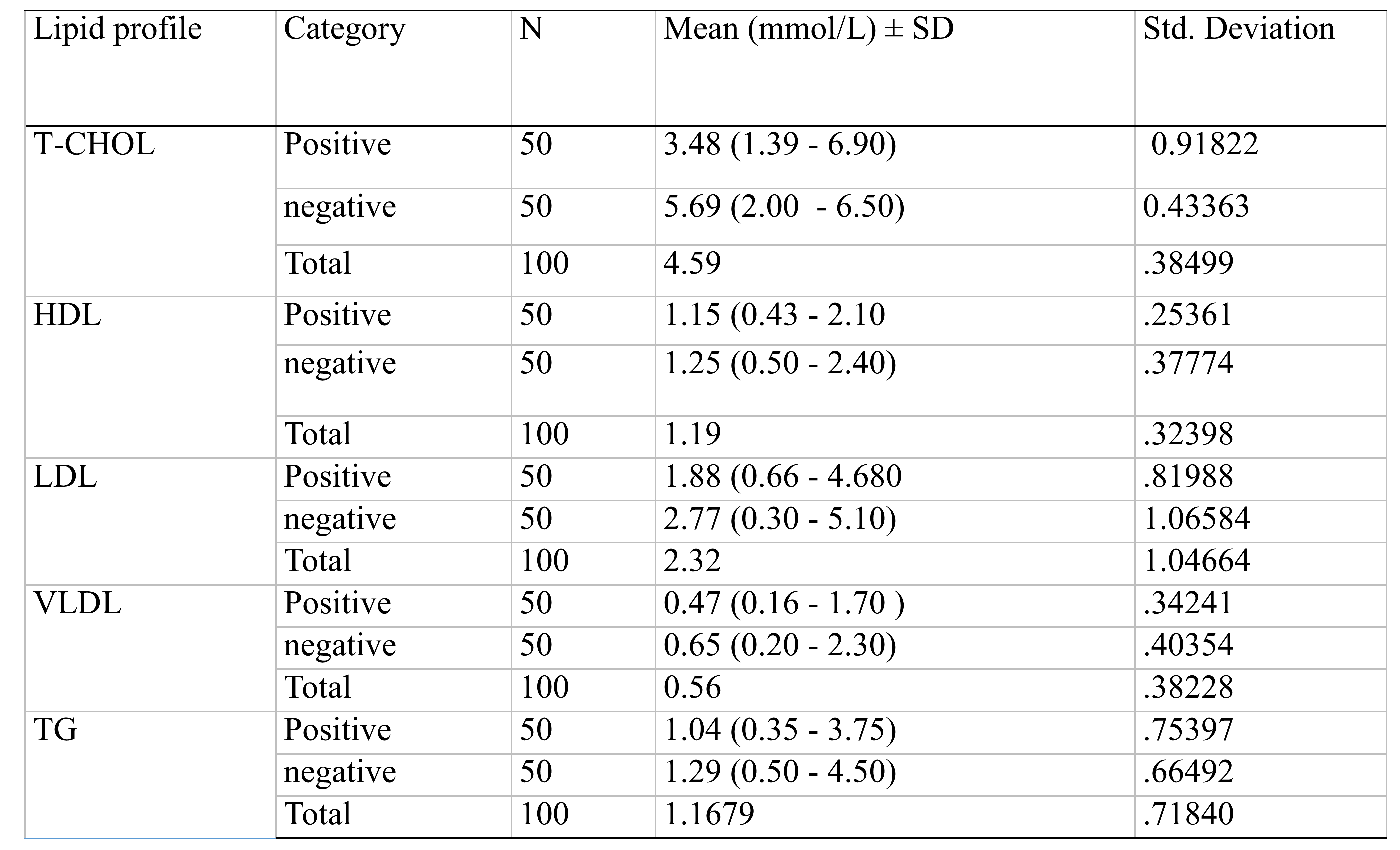
Globally, the advent of highly active antiretroviral therapy (HAART) has successfully transitioned HIV from a fatal diagnosis to a manageable chronic condition. However, long-term use of these drugs triggers metabolic and hepatic complications. This hospital-based cross-sectional study aimed to investigate the association of HAART with lipid profile alterations and hepatic transaminases among 50 HIV-positive adults undergoing first-line HAART regimen treatment (≥ 6 months) compared to 50 healthy HIV-negative controls at Enugu State University of Science and Technology (ESUT) Teaching Hospital, Nigeria. Fasting biochemical analysis revealed total cholesterol was significantly lower in patients on HAART compared to the control group (3.48 ± 0.92 mmol/L vs. 5.69 ± 0.43 mmol/L, p < 0.001), along with low-density lipoprotein cholesterol (LDL-C: 1.88 ± 0.82 mmol/L vs. 2.77 ± 1.07 mmol/L, p < 0.001) and very low-density lipoprotein cholesterol (VLDL-C: 0.47 ± 0.34 mmol/L vs. 0.65 ± 0.40 mmol/L, p = 0.023). Meanwhile, High-density lipoprotein cholesterol (HDL-C: 1.15 ± 0.25 mmol/L vs. 1.25 ± 0.38 mmol/L, p = 0.125) and triglycerides (1.04 ± 0.75 mmol/L vs. 1.29 ± 0.66 mmol/L, p = 0.081) remained statistically similar between groups (p > 0.05). Serum transaminases displayed a conflicting pattern where Alanine transaminase (ALT) levels were significantly lower in the HAART cohort compared to the control group (14.44 ± 4.80 IU/L vs. 22.46 ± 9.43 IU/L, p < 0.001). Conversely, aspartate transaminase (AST) levels were significantly higher in patients on HAART than the controls (28.52 ± 4.60 IU/L vs. 24.76 ± 8.10 IU/L, p = 0.005). Long-term HAART regimen in HIV-positive adults is associated with distinct lipid and transaminase profiles, underscoring the necessity of routine dual-transaminase and lipid monitoring during chronic care management.
Downloads
Article Details

This work is licensed under a Creative Commons Attribution-NonCommercial-NoDerivatives 4.0 International License.
References
Albers, J. J., Warnick, G. R., & Cheung, M. C. (1978). Quantitation of high-density lipoproteins. Lipids, 13(12), 926–932. https://doi.org/10.1007/BF02533852
Aloh, G. S., & Ozougwu, V. E. O. (2010). Glutathione and lipid peroxidation profiles of normal, G6PD-deficient and sickle erythrocytes exposed to oxidative stress. Bio-Research, 8(1), 579–582. https://doi.org/10.4314/br.v8i1.62534
Asmelash, A., Tesfay, W., & Weldegebreal, F. (2019). Liver enzyme elevation in patients taking HAART compared with treatment naïve controls at Debre Berhan Referral Hospital. BMC Research Notes, 12(1), Article 714. https://doi.org/10.1186/s13104-019-4756-x
Brunet, L., Marrone, G., & Harrison, L. (2021). Lipid changes after switching from tenofovir disoproxil fumarate to tenofovir alafenamide: A systematic review. AIDS Patient Care and STDs, 35(9), 341–349. https://doi.org/10.1089/apc.2021.0084
Chisati, E. M., Constantinou, D., & Lampiao, F. (2020). Mitochondrial and oxidative impacts of short and long-term administration of HAART on HIV patients. Biomedical Reports, 13(6), Article 61. https://doi.org/10.3892/br.2020.1368
Fossati, P., & Prencipe, L. (1982). Serum triglycerides determined enzymatically with an enzyme that produces a polychromatic dye. Clinical Chemistry, 28(10), 2077–2080. https://doi.org/10.1016/0009-8981(82)90223-4
Fredrickson, D. S., Levy, R. I., & Lees, R. S. (1967). Fat transport in lipoproteins—An integrated approach to mechanisms and disorders. New England Journal of Medicine, 276(1), 34–44. https://doi.org/10.1056/NEJM196701052760106
Friedewald, W. T., Levy, R. I., & Fredrickson, D. S. (1972). Estimation of the concentration of low-density lipoprotein cholesterol in plasma, without use of the preparative ultracentrifuge. Clinical Chemistry, 18(6), 499–502. https://doi.org/10.1093/clinchem/18.6.499
Gagliardini, R., Fabbiani, M., & De Luca, A. (2017). Impact of tenofovir disoproxil fumarate on proprotein convertase subtilisin/kexin type 9 (PCSK9) levels and low-density lipoprotein receptor recycling. Antiviral Therapy, 22(4), 315–322. https://doi.org/10.3851/IMP3110
Ikekpeazu, E. J., Neboh, E. E., & Ejezie, F. E. (2009). Serum transaminase activities in HIV-positive patients on highly active antiretroviral therapy (HAART). Biomedical Research, 20(3), 193–196.
Kalra, D. K., Vorla, M., Michos, E. D., Agarwala, A., Virani, S., Duell, P. B., & Raal, F. J. (2023). Dyslipidemia in human immunodeficiency virus disease: JACC review topic of the week. Journal of the American College of Cardiology, 82(2), 171–181. https://doi.org/10.1016/j.jacc.2023.04.050
Luciw, P. A. (1996). Human immunodeficiency viruses and their replication. In B. N. Fields, D. M. Knipe, & P. M. Howley (Eds.), Fields virology (3rd ed., pp. 1881–1952). Lippincott-Raven.
Muswe, R., Khan, S., & Marais, S. (2017). Systemic inflammation, cytokine profiles, and hepatocyte integrity in chronic viral infections. Cytokine, 96, 144–151. https://doi.org/10.1016/j.cyto.2017.04.008
Nguendo-Yongsi, H. B. (2021). Substance use, highly active antiretroviral therapy, and liver enzymes: Evidence from a cross-sectional study of HIV-infected adult patients without comorbidities on HAART in the University of Port Harcourt Teaching Hospital. Frontiers in Reproductive Health, 3, Article 664080. https://doi.org/10.3389/frph.2021.664080
Nwaka, A. C., & Uzoegwu, P. N. (2008). Comparison of serum concentrations of total cholesterol and total lipid in different groups of female tuberculosis patients. Bio-Research, 6(1), 323–327. https://doi.org/10.4314/br.v6i1.28616
Nwobodo, H. A., Ezeaku, J. I., Ude, D. I., & Onovo, O. F. (2025). Evaluation of liver enzymes among HIV positive individuals attending clinic at ESUT Teaching Hospital, Enugu State, Nigeria. World Journal of Advance Pharmaceutical Sciences, 2(2), 160–166.
Onyenekwu, C. P., Ebenezer, A. O., & Okpara, I. C. (2023). Lipids and apolipoproteins C-III and E among treatment-naïve and treatment-experienced persons with HIV in Nigeria. PLoS ONE, 18(11), e0294156. https://doi.org/10.1371/journal.pone.0294156
Ouyang, J., Zhang, R., Yi, X., Zhang, C., & Wang, L. (2020). Metabolic effects and lipid trajectories during transitions to dolutegravir-based regimens in developing health systems. Journal of the International AIDS Society, 23(8), e25590. https://doi.org/10.1002/jia2.25590
Reitman, S., & Frankel, S. (1957). A colorimetric method for the determination of serum glutamic oxalacetic and glutamic pyruvic transaminases. American Journal of Clinical Pathology, 28(1), 56–63. https://doi.org/10.1093/ajcp/28.1.56
Santos, J. R., Saumoy, M., & Podzamczer, D. (2017). Lipid-lowering effect and changes in estimated cardiovascular risk after switching to a tenofovir-containing regimen for the treatment of HIV-infected patients. Expert Opinion on Drug Safety, 16(2), 125–131. https://doi.org/10.1080/14740338.2017.1268192
Taramasso, L., Ricci, E., Di Biagio, A., Menzaghi, B., Orofino, G., Squillace, N., De Socio, G. V., Gulminetti, R., Madeddu, G., Quirino, T., & Bonfanti, P. (2021). Switch from tenofovir disoproxil fumarate to tenofovir alafenamide in people living with HIV: Lipid changes and statin underutilization. Microorganisms, 9(11), Article 2296. https://doi.org/10.3390/microorganisms9112296
UNAIDS. (2023). Fact sheet — Global HIV & AIDS statistics: 2023 epidemiological updates and regional analysis. Joint United Nations Programme on HIV/AIDS. https://www.unaids.org/en/resources/documents/2023/global-hiv-statistics