

Antidiarrheal and Lipid Profile Ameliorative Activity of a Bi-Herbal Aqueous (Plant) Extract on Castor Oil-Induced Diarrheal in Male Wistar Rats and Mice
Article Sidebar
Main Article Content
Abstract
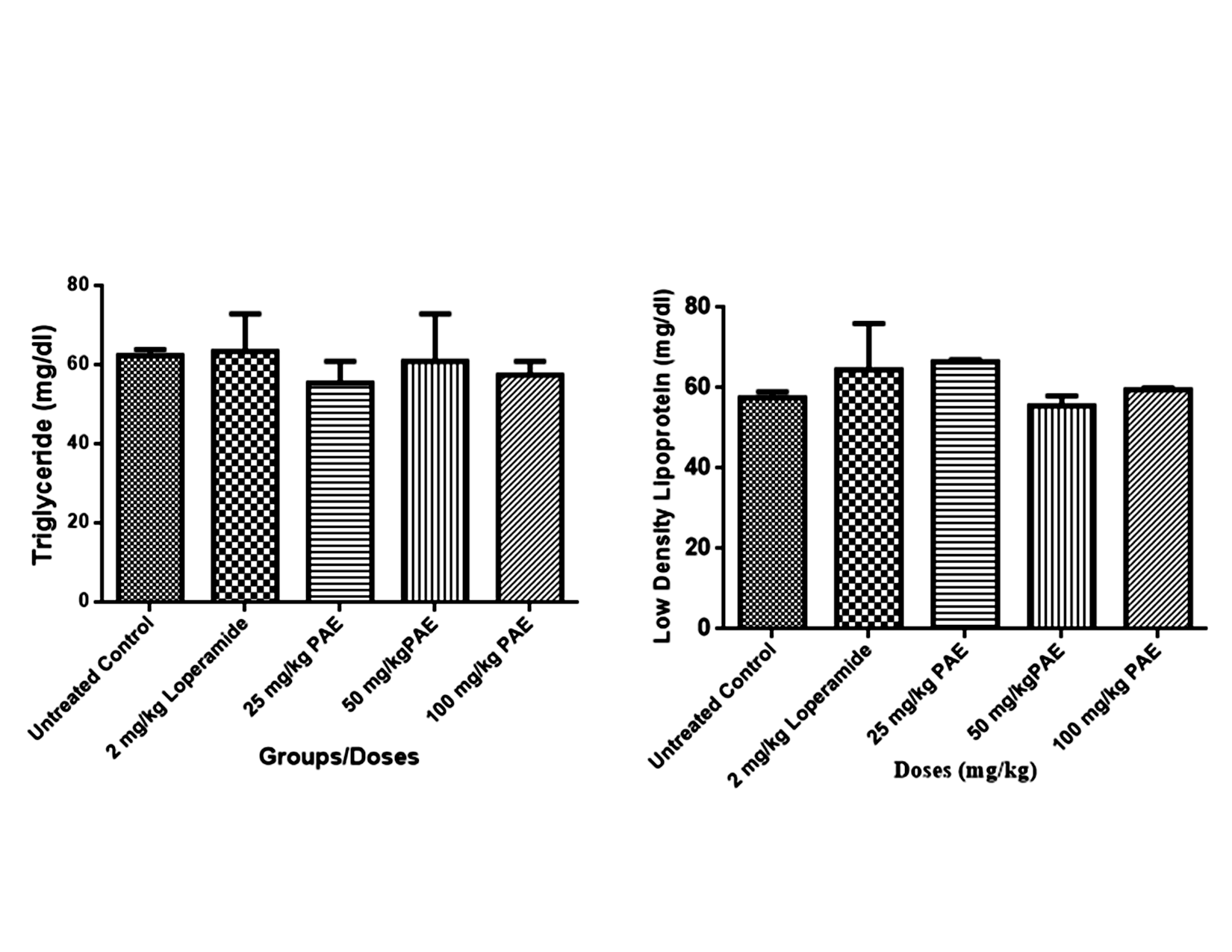
Natural remedies play a notable role in managing and treating numerous diseases. The growing interest in medicinal plants for managing a range of diseases has prompted investigations into their potential to treat diarrhoea and lower cholesterol levels. This work evaluated the effects of a bi-herbal extract from Ocimum gratissimum (scent leaf) and Psidium guajava (guava) on diarrhoea, lipid profile and acute toxicity response in adult male Wistar rats and mice. The tested animals were randomly assigned to five groups (n = 3). The bi-herbal extract was administered at 25 mg/kg (Group 3), 50 mg/kg (Group 4), and 100 mg/kg (Group 5), with 2 mg/kg loperamide (Group 2) and 0.5 ml/kg distilled water (Group 1) as controls. Diarrhoea was induced using castor oil and magnesium sulphate, and lipid parameters and anti-diarrhoeal activities were evaluated. The results indicated that the bi-herbal extract, particularly at 50 mg/kg, significantly reduced (p < 0.05) Total cholesterol and low-density lipoprotein levels compared to the controls. The acute toxicity study revealed no death or untoward effects up to 100 mg/kg. The effect of the bi-herbal extract on high-density lipoprotein levels (28.00 ± 1.00 mg/dL to 30.50 ± 5.50 mg/dL) did not differ significantly across groups (p > 0.05). The study also indicates that the bi-herbal aqueous extract displayed significant antidiarrheal activity, effectively reducing stool frequency and water content in both magnesium sulphate (MgSO4) and castor oil–induced diarrhea. In conclusion, it can be inferred that the bi-herbal extract possesses significant anti-diarrheal and hypolipidemic properties, effectively lowering key atherogenic lipids without toxicity.
Downloads
Article Details

This work is licensed under a Creative Commons Attribution-NonCommercial-NoDerivatives 4.0 International License.
References
Adegboye, M. F., Akinpelu, D. A. and Okoh, A. I. (2008). The bioactive and phytochemical properties of Garcinia kola (Heckel) seed extract on some pathogens. African Journal of Biotechnology, 7(21): 3934–3938. https://doi.org/10.5897/AJB08.586
Assemand, E., Camara, F., Kouame, F., Konan, V. and Kouame, L. P. (2012). Biochemical characterisation of the fruits of plantain (Musa paradisiaca L.) variety “Agnrin” fruits in Côte d’Ivoire and sensory evaluation of its derivatives. Journal of Applied Biosciences, 60: 4438–4444.
Barbalho, S. M., Farinazzi-Machado, F. M. V., de Alvares Goulart, R., Brunnati, A. C. S., Otoboni, A. M. M. B. and Nicolau, C. C. T. (2021). Psidium guajava (Guava): A plant of multipurpose medicinal applications. Medicinal & Aromatic Plants, 1(1): 1–10.
Castilla, P., Echarri, R., Dávalos, A., Cerrato, F., Ortega, H. et al. (2006). Concentrated red grape juice exerts antioxidant, hypolipidemic, and anti-inflammatory effects in both hemodialysis patients and healthy subjects. The American Journal of Clinical Nutrition, 84(1): 252–262. https://doi.org/10.1093/ajcn/84.1.252
CIOMS and ICLAS (2012). International guiding principles for biomedical research involving animals. Council for International Organization of Medical Sciences (CIOMS) and International Council for Laboratory Animal Science (ICLAS). Online-Available at: https://grants.nih.gov/grants/olaw/guiding_principles_2012.pdf Accessed 20 June 2024.
Erhabor, J.O., and Idu, M. (2017). Aphrodisiac potentials of the ethanol extract of Aloe barbadensis Mill. root in male Wistar rats. BMC Complement Alternative Medicine, 17: 360 (2017). https://doi.org/10.1186/s12906-017-1866-1.
Erhabor, J.O., and Idu, M. (2022). Toxicological evaluation of Aloe barbadensis root extracts in Wistar rats using Haematology and Lipid profile. Journal of Experimental Research 10(4): 239-249.
Díaz-De-Cerio, E., Verardo, V., Gómez-Caravaca, A. M., Fernández-Gutiérrez, A. and Segura-Carretero, A. (2017). Health effects of Psidium guajava L. leaves: An overview of the last decade. International Journal of Molecular Sciences, 18(4), 897. https://doi.org/10.3390/ijms18040897
Doherty, S. S. (1981). Inhibition of arachidonic acid release is the mechanism by which glucocorticoids inhibit endotoxin-induced diarrhoea. British Journal of Pharmacology, 73(3): 549–554.
Ezekwe, C. I., Okezie, U. and Onyeoziri, U. F. (2020). In vitro inhibitory effect of Ocimum gratissimum leaf extract on pancreatic lipase. Journal of Complementary and Alternative Medical Research, 11(4): 1–9.
Ference, B. A., Ginsberg, H. N., Graham, I., Ray, K. K., Packard, C. J., Bruckert, E., et al., (2017). Low-density lipoproteins cause atherosclerotic cardiovascular disease. European Heart Journal, 38(32), 2459–2472. https://doi.org/10.1093/eurheartj/ehx144
Friedewald WT, Levy RI, Fredrickson DS. Estimation of the concentration of low-density lipoprotein cholesterol in plasma, without use of the preparative ultracentrifuge. Clin Chem. 1972, 18;499-502. PubMed ID: 4337382
Galvez, J., Zarzuelo, A., Crespo, M. E., Lorente, M. D., Ocete, M. A. et al. (1993). Anti-diarrheal activity of Euphorbia hirta extract and isolation of an active flavonoid constituent. Planta Medica, 59(4): 333–336.
Hamilton, A. C. (2004). Medicinal plants, conservation and livelihoods. Biodiversity and Conservation, 13(8): 1477–1517.
Hermione, T. M., Armelle, T. M., Samuel, A. N. M., Armel-Joseph, D. A. and Victor, K. (2019). Evaluation of acute and subacute toxicities of Psidium guajava methanolic bark extract: A botanical with in vitro antiproliferative potential. Evidence-Based Complementary and Alternative Medicine, 2019: 8306986. https://doi.org/10.1155/2019/8306986
Kamboj, V. P. (2000). Herbal medicine. Current Science, 78(1): 35–39.
Lorke, D. (1983). A new approach to practical acute toxicity testing. Archives of Toxicology, 54(4): 275-287.
Magili, S. and Bwatanglang, I. (2018). Toxicity study of aqueous leaves extract of Jatropha gossypiifolia from Nigeria in albino rats: Serum biochemistry and histopathological evaluation. International Journal of Biochemistry Research and Review, 21(3): 1–12.
Murphy, K. J., Meyer, B. J., Mori, T. A., Burke, V., Mansour, J. et al. (2007). Impact of foods enriched with n-3 long-chain polyunsaturated fatty acids on erythrocyte n-3 levels and cardiovascular risk factors. British Journal of Nutrition, 97(4): 749–757. https://doi.org/10.1017/S0007114507433006
Odetola, A. A., Akinloye, O., Egunjobi, C., Adekunle, W. A. and Ayoola, A. O. (2006). Possible antidiabetic and antihyperlipidemic effect of fermented Parkia biglobosa (Jacq) extract in alloxan-induced diabetic rats. Clinical and Experimental Pharmacology and Physiology, 33(9): 808–812. https://doi.org/10.1111/j.1440-1681.2006.04451.x
Okwu, D. E. (2001). The role of medicinal plants in Nigeria’s health care delivery system. African Journal of Biotechnology, 9(12): 2710–2717.
Olowofela, O. F., Isimi, C. Y., Ochekpe, N. A. and Olorunfemi, P. O. (2020). Hepatoprotective and in vivo antioxidant activities of Ocimum gratissimum leaf extract in Wistar rats. Clinical Phytoscience, 6(1): 80. https://doi.org/10.1186/s40816-020-00223-7
Oluwole, O. G., Esan, A. M. and Ogunlana, O. O. (2022). Antimicrobial and antidiarrheal activities of Ocimum gratissimum leaf extract. Journal of Ethnopharmacology, 285: 114847. https://doi.org/10.1016/j.jep.2021.114847
Prabhu, K. S., Lobo, R. and Shirwaikar, A. A. (2021). Ocimum gratissimum: A review of its chemical constituents and pharmacological activities. Drug Invention Today, 15(1): 1–10.
Rifai, N., Joubran, R., Yu, H., Asmi, M. and Jouma, M. (1999). Inflammatory markers in men with angiographically documented coronary heart disease. Clinical Chemistry, 45(11): 1967–1973.
Rodrigues, E. and Barnes, J. (2013). Pharmacovigilance of herbal medicines: The potential contributions of ethnobotanical and ethnopharmacological studies. Drug Safety, 36(1): 1–12. https://doi.org/10.1007/s40264-012-0006-6
Rosenson, R. S., Davidson, M. H., Pourfarzib, R., and Underberg, J. A. (2020). Systematic review: Evaluating the effect of lipid-lowering therapies on lipoprotein subclasses. Journal of Clinical Lipidology, 14(5), 597–608. https://doi.org/10.1016/j.jacl.2020.06.004
Sekhar, C. N., Jayasree, T., Ubedulla, S., Dixit, R., Manohar, V. S. et al. (2014). Evaluation of antinociceptive activity of aqueous extract of bark of Psidium guajava in albino rats and albino mice. Journal of Clinical and Diagnostic Research, 8(9): HF01–HF04. https://doi.org/10.7860/JCDR/2014/10646.4844
Shabbir, H., Kausar, T., Noreen, S., Rehman, H., Hussain, A. et al. (2021). Phytochemical profiling and bioactivity of guava (Psidium guajava L.) leaf: A comprehensive review. Food Science & Nutrition, 9(10): 5419–5432. https://doi.org/10.1002/fsn3.2503
Shoba, F. G. and Thomas, M. (2001). Study of the antidiarrheal activity of some medicinal plants used in traditional medicine in Sri Lanka. Journal of Ethnopharmacology, 76(1): 73–76. https://doi.org/10.1016/S0378-8741(01)00207-4
Stewart, J. J., Gaginella, T. S. and Bass, P. (1975). Actions of ricinoleic acid and structurally related fatty acids on the gastrointestinal tract. I. Effects on smooth muscle contractility in vitro. The Journal of Pharmacology and Experimental Therapeutics, 195(2): 347–354.
Tilburt, J. C. and Kaptchuk, T. J. (2008). Herbal medicine research and global health: An ethical analysis. Bulletin of the World Health Organisation, 86(8): 594–599. https://doi.org/10.2471/blt.08.042820
Tirtha, S. (1998). Overview of Ayurveda. In: A. K. Khalsa and R. Paon (Eds.), Ayurveda Encyclopedia, Pp. 3–11.
Udenze, E. C. C., Braide, V. B., Okwesilieze, C. N. and Akuodor, G. C. (2012). Pharmacological effects of Garcinia kola seed powder on blood sugar, lipid profile and atherogenic index of alloxan-induced diabetes in rats. Pharmacologia, 3(12): 693–699.
Uddin, S. J., Shilpi, J. A., Alam, S. M. S., Alamgir, M., Rahman, M. T., and Sarker, S. D. (2005). Antidiarrhoeal activity of the methanol extract of the barks of Xylocarpus moluccensis in castor oil-and magnesium sulphate-induced diarrhoea models in mice. Journal of Ethnopharmacology, 101(1-3): 139-143.
Udo, I. A., Nna, V. U., Joshua, D. E. and Umoh, U. E. (2020). Ocimum gratissimum leaf extract ameliorates hyperglycemia and oxidative stress in alloxan-induced diabetic rats. Journal of Complementary and Integrative Medicine, 17(4): 20190114. https://doi.org/10.1515/jcim-2019-0114
Yakubu, M.T., Akanji, M.A., and Oladiji, A.T. (2005). Aphrodisiac potentials of the aqueous extract of Fadogia agresitis (Schweinf.Ex Hiern) stem in male albino rats. Asian Journal of Andrology, 7(4): 399-404.
Zhou, J., Ouedraogo, M., Qu, F. and Duez, P. (2013). Potential genotoxicity of traditional Chinese medicinal plants and phytochemicals: An overview. Phytotherapy Research, 27(12): 1745–1755. https://doi.org/10.1002/ptr.4942