

Screening of Rice Genotypes for Adaptability to Ferruginous Ultisol using Morphological, Physiological and Molecular Makers
Article Sidebar
Main Article Content
Abstract
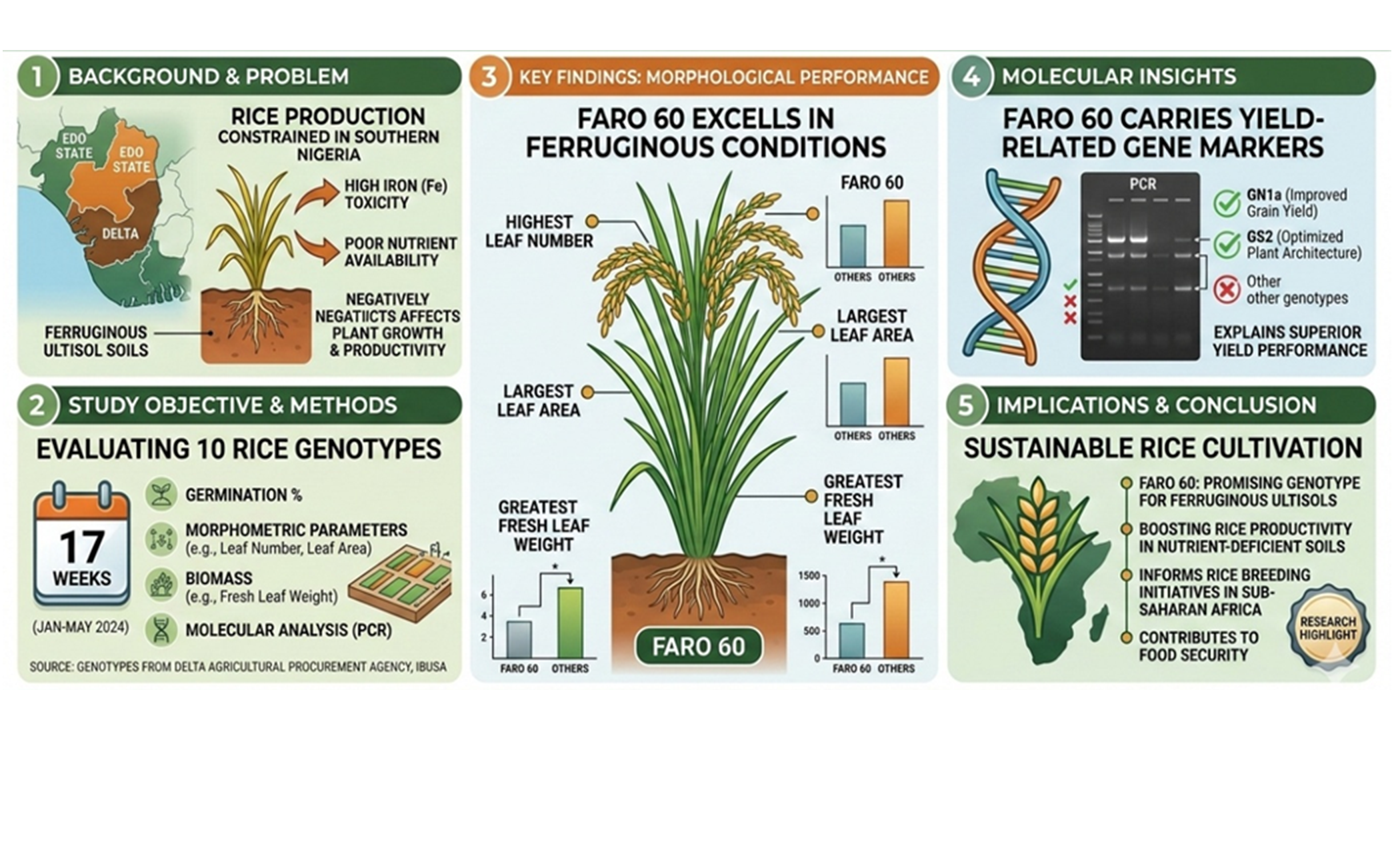
Rice production in many tropical regions is constrained by ferruginous ultisol soils characterized by high iron toxicity and poor nutrient availability, which negatively affect plant growth and productivity. Despite the prevalence of ferruginous soils in many rice-growing regions. Limited information exists on the adaptability and growth performance of different rice genotypes under such soil conditions. Therefore, this study evaluated 10 rice genotypes cultivated in ferruginous ultisol soils to identify varieties with superior adaptability based on morphological, physiological and molecular characteristics in Delta and Edo States, Nigeria. The selected genotypes were commonly grown in the region and were obtained from the Delta Agricultural Procurement Agency, Ibusa, Delta State. Rice seeds were grown for 17 weeks. Germination percentage, morphometric and biomass parameters of all the rice genotypes were assessed. Results revealed that FARO 60 consistently outperformed other genotypes in yield-related traits, including leaf number, leaf area and fresh leaf weight in ferruginous ultisol condition. Molecular analysis using PCR revealed that FARO 60 contained both GN1a and GS2 marker genes associated with improved grain yield and plant architecture. These findings underscore the significance of genotype selection for boosting rice productivity in nutrient-deficient soils and establish FARO 60 as a promising genotype for cultivation in ferruginous ultisols of Southern Nigeria. The results have broad implications for rice breeding initiatives focused on sustainability and food security in sub-Saharan Africa.
Downloads
Article Details

This work is licensed under a Creative Commons Attribution-NonCommercial-NoDerivatives 4.0 International License.
References
Africa Rice Center (AfricaRice). (2019). Annual Report: Toward rice-based food systems transformation in Africa. Abidjan, Côte d’Ivoire: 28 pp.
Bado, S., Bazongo, P., Son, G., Kyaw, M., Forster, B., Nielen, S., Lykke, A., Ouedraogo, A., Bassole, I. (2015). Physicochemical characteristics and composition ofthree morphotypes of Cyperus esculentus tubers and tuber oils. Journal of Annual Methods in Chemistry. 6(7): 35-47.
Bara’u, Y., Salaudeen, A., Gana, S., Anas, A., Mohammed, A., Makarfi, A. (2024). Evaluation of yield indices and identification of yield responsive genes (GN1a and GS3) of selected rice genotypes. Asian Journal of Biological Sciences. 17(4): 123-129.
Dang, F., Wang, L., Zhang, X. (2013). Quantitative trait loci for iron toxicity tolerance in rice. Euphytica. 191(12): 251-262.
Calicioglu, O., Flammini, A., Bracco, S., Bellu, L., Sims, R. (2019). The future challenges of food and crops: trends and solutions. Sustainability. 11: 22-29.
Fageria, N., dos-Santos, A., Coelho, A. (2011). Growth, yield and yield components of lowland rice as influenced by ammonium sulfate and urea fertilization. Journal of Plant Nutrition. 4: 371-386.
Fan, C., Xing, Y., Mao, H. Lu, T., Han, B. Xu, C. & Zhang, Q. (2016). GS2, a major QTL for grain length and weight, encodes a putative transmembrane protein. Theoretical and Applied Genetics. 112(6): 1164-1171.
FAO (2020). FAOSTAT. FAO. Food and Agriculture Organization of the United Nations, Rome, Italy.
Ikhajiagbe, B. & Musa, S. (2020a). Application of biosynthesized nanoparticles in the enhancement of growth and yield performances of rice (Oryza sativa var. Nerica) under salinity conditions in a ferruginous ultisol. FUDMA Journal of Science. 4(1): 120–132.
Ikhajiagbe, B. & Musa, S.I. (2020b). The effects of salicylic acid on the germination and early seedling growth of pigeon pea (Cajanus cajan). Notulae Sci. Biol. 12(3): 683–692.
Julian, S., Giso, P. & Holger, K. (2017). Leaf-IT: An android application for measuring leaf area. Ecology and Evolution. 7: 9731–9738.
Karim, K., Ifie, B., Dzidzienyo, D., Danquah, A. & Blay, C. (2020). Genetic characterization of cassava (Manihot esculenta Crantz) genotypes using agro-morphological and single nucleotide polymorphism markers. Physiol. Mol. Biol. Plants. 26: 317-330.
Khush, G. (2015). What it will take to feed 5.0 billion rice consumers in 2030. Plant Molecular Biology. 59(1): 1-6.
Korsakov, K., Stepanov, A., Pozdnyakov, L. & Yakimenko, O. (2023). Humate-coated urea as a tool for change soil properties. Agronomy. 13(2): 19-58.
Kumar, J., Singh, G. & Sharma, T. (2019). Screening of rice genotypes for iron toxicity tolerance. International Journal of Plant Physiology. 24(2): 123-132.
Liu, M., Song, F., Yin, Z., Chen, P., Zhang, Z., Qi, Z., Wang, B., Zheng, E. (2022). Effects of reduced nitrogen in Maize Fields in Mollisols in Northeast China: A 15N tracing study. Agronomy. 12(2): 30-43.
Monokrousos, N. & Mourouzidou, S. (2023). Ensuring plant nutrition through sustainable soil. Research Progress and Challenges. Agronomy. 13(1): 2061-2073.
Musa, S. & Ikhajiagbe. I. (2024). Evaluation of ppreviously isolated and characterized phosphate-solubilizing bacteria with plant growth-promoting potentials for rice grown in ferruginous ultisol Soil in Benin City, Edo State, Nigeria. Journal of Appllied Science and Environmental Management. Vol. 28 (12B Supplementary) 4393-4407 Dec. 2024.
Musa, S.I. & Ikhajiagbe B. (2020a). Screening bacterial isolates for phosphate Solubilizing capability in a ferruginous ultisol in Benin City, Edo State Nigeria. Bayero Journal of Pure Appllied Science. 13(2): 14–20.
Musa, S.I. & Ikhajiagbe, B. (2020b). Assessment of physicochemical properties of ferruginous ultisol in Benin City, Edo State – possible impact on plant distribution. Studia Univer. “Vasile Goldiş”, Ser. Ştiinţele Vieţii. 30(2): 88–95.
Musa, S.I. & Ikhajiagbe, B. (2023). Seed bio-priming with phosphate-solubilizing bacteria strains to improve rice (Oryza sativa L. var. FARO 44) growth under ferruginous ultisol conditions. Journal of Biotechnology, Computational Biology and Biotechnology. 104(1): 33-51.
Musa, S.I. & Ikhajiagbe, B. (2022). Rhizo-inoculation of phosphate solubilizing bacteria strains to improve rice (Oryza sativa L. var. FARO 44) growth under ferruginous ultisol conditions. Research Square. 10(3): 39-42.
Ojo, D., Oduwaye, O. & Ayo-Vaughan, M. (2019). Genetic variability and heritability of yield and yield components in rice (Oryza sativa L.). Nigerian Journal of Genetics. 25(1): 1-8.
Rossi, G., Beni, C., Benedetti, A., Felici, B. & Neri, U. (2023). Effect of mineral or OFMSW digestate food on leaching. Agronomy. 13(1): 1958-1967.
Singh, R., Singh, Y. & Singh, G. (2017). Rice breeding for improved yield and stress tolerance. Journal of Crop Science and Biotechnology. 20(2): 257-265.
TenHuf, M., Reinsch, T., Zutz, M., Essich, C., Ruser, R., Buchen-Tschiskale, C. & da Silva, J. (2023). Application techniques on ammonia emission and winter wheat yield. Agronomy. 12(2): 34-44.
Tubeileh, A., Alam-Eldein, S. & Banks, S. (2023). Effects of polymer-cpated urea/urea blends ob season conditions in Eastern Canada. Agronomy. 13(4): 695-712.
Wang, X., Deng, F. & Zhang, X. (2015). Physiological and molecular mechanisms of iron toxicity tolerance in rice. Plant and Soil. 397:(1-13).
Yang, A., Kumar, J. & Li, C. (2018). Iron uptake and utilization in rice: A review. Journal of Experimental Botany. 69(11): 2675-2685.
Zhao, M., Lin, Y. & Chen, H. (2020). Improving nutritional quality of rice for human health. Journal of Plant Biology. 12(2): 12-34.