

Molecular Characterization of Plastic Bio-Degrading Bacteria Isolated from River Ethiope Molecular Characterization of Plastic Bio-Degrading Bacteria
Article Sidebar
Main Article Content
Abstract
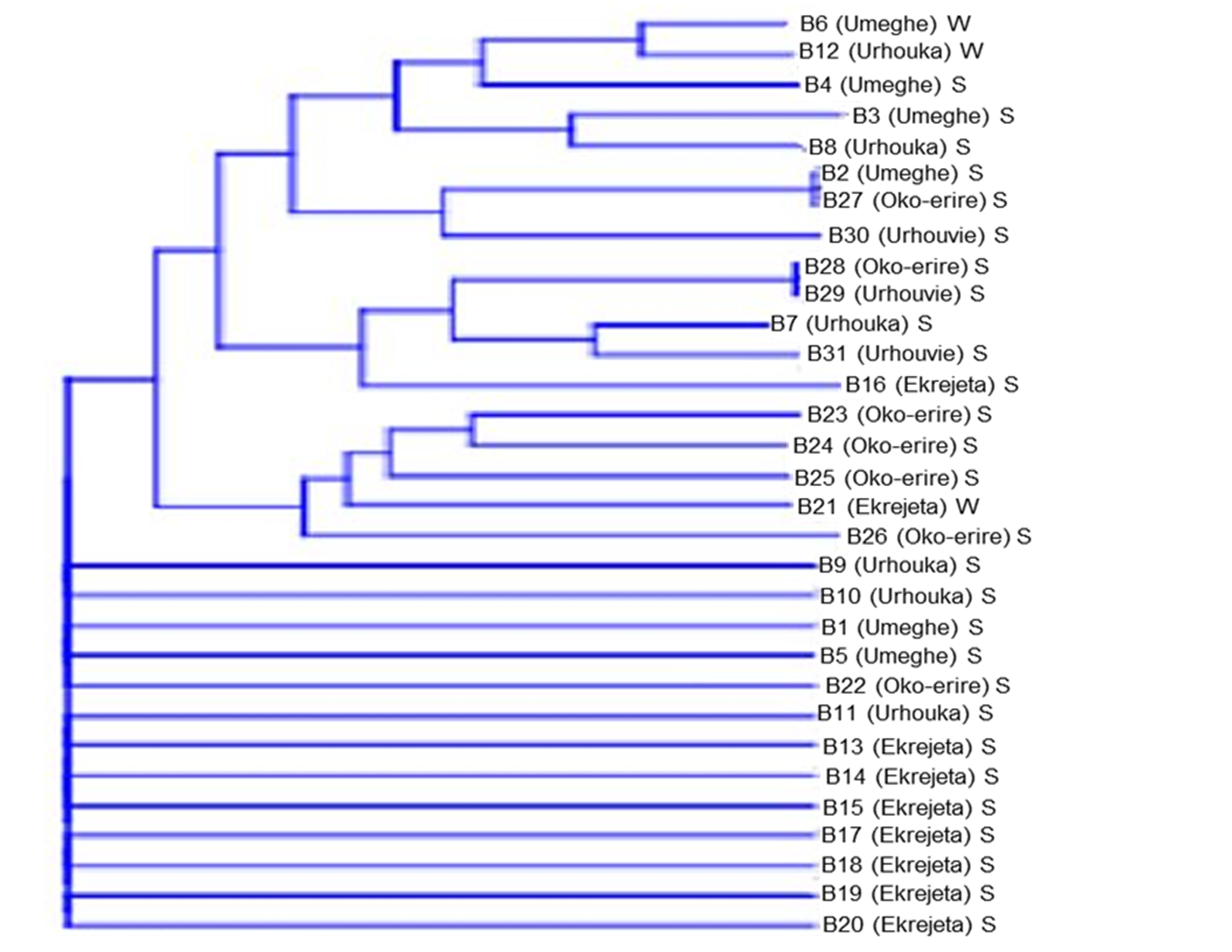
Plastic pollution is a global problem worsened by the widespread use and durability of plastics, affecting all levels of life. Many African nations, including Nigeria have initiated policies to reduce plastic pollution. This study investigates plastic biodegrading bacteria isolated from water and sediment samples collected from five locations (Umege, Urhouka, Ekrejeta, Oko-erire, Urhouvie) along river Ethiope in June 2023. Physicochemical analyses assessed parameters such as pH, total solids (TS), total dissolved solids (TDS), total suspended solids (TSS), biological oxygen demand (BOD), chemical oxygen demand (COD), dissolved oxygen (DO), nitrate, sulphate and selected heavy metals, additionally, DNA extracted from pure cultures of isolated bacteria were amplified with RAPD-PCR using primer OPA07 and selected molecularly identified isolates monitored for biodegradation of different plastic densities over a 35day period. Physicochemical results indicated water and sediment pH ranged from 5.3 to 5.9 and 5.8 to 6.4 respectively, with detectable levels of copper, iron and zinc while cadmium and lead were undetected in water samples. Random amplified polymorphic DNA-Polymerase chain reaction (RAPD-PCR) analysis revealed seven clades, of the thirty-one bacteria isolates, seven (22.58%) were putatively identified via 16S rRNA sequencing as Enterobacter bugandensis, Lysinibacillus cresolivorans, Kosakonia pseudosacchari, Bacillus weidmannii, Lysinibacillus sphaericus, Bacillus tropicus and Lysinibacillus tabacifolli demonstrated plastic degrading capabilities with Bacillus tropicus being the most effective. Further research could uncover innovative bioremediation strategies and identify additional plastic-degrading microorganisms from diverse genera or strains, aimed at combating and potentially eradicating plastic pollution globally.
Downloads
Article Details

This work is licensed under a Creative Commons Attribution-NonCommercial-NoDerivatives 4.0 International License.
References
Akpo, C.O. and Mukoro, J. (2020). Bacteriological and Physiochemical Analysis of Water from River Ethiope, Abraka. Sokoto Journal of Medical Laboratory Science, 5(1).
Ali, S.S., Elsamahy, T., Koutra, E., Kornaros, M., El-Sheekh, M., Abdelkarim, E.A., Zhu, D. and Sun, J. (2021). Degradation of conventional plastic wastes in the environment: A review on current status of knowledge and future perspectives of disposal. Science of the Total Environment, 771, 144719. doi: 10.1016/j.scitotenv.2020.144719.
Amobonye, A., Bhagwat, P., Singh, S. and Pillai, S. (2021). Plastic biodegradation: Frontline microbes and their enzymes. Science of the Total Environment, 759, 143536. doi: 10.1016/j.scitotenv.2020.143536.
Awasthi, S. K., Srivastava, P. K., Singh, P., Tiwary, R., Singh, S. K., Dwivedi, A., & Bajpai, V. K. (2022). Microbial degradation of plastics: Current status and future perspectives. Journal of Environmental Chemical Engineering, 10(4), 108086. doi: 10.1016/j.jece.2022.108086
Blair, J. and Mataraarachchi, S. (2021). A review of landfills, waste and the nearly forgotten nexus with climate change. Environments, 8(8): 73. doi: 10.3390/environments8080073.
Chokor, A.A. (2021). Impact of urban activities on the physicochemical characteristics and metals content of the Sapele section of the Benin-Ethiope river system, Delta State, Nigeria. Quest Journal of Research in Environmental and Earth Sciences, 7(3): 1-8.
Clarridge III, J.E. (2004). Impact of 16S rRNA gene sequence analysis for identification of bacteria on clinical microbiology and infectious diseases. Clinical microbiology reviews, 17(4): 840-862. doi: 10.1128/cmr.17.4.840-862.2004.
Costa, O.Y., Raaijmakers, J.M. and Kuramae, E.E. (2018). Microbial extracellular polymeric substances: ecological function and impact on soil aggregation. Frontiers in microbiology, 9: 1636. doi: 10.3389/fmicb.2018.01636.
Damayanti, N., Sulaiman, N. and Ibrahim, N. (2020). Plastic biodegradation of peseudomonas aeruginosa UKMCC1011 using a modified winogradsky column. Sci. Eng, 7, 43-49.
Das, M. P., & Kumar, S. (2015). Microbial degradation of plastic waste: A review. Journal of Biochemical Technology, 6(2), 952–961.
Dumbili, E. and Henderson, L. (2020). The challenge of plastic pollution in Nigeria. In Plastic waste and recycling. pp 569-583. Academic Press. doi: 10.1016/B978-0-12-817880-5.00022-0.
Felsenstein, J. (1985). Confidence limits on phylogenies: an approach using the bootstrap. evolution, 39(4), 783-791. doi: 10.1111/j.1558-5646.1985.tb00420.x.
Goodman, A.J., Walker, T.R., Brown, C.J., Wilson, B.R., Gazzola, V. and Sameoto, J.A. (2020). Benthic marine debris in the Bay of Fundy, eastern Canada: Spatial distribution and categorization using seafloor video footage. Marine pollution bulletin, 150, 110722. doi: 10.1016/j.marpolbul.2019.110722.
Gricajeva, A., Nadda, A.K. and Gudiukaite, R. (2022). Insights into polyester plastic biodegradation by carboxyl ester hydrolases. Journal of Chemical Technology & Biotechnology, 97(2), 359-380. doi: 10.1002/jctb.6745.
Kästner, M., Breuer-Jammali, M. and Mahro, B. (1994). Enumeration and characterization of the soil microflora from hydrocarbon-contaminated soil sites able to mineralize polycyclic aromatic hydrocarbons (PAH). Applied Microbiology and Biotechnology, 41, 267-273. doi: 10.1007/BF00186971.
Kumar, S., Manna, S., & Jana, M. (2021). Biodegradation of plastics: A microbial approach. Environmental Nanotechnology, Monitoring & Management, 15, 100433. doi: 10.1016/j.enmm.2021.100433
Kurniawan, T.A., Haider, A., Ahmad, H.M., Mohyuddin, A., Aslam, H.M.U., Nadeem, S., Javed, M., Othman, M.H.D., Goh, H.H. and Chew, K.W. (2023). Source, occurrence, distribution, fate, and implications of microplastic pollutants in freshwater on environment: A critical review and way forward. Chemosphere, 325: 138367. doi: 10.1016/j.chemosphere.2023.138367.
Lv, S., Li, Y., Zhao, S. and Shao, Z. (2024). Biodegradation of typical plastics: from microbial diversity to metabolic mechanisms. International Journal of Molecular Sciences, 25(1), 593. doi: 10.3390/ijms25010593.
Najar, I.N., Sharma, P., Das, R., Tamang, S., Mondal, K., Thakur, N., Gandhi, S.G. and Kumar, V. (2024). From waste management to circular economy: Leveraging thermophiles for sustainable growth and global resource optimization. Journal of Environmental Management, 360, 121136. doi: 10.1016/j.jenvman.2024.121136.
Navarro-Pérez, M.L., Fernández-Calderón, M.C. and Vadillo-Rodríguez, V. (2022). Decomposition of growth curves into growth rate and acceleration: a novel procedure to monitor bacterial growth and the time-dependent effect of antimicrobials. Applied and Environmental Microbiology, 88(3), e01849-21. doi: 10.1128/aem.01849-21.
Naveed, M., Naveed, R., Aziz, T., Azeem, A., Afzal, M., Waseem, M., Alharbi, M., Alshammari, A., Alasmari, A.F. and Albekairi, T. H. (2024). Biodegradation of PVCs through in-vitro identification of Bacillus albus and computational pathway analysis of ABH enzyme. Biodegradation, 1-18. doi: 10.1007/s10532-023-10064-z.
Nwafor, N. and Walker, T.R. (2020). Plastic Bags Prohibition Bill: A developing story of crass legalism aiming to reduce plastic marine pollution in Nigeria. Marine Policy, 120, 104160. doi: 10.1016/j.marpol.2020.104160.
Ojha, N., Pradhan, N., Singh, S., Barla, A., Shrivastava, A., Patra, K. C., & Panda, P. K. (2017). Evaluation of biodegradation of low-density polyethylene by Bacillus sp. and Pseudomonas sp. isolated from landfill soil. 3 Biotech, 7(2), 1–13. doi: 10.1007/s13205-017-0732-1
Oliveira, J., Belchior, A., da Silva, V.D., Rotter, A., Petrovski, Ž., Almeida, P.L., Lourenço, N.D. and Gaudêncio, S.P. (2020). Marine environmental plastic pollution: mitigation by microorganism degradation and recycling valorization. Frontiers in Marine Science, 7, 567126. doi: 10.3389/fmars.2020.567126.
Priya, A., Dutta, K. and Daverey, A. (2022). A comprehensive biotechnological and molecular insight into plastic degradation by microbial community. Journal of Chemical Technology & Biotechnology, 97(2), 381-390. doi: org/10.1002/jctb.6675.
Qin, Z.H., Mou, J.H., Chao, C.Y.H., Chopra, S.S., Daoud, W., Leu, S.Y., Ning, Z., Tso, C.Y., Chan, C.K., Tang, S. and Hathi, Z.J. (2021). Biotechnology of plastic waste degradation, recycling, and valorization: Current advances and future perspectives. ChemSusChem, 14(19), 4103-4114. doi: 10.1002/cssc.202100752.
Skariyachan, S., Manjunath, M., Sultana, S., Jois, C., Bai, V. S., & Vasist, K. S. (2017). Novel bacterial consortia isolated from plastic garbage processing sites demonstrate enhanced degradation for low-density polyethylene. Journal of Hazardous Materials, 348, 109–120. doi: 10.1016/j.jhazmat.2017.03.024
Sunday, J.J., Spencer, N.C., Kingsley, O., Edet, A.O. and Amaka, D.D. (2014). Physico-chemical and microbiological properties of water samples used for domestic purposes in Okada town, Edo state, Nigeria. International Journal of Current Microbiology Applied Science, 3(6), 886-894.
Tamura, K. and Nei, M. (1993). Estimation of the number of nucleotide substitutions in the control region of mitochondrial DNA in humans and chimpanzees. Molecular biology and evolution, 10(3), 512-526. doi: 10.1093/oxfordjournals.molbev.a040023.
Tamura, K., Stecher, G. and Kumar, S. (2021). MEGA11: molecular evolutionary genetics analysis version 11. Molecular biology and evolution, 38(7), 3022-3027. doi: 10.1093/molbev/msab120.
Uchida, H., Nakajima-Kambe, T., Shigeno-Akutsu, Y., Nomura, N., Tokiwa, Y. and Nakahara, T. (2000). Properties of a bacterium which degrades solid poly (tetramethylene succinate)-co-adipate, a biodegradable plastics. FEMS microbiology letters, 189(1), 25-29. doi: 10.1111/j.1574-6968.2000.tb09201.x.
World Health Organization. (2021). Guidelines for drinking-water quality: Fourth edition incorporating the first and second addenda. Geneva: World Health Organization.
World Health Organization. (2022). Guidelines for drinking-water quality: Fourth edition incorporating the first and second addenda. Geneva: World Health Organization.
Wu, Z., Shi, W., Valencak, T. G., Zhang, Y., Liu, G. and Ren, D. (2023). Biodegradation of conventional plastics: Candidate organisms and potential mechanisms. Science of the Total Environment, 885, 163908. doi: 10.1016/j.scitotenv.2023.163908.
Zhang, Y., Pedersen, J.N., Eser, B.E. and Guo, Z. (2022). Biodegradation of polyethylene and polystyrene: From microbial deterioration to enzyme discovery. Biotechnology Advances, 60, 107991. doi: 10.1016/j.biotechadv.2022.107991.
Zhang, Y., Zhang, H., Zhang, Z., Liu, C., Sun, C., Zhang, W. and Marhaba, T. (2018). pH effect on heavy metal release from a polluted sediment. Journal of Chemistry, 2018(1), 7597640. doi: 10.1155/2018/7597640.