

In silico exploration and identification of key bioactive compounds of the molecular targets of Piper guineense in colon cancer through network pharmacology, and molecular docking
Article Sidebar
Main Article Content
Abstract
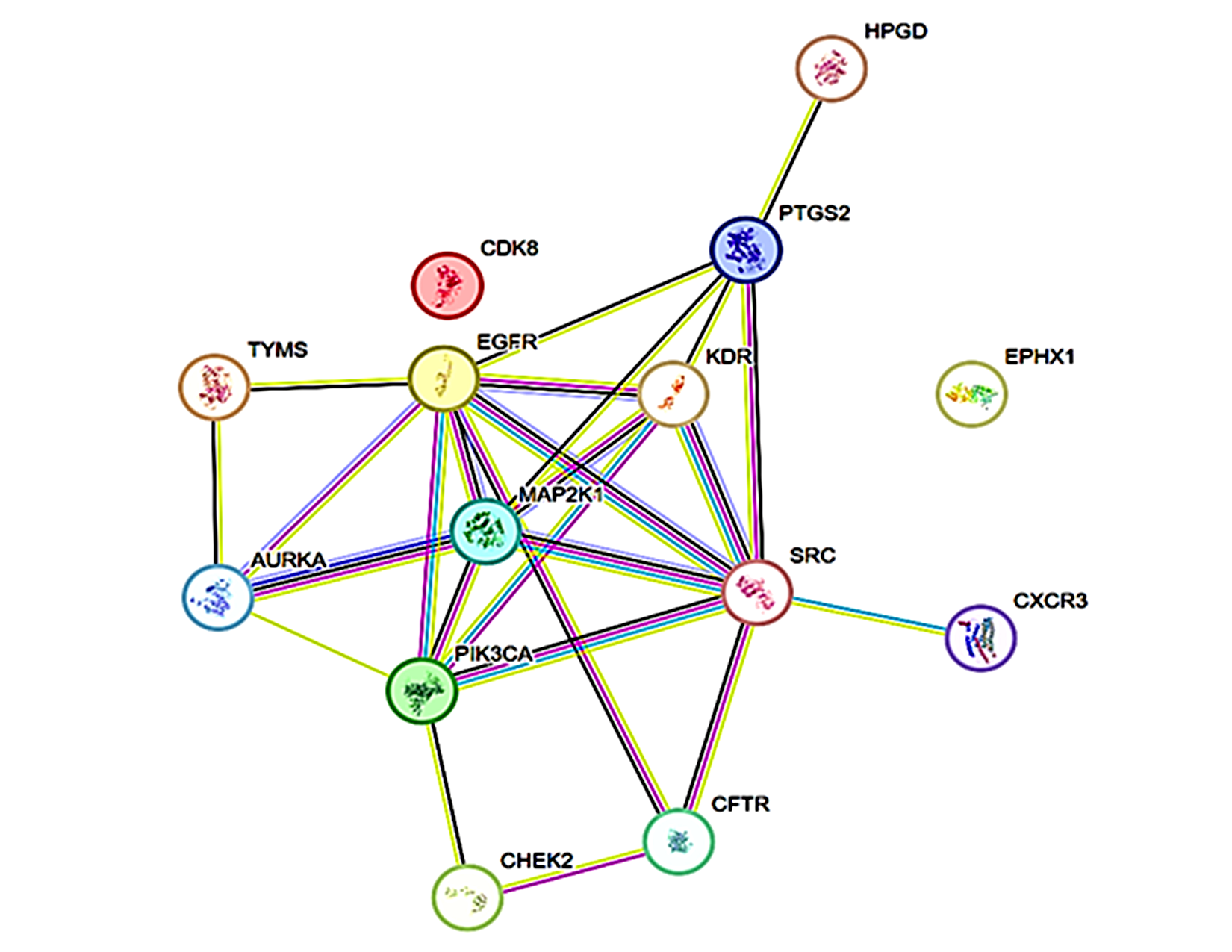
Colon cancer is a severe and rapidly progressing disease that represents a substantial global health challenge. Piper guineense is a plant with anticancer potential that requires experimental validation; however, its molecular mechanisms against colon cancer remain poorly understood. This research utilized a network pharmacology approach combined with molecular docking to explore possible therapeutic mechanisms. The bioactive compounds were identified using gas chromatography–mass spectrometry (GC–MS). Colon cancer–related genes were obtained from the GeneCards and DisGeNET databases, while predicted targets of the identified compounds were generated through SwissTarget Prediction. Overlapping targets between compounds and disease genes were identified and used to construct protein–protein interaction network via STRING. The network was visualized in Cytoscape, hub genes were screened using CytoHubba, and functional enrichment analysis was conducted using Gene Ontology and KEGG pathway databases. Molecular docking was performed using PyRx software. A total of 21 compounds from GC-MS corresponding to 452 non-redundant targets were identified, and 7,332 colon cancer targets were obtained from the databases. Five hub genes were identified as key targets: EGFR, MAP2K1, SRC, KDR, and PIK3CA. Molecular docking analysis demonstrated that α-selinene bound to EGFR, MAP2K1, SRC, and PIK3CA with docking scores of −7.6, −7.7, −5.1, and −7.5 kcal/mol, respectively, while β-selinene had scores of −7.5, −7.7, −5.4, and −7.6 kcal/mol with the same targets. β-humulene exhibited a strong docking score of −8.7 kcal/mol towards KDR. The α and β-selinene, and humulene showed better docking scores in comparison with 5-fluorouracil, which contributes to its anticancer potential.
Downloads
Article Details

This work is licensed under a Creative Commons Attribution-NonCommercial-NoDerivatives 4.0 International License.
References
Akubugwo, E. I., Emmanuel, O., Ekweogu, C. N., Ugbogu, O. C., Onuorah, T. R., Egeduzu, O. G. and Ugbogu, E. A. (2022). GC-MS Analysis of the Phytochemical Constituents, Safety Assessment, Wound Healing and Anti-Inflammatory Activities of Cucurbita pepo Leaf Extract in Rats. Scientia Pharmaceutica, 90(4), 64. https://doi.org/10.3390/scipharm90040064
Alajangi, H. K., Kaur, M., Sharma, A., Rana, S., Thakur, S., Chatterjee, M., Singla, N., Jaiswal, P. K., Singh, G. and Barnwal, R. P. (2022). Blood–brain barrier: emerging trends on transport models and new-age strategies for therapeutics intervention against neurological disorders. Molecular Brain, 15(1), 49. https://doi.org/10.1186/s13041-022-00937-4
Attia, M. S., Elsebaey, M. T., Yahya, G., Chopra, H., Marzouk, M. A., Yahya, A. and Abdelkhalek, A. S. (2023). Pharmaceutical polymers and P-glycoprotein: Current trends and possible outcomes in drug delivery. Materials Today Communications, 34, 105318. https://doi.org/10.1016/j.mtcomm.2023.105318
Bansod, S., Saifi, M. A. and Godugu, C. (2021). Molecular updates on berberine in liver diseases: bench to bedside. Phytotherapy Research, 35(10), 5459-5476. https://doi.org/10.1002/ptr.7181
Chen, H., Yuan, J., Hao, J., Wen, Y., Lv, Y., Chen, L. and Yang, X. (2019). α-Humulene inhibits hepatocellular carcinoma cell proliferation and induces apoptosis through the inhibition of Akt signaling. Food and Chemical Toxicology, 134, 110830. https://doi.org/10.1016/j.fct.2019.110830
Chen, J. F., Wu, S. W., Shi, Z. M., Qu, Y. J., Ding, M. R. and Hu, B. (2023). Exploring the components and mechanism of Solanum nigrum L. for colon cancer treatment based on network pharmacology and molecular docking. Frontiers in oncology, 13, 1111799. https://doi.org/10.3389/fonc.2023.1111799
Chen, J. S., Enwolo-Chibueze, C. G., Chinyama, H. A., Lai, C. T., Ezeala, I. C., Huang, P. Y. and Huang, Y. J. (2025). Integrated In Silico and Experimental Validation of Antrocin as a Plant-Derived Multi-Target Therapeutic for BRAF/MEK/PI3K-Driven Colorectal Cancer. International journal of molecular sciences, 26(18), 8780. https://doi.org/10.3390/ijms26188780
Chike-Ekwughe, A., Abdulameed, H. T., Adebayo-Gege, G. I., Usman, A., Omoyungbo, E. J., Ala, A. A. and Johnson, T. O. (2025). Molecular modeling of the interactions of compounds of Irvinga wombulu against dihydrofolate reductase-thymidylate synthase in Plasmodium falciparum towards development of anti-malarial drug. In Silico Pharmacology, 13(1), 31. https://doi.org/10.1007/s40203-025-00317-5
Daina, A., Michielin, O. and Zoete, V. (2017). SwissADME: a free web tool to evaluate pharmacokinetics, drug-likeness and medicinal chemistry friendliness of small molecules. Scientific reports, 7(1), 42717. https://doi.org/10.1038/srep42717
Dey, D., Hossain, R., Biswas, P., Paul, P., Islam, M. A., Ema, T. I., Gain, B. K., Hasan, M. M., Bibi, S., Islam, M. T., Rahman, M. A. and Kim, B. (2023). Amentoflavone derivatives significantly act towards the main protease (3CLPRO/MPRO) of SARS-CoV-2: in silico admet profiling, molecular docking, molecular dynamics simulation, network pharmacology. Molecular Diversity, 27(2), 857–871. https://doi.org/10.1007/s11030-022-10459-9
Fakih, M. G., Salvatore, L., Esaki, T., Modest, D. P., Lopez-Bravo, D. P., Taieb, J., Karamouzis, M. V., Ruiz-Garcia, E., Kim, T.-W., Kuboki, Y., Meriggi, F., Cunningham, D., Yeh, K.-H., Chan, E., Chao, J., Saportas, Y., Tran, Q., Cremolini, C. and Pietrantonio, F. (2023). Sotorasib plus Panitumumab in Refractory Colorectal Cancer with Mutated KRAS G12C . New England Journal of Medicine, 389(23), 2125–2139. https://doi.org/10.1056/nejmoa2308795
Gelibter, A. J., Caponnetto, S., Urbano, F., Emiliani, A., Scagnoli, S., Sirgiovanni, G. and Cortesi, E. (2019). Adjuvant chemotherapy in resected colon cancer: When, how and how long?. Surgical Oncology, 30, 100-107. https://doi.org/10.1016/j.suronc.2019.06.003
Gupta, P. K., Pal, Y., Kumar, P., Gupta, S., Singh, S. D. and Tiwari, S. B. (2024). A Critical Review on Computational Techniques through in silico Assisted Drug Design. International Journal of Pharmaceutical Investigation, 14(4), 1035–1041. https://doi.org/10.5530/ijpi.14.4.113
Gupta, R., Bhatt, L. K., Johnston, T. P. and Prabhavalkar, K. S. (2019). Colon cancer stem cells: Potential target for the treatment of colorectal cancer. Cancer biology & therapy, 20(8), 1068-1082. https://doi.org/10.1080/15384047.2019.1599660
He, Q., Liu, C., Wang, X., Rong, K., Zhu, M., Duan, L. and Mi, Y. (2023). Exploring the mechanism of curcumin in the treatment of colon cancer based on network pharmacology and molecular docking. Frontiers in pharmacology, 14, 1102581. https://doi.org/10.3389/fphar.2023.1102581
Jin, W. (2020). Regulation of Src family kinases during colorectal cancer development and its clinical implications. Cancers, 12(5), 1339. https://doi.org/10.3390/cancers12051339
Kumar, S., Ali, I., Abbas, F., Khan, N., Gupta, M. K., Garg, M., Kumar, S. and Kumar, D. (2023). In-silico identification of small molecule benzofuran-1,2,3-triazole hybrids as potential inhibitors targeting EGFR in lung cancer via ligand-based pharmacophore modeling and molecular docking studies. In Silico Pharmacology, 11(1). https://doi.org/10.1007/s40203-023-00157-1
Lu, X., Li, Y., Li, Y., Zhang, X., Shi, J., Feng, H. and Gao, Y. (2023). Prognostic and predictive biomarkers for anti-EGFR monoclonal antibody therapy in RAS wild-type metastatic colorectal cancer: a systematic review and meta-analysis. BMC cancer, 23(1), 1117. https://doi.org/10.1186/s12885-023-11600-z
Mir, W. R., Bhat, B. A., Kumar, A., Dhiman, R., Alkhanani, M., Almilaibary, A., Dar, M. Y., Ganie, S. A. and Mir, M. A. (2023). Network pharmacology combined with molecular docking and in vitro verification reveals the therapeutic potential of Delphinium roylei munz constituents on breast carcinoma. Frontiers in Pharmacology, 14, 1135898. https://doi.org/10.3389/fphar.2023.1135898
Mukhtar, M., Khan, H. A. and Zaidi, N. us S. S. (2023). Exploring the inhibitory potential of Nigella sativa against dengue virus NS2B/NS3 protease and NS5 polymerase using computational approaches. RSC Advances, 13(27), 18306–18322. https://doi.org/10.1039/d3ra02613b
Nafisah, W., Fatchiyah, F., Widyananda, M. H., Christina, Y. I., Rifa’I, M., Widodo, N. and Djati, M. S. (2022). Potential of bioactive compound of Cyperus rotundus L. rhizome extract as inhibitor of PD-L1/PD-1 interaction: An in silico study. Agriculture and Natural Resources, 56(4), 751–760. https://doi.org/10.34044/J.ANRES.2022.56.4.09
Nag, A., Dhull, N. and Gupta, A. (2023). Evaluation of tea (Camellia sinensis L.) phytochemicals as multi-disease modulators, a multidimensional in silico strategy with the combinations of network pharmacology, pharmacophore analysis, statistics and molecular docking. Molecular Diversity, 27(1), 487–509. https://doi.org/10.1007/s11030-022-10437-1
Ogbonna, C. N., Nozaki, K, Yajima, and H. (2013). Antimicrobial activity of Xylopia aethiopica, Aframomum melegueta and Piper guineense ethanolic extracts and the potential of using Xylopia aethiopica to preserve fresh orange juice. African Journal of Biotechnology, 12(16), 1993–1998. https://doi.org/10.5897/ajb2012.2938
Ojimelukwe, P. C. (2023). Piper guineense-an underutilized aromatic spice with medicinal value. Advances in Traditional Medicine, 23(2), 381-392. https://doi.org/10.1007/s13596-021-00586-3
Qamar, F., Sana, A., Naveed, S. and Faizi, S. (2023). Phytochemical characterization, antioxidant activity and antihypertensive evaluation of Ocimum basilicum L. in L-NAME induced hypertensive rats and its correlation analysis. Heliyon, 9(4). https://doi.org/10.1016/j.heliyon.2023.e14644
Rodina, A., Xu, C., Digwal, C. S., Joshi, S., Patel, Y., Santhaseela, A. R., Bay, S., Merugu, S., Alam, A., Yan, P., Yang, C., Roychowdhury, T., Panchal, P., Shrestha, L., Kang, Y., Sharma, S., Almodovar, J., Corben, A., Alpaugh, M. L. and Chiosis, G. (2023). Systems-level analyses of protein-protein interaction network dysfunctions via epichaperomics identify cancer-specific mechanisms of stress adaptation. Nature communications, 14(1), 3742. https://doi.org/10.1038/s41467-023-39241-7
Roney, M., & Aluwi, M. F. F. M. (2024). The importance of in-silico studies in drug discovery. Intelligent Pharmacy, 2(4), 578-579. KeAi Publishing Communications Ltd. https://doi.org/10.1016/j.ipha.2024.01.010
Saganuwan, S. A. (2017). Toxicity studies of drugs and chemicals in animals: an overview. Bulgarian Journal of Veterinary Medicine, 20(4). https://doi.org/10.15547/bjvm.983
Salehi, B., Zakaria, Z. A., Gyawali, R., Ibrahim, S. A., Rajkovic, J., Shinwari, Z. K., Khan, T., Sharifi-Rad, J., Ozleyen, A., Turkdonmez, E., Valussi, M., Tumer, T. B., Fidalgo, L. M., Martorell, M. and Setzer, W. N. (2019). Piper species: A comprehensive review on their phytochemistry, biological activities and applications. Molecules, 24(7), 1364. https://doi.org/10.3390/molecules24071364
Shahid, A., Khan, K. ur R., Rao, H., Aati, H. Y., Sherif, A. E., Khan, D. A., Basit, A., Umair, M., Mueed, A., Esatbeyoglu, T. and Korma, S. A. (2023). Phytochemical profiling of the ethanolic extract of Zaleya pentandra L. Jaffery and its biological activities by in-vitro assays and in-silico molecular docking. Applied Sciences, 13(1), 584. https://doi.org/10.3390/app13010584
Shahzadi, Z., Yousaf, Z., Anjum, I., Bilal, M., Yasin, H., Aftab, A., Booker, A., Ullah, R. and Bari, A. (2024). Network pharmacology and molecular docking: combined computational approaches to explore the antihypertensive potential of Fabaceae species. Bioresources and Bioprocessing, 11(1), 53. https://doi.org/10.1186/s40643-024-00764-6
Siddiqui, S., Upadhyay, S., Ahmad, R., Gupta, A., Srivastava, A., Trivedi, A., Husain, I., Ahmad, B., Ahamed, M. and Khan, M. A. (2022). Virtual screening of phytoconstituents from miracle herb nigella sativa targeting nucleocapsid protein and papain-like protease of SARS-CoV-2 for COVID-19 treatment. Journal of Biomolecular Structure and Dynamics, 40(9), 3928–3948. https://doi.org/10.1080/07391102.2020.1852117
Sulaimon, L. A., Anise, E. O., Obuotor, E. M., Samuel, T. A., Moshood, A. I., Olajide, M. and Fatoke, T. (2020). In vitro antidiabetic potentials, antioxidant activities and phytochemical profile of african black pepper (Piper guineense). Clinical Phytoscience, 6(1), 90. https://doi.org/10.1186/s40816-020-00236-2
Sung, H., Ferlay, J., Siegel, R. L., Laversanne, M., Soerjomataram, I., Jemal, A. and Bray, F. (2021). Global Cancer Statistics 2020: GLOBOCAN Estimates of Incidence and Mortality Worldwide for 36 Cancers in 185 Countries. CA: A Cancer Journal for Clinicians, 71(3), 209–249. https://doi.org/10.3322/caac.21660
Tabassum, S., Khalid, H. R., Ul Haq, W., Aslam, S., Alshammari, A., Alharbi, M., Riaz Rajoka, M. S., Khurshid, M. and Ashfaq, U. A. (2022). Implementation of System Pharmacology and Molecular Docking Approaches to Explore Active Compounds and Mechanism of Ocimum Sanctum against Tuberculosis. Processes, 10(2), 298. https://doi.org/10.3390/pr10020298
Taheri, M., Rezaei, F. M., Hashemzadeh, S., Gavgani, R. R., Feizi, M. H., Pouladi, N., Kafil, H. S., Rostamizadeh, L., Oskooei, V. K. and Sakhinia, E. (2019). Dysregulated KDR and FLT1 gene expression in colorectal cancer patients. Reports of biochemistry & molecular biology, 8(3), 244.
Tian, W., Chen, C., Lei, X., Zhao, J. and Liang, J. (2018). CASTp 3.0: Computed atlas of surface topography of proteins. Nucleic Acids Research, 46(W1), W363–W367. https://doi.org/10.1093/nar/gky473
Voutsadakis, I. A. (2021). The Landscape of PIK3CA Mutations in Colorectal Cancer. Clinical Colorectal Cancer, 20(3), 201–215. https://doi.org/10.1016/j.clcc.2021.02.003
Wang, J., Uddin, M. N., Wang, R., Gong, Y. H. and Wu, Y. (2022). Comprehensive analysis and validation of novel immune and vascular remodeling related genes signature associated with drug interactions in pulmonary arterial hypertension. Frontiers in Genetics, 13, 922213. https://doi.org/10.3389/fgene.2022.922213
Xing, Y., Yu, Q., Zhou, L., Cai, W., Zhang, Y., Bi, Y., Zhang, Y., Fu, Z. and Han, L. (2023). Cytochrome P450-mediated herb-drug interaction (HDI) of Polygonum multiflorum Thunb. based on pharmacokinetic studies and in vitro inhibition assays. Phytomedicine, 112, 154710. https://doi.org/10.1016/j.phymed.2023.154710
Zhou, Q., Zhou, J., Liu, X., Zhang, Y. B. and Cai, S. (2020). Digestive enzyme inhibition of different phenolic fractions and main phenolic compounds of ultra‐high‐pressure‐treated palm fruits: interaction and molecular docking analyses. Journal of Food Quality, 2020(1), 8811597. https://doi.org/10.1155/2020/8811597