

Prevalence and Intensity of Soil-transmitted Helminths Among Adults Attending Nsukka Health Centre in Nsukka LGA, Enugu State, Nigeria
Article Sidebar
Main Article Content
Abstract
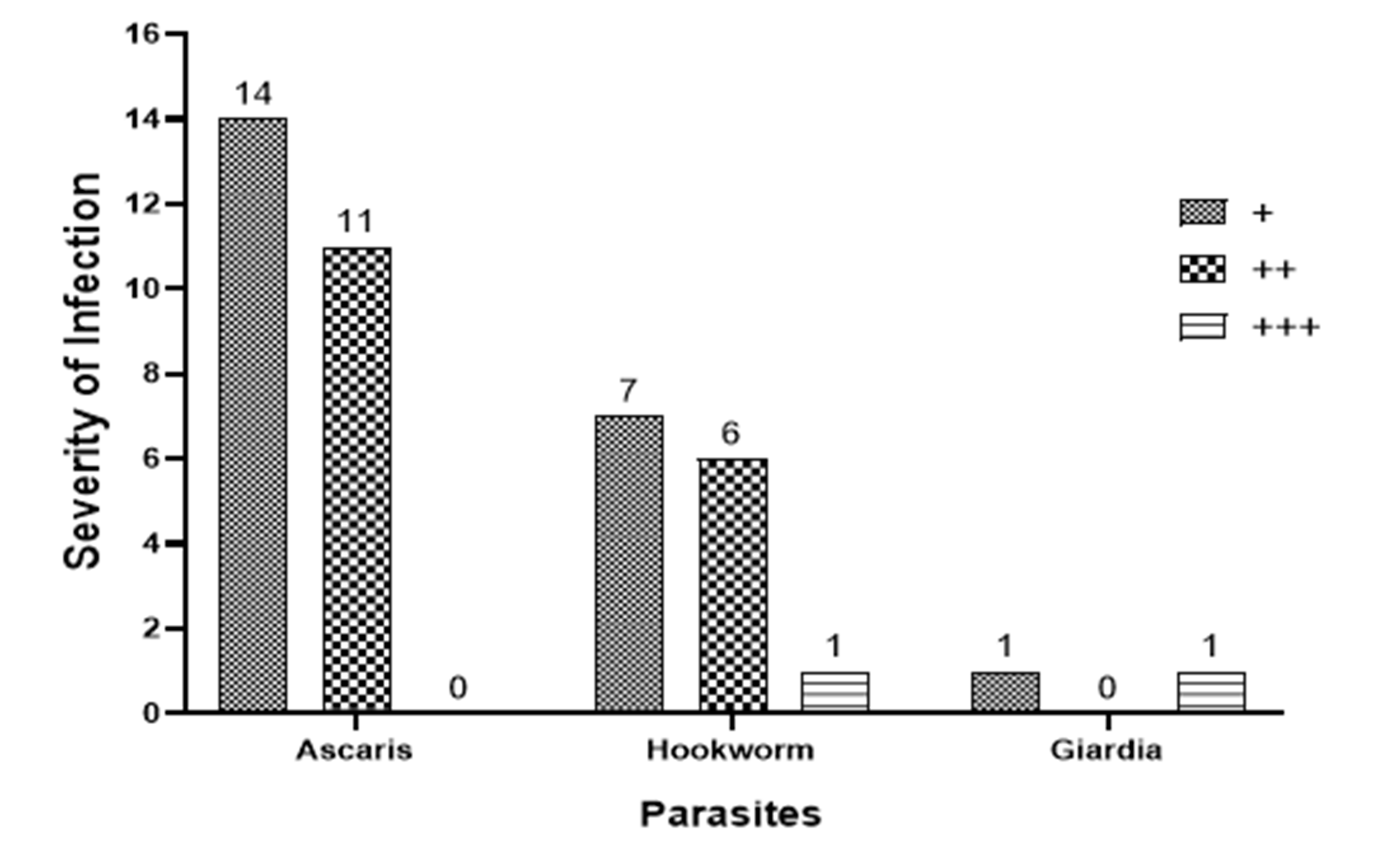
Soil-transmitted helminths (STHs) remain a major public health concern in sub-Saharan Africa, yet evidence on their prevalence and species distribution among adults attending healthcare at Nsukka Health Center remains limited. This study was conducted to determine the prevalence and intensity of STHs among adults attending Nsukka Health Center in Nsukka LGA, Nigeria. A total of 112 stool samples were collected from adult patients attending the healthcare and examined using the direct examination method and the formol-ether concentration technique, followed by microscopic identification. Infection intensity was assessed using the Kato-Katz method, with egg counts expressed as eggs per gram (EPG) of feces. Overall, 41(36.6%) participants were infected with STHs. Among infected individuals, 25(22.3%) had Ascaris infection, 14(12.5%) had hookworm infection, and 2(10.5% infected females) had hookworm and Ascaris co-infection with Giardia lamblia. Sex-based analysis showed 19(46.3%) females and 22(53.7%) males among the 41 infected persons. Intensity assessment showed predominantly moderate infection: for Ascaris, 14 had light infection (<5,000 EPG) and 11 had moderate infection (5,000–50,000 EPG); for hookworm, 7 had light infection (<2,000 EPG), 6 had moderate infection (2,000–4,000 EPG), and one had heavy infection (>4,000 EPG). These findings demonstrate that STHs are moderately prevalent among adults attending the Health Center, with Ascaris being the most common. Health education, deworming programs targeting adults, and intensified promotion of handwashing, sanitation, and personal hygiene are recommended. The modest sample size and the hospital-based design may limit the generalizability of prevalence estimates, and larger community-based studies are needed to validate these findings.
Downloads
Article Details

This work is licensed under a Creative Commons Attribution-NonCommercial-NoDerivatives 4.0 International License.
References
Achi, E. C., Njoku, O. O., Nnachi, A. U., Efunshile, A. M., Mbah, J. O., Aghanya, I. N., and Nnemelu, P. O. (2017). Prevalence of intestinal parasitic infections among under five children in Abakaliki Local Government Area of Ebonyi State. Eur J Pharm Med Res, 4(4), 218-22.
Adamu, R., Abd Aziz, N. A., Mustafa, M., and Shohaimi, S. (2025). Soil-transmitted Helminth (STH) Infections in Northern Nigeria between 2000-2022: A Review. UMYU Journal of Microbiology Research (UJMR), 10(1), 39-55. https://doi.org/10.47430/ujmr.25101.005
Ahmed, Z., Degefa, T., Tesfaye, M., Sultan, S., Elias A. E., Zuber, H., Ali, S., Azam, K., Husen, A., Yasin, J. and Wieser, A. (2022). Prevalence and intensity of soil transmitted helminth infections and associated risk factors among household heads living in the peri-urban areas of Jimma town, Oromia, Ethiopia: A community–based cross sectional study. PLOS ONE Neglected Tropical Disease. https://doi.org/10.1371/jornal.pone.0274702
Amidou, S., Nicoline, F. T., Itumeleg, S. and Mbati, P. (2020). Prevalence and genetic characterization of Giardia lamblia in relation to diarrhea in Limpopo and Gauteng provinces, South Africa. Parasite Epidemiology and Control of Open Access Journal, 9(1). DOI: 10.1016/j.parepi.2020.e00140
Asemota O, O., Nmorsi OP, G., Isaac C, C., Umukoro D, O., and Akhile A, O. (2012). Distribution of intestinal parasites among school-age children in Delta and Edo State of Nigeria. Parasitologists United Journal, 5(2): 121 – 126.
Bosch, F., Palmeirim, M. S., Ali, S. M., Ame, S. M., Hattendorf, J. and Keiser, J. (2021). Diagnosis of soil-transmitted helminths using the Kato-Katz technique: What is the influence of stirring, storage time and storage temperature on stool sample egg counts? PLoS Neglected Tropical Diseases, 15(1): e0009032. DOI: 10.1371/journal.pntd.0009032
Brahmantya, B. I., Haikal, P. I., Ryalino, C. and Sudarmaja, M. (2020). Risk factors and Prevalence of Soil transmitted helminths infections. Open Access Macedonian Journal of Medical Science. 8: 521-524. https://doi.org/10.1016/j.parepi.2025.e00473
Cheesbrough, M. (1998). Parasitological Test in District Laboratory Practice in Tropical Countries. Monica Cheesbrough. Tropical Health Technology, pp 184-235. https://doi.org/10.1017/CBO9780511581304.007
Cochran, W. G. (1963). Sampling Techniques, 2nd Ed., New York: John Wiley and Sons, Inc.
Crompton, D. W. and Nesheim, M. C. (2002). Nutritional impact of intestinal helminthiasis during the human life cycle. Annu Rev Nutr, 22: 35–59. DOI: 10.1146/annurev.nutr.22.120501.134539
Dennis, A., Kwaku, P. A., Dennis, K. G., Agyei, O., Seeba, A., Gyan, B., Dosoo, D., Adeniji, E. and Iddrisu, L. F. (2018). Epidemiology of soil transmitted helminth infections in the middle of Ghana, Africa. Parasite Epidemiology and Control of Open Access Journal, 3(3). DOI: 10.1016/j.parepi.2018.e00071
Edoa, J. R., Adégbitè, B. R., Honkpéhèdji, Y. J., Zinsou, J. F., Boussougou-Sambe, S. T., Woldearegai, T. G., ... and Dejon Agobé, J. C. (2024). Epidemiology of soil-transmitted helminth infections and the differential effect of treatment on the distribution of helminth species in rural areas of Gabon. Tropical medicine and health, 52(1): 3. DOI: 10.1186/s41182-023-00567-z
Ekwezuo, J. C., Nnodim, C. C., Okwuonu, E., Ngwu, G. I., Agbedo, E. C., Aguzie, I. O. N., ... and Audu, J. M. (2025). Prevalence of soil-transmitted helminths and protozoan parasites’ infections among inmates in Nsukka Correctional Centre. Journal of Biological Research and Biotechnology, 23(3). DOI: 10.4314/br.v23i3.4
Ibidapo, A. C. and Okwa, O. (2008). The Prevalence and intensity of soil transmitted helminths in a rural community, Lagos suburbs, South West Nigeria. International Journal of Agriculture and Biology. 10: 89-92.
Imalele, E. E., Effanga, E. O., and Usang, A. U. (2023). Environmental contamination by soil-transmitted helminths ova and subsequent infection in school-age children in Calabar, Nigeria. Scientific African, 19: e01580. https://doi.org/10.1016/j.sciaf.2023.e01580
Kache, R., Phasuk, N., Viriyavejakul, P. and Punsawad, C. (2020). Prevalence of soil transmitted infections and risk associated risk factors among elderly individuals living in rural areas of Southern Thailand; 20: 1882. https://doi.org/10.1186/s12889-020-09986-7
Karshima, S. N. (2018). Prevalence and distribution of soil-transmitted helminth infections in Nigerian children: a systematic review and meta-analysis. Infectious diseases of poverty, 7(04), 1-14. DOI: 10.1186/s40249-018-0451-2
Mascarini, S. L. (2011). Prevention of Soil transmitted Helminths Infection. Journal of Global Infectious Disease; 3(2): 175-182. https//doi:10.4103/0974-777X.81696
Mascarini-Serra, L. M., Telles, C. A., Prado, M. S., Mattos, S. A., Strina, A., Alcantara-Neves, N. M., and Barreto, M. L. (2010). Reductions in the prevalence and incidence of geohelminth infections following a city-wide sanitation program in a Brazilian Urban Centre. PLoS Neglected Tropical Diseases, 4(2): e588. https://doi.org/10.1371/journal.pntd.0000588
Mengistu, B., Maddren, R., Collyer, B., and Anderson, R. M. (2025). Trends in the prevalence and intensity of soil-transmitted helminth (STH) infection in Ethiopia 2000 to 2023: a systematic review. Parasites & Vectors, 18(1): 340. DOI: 10.1186/s13071-025-06928-3
Nwadike, C. C., Mgbachi, A. J., Ogbuefi, E. O., Olisa, C. S., Obiefule, I. E., Nnatuanya, I. O., Okeke, O. A., Okpara, C. C., Anayor, G. C., and Ezedialu, C. M. (2026). Prevalence of Intestinal Parasites among Primary School Children in Idemili North Local Government Area of Anambra State, Southeast Nigeria. International Journal of Pathogen Research, 15(4): 136 – 157. DOI: 10.9734/ijpr/2026/v15i4474
Okwuonu, E. S., Aguzie, I. O. N., Atama, C. I., and Ani, C. P. (2020). A review on geohelminths and pharmaceuticals. Journal of Biologics Research and Development, 1: 92-112.
Oyeyemi, O. T., and Okunlola, O. A. (2023). Soil-transmitted helminthiasis (STH) endemicity and performance of preventive chemotherapy intervention program in Nigeria (in year 2021). Scientific Reports, 13(1): 10155. DOI: 10.1038/s41598-023-37402-8
Roach, R. R., Octain, J., and Friedman, E. (2012). Soil-Transmitted Helminths. Book Chapter In book: Helminthiasis. IntechOpen, pp.345-351. DOI: 10.5772/intechopen.87143
Samuel, F., Mirko, S., Winkler, P., Dung, S., Christian, S., Jurg, U. and Gueladio, C. (2016). Intestinal parasite infections and associated risk in communities. Parasites and Vectors, 9: 537-544. DOI: 10.1002/hsr2.70473
Tandukar, S., Adhikari, N., Ansari, S., Shrestha, A., Gautam, J. and Sharma, B. (2005). Intestinal parasitosis in school children of Lalitpur district of Nepal. Biomedical Central Open Access Journal, 6: 1-6. DOI: 10.1186/1756-0500-6-449
Tashikuta, J. G., Scott, M. E., Gray-Donald, K. (1995). Ascaris lumbricoides infection and environmental risk factors in an urban African setting. Ann Tropical Medical Parasitology, 89: 505-514. DOI: 10.1080/00034983.1995.11812983
Taylor‐Robinson, D. C., Donegan, S., Chaplin, M., and Garner, P. (2019). Public health deworming programs for soil‐transmitted helminths in children living in endemic areas. Cochrane Database of Systematic Reviews, (9). DOI: 10.1002/14651858.CD000371.pub7
Unigwe, C. R., Egwu U. L., and Ukwueze S. C. (2022). Prevalence of gastro-intestinal helminths of slaughtered pigs at Bodija abattoir, Ibadan, Oyo State, Nigeria. Journal of Biological Research and Biotechnology, 20(2): 1506-1512. DOI:10.4314/br.v20i2.1
WHO (2008). World Health Statistics 2008. https://www.who.int/docs/default-source/gho-documents/world-health-statistic-reports/en-whs08-full.pdf
WHO (2015). Investing to Overcome the Global Impact of Neglected Tropical Diseases. https://reliefweb.int/report/world/investing-overcome-impact-neglected-tropical-disease-third-who-report-neglected
WHO (2017). Deadly worms- A look at soil transmitted helminths. https://www.who.int/health-topics/soil-transmitted-helmithiasis
WHO (2023). Soil-transmitted helminths. https://www.who.int/news-room/fact-sheets/detail/soil-transmitted-helminth-infections
WHO and PAHO (2015). Soil transmitted helmithiases and communicable disease prevention, control and elimination. World Health Organization and Pan America Health Organization collaborating center. https://www.paho.org/en/topics/soil-transmitted-helminthiasis