

Integrative Transcriptomics Reveals Immune–Metabolic and Signalling Crosstalk in a Diabetes-Like State of Colorectal Cancer
Article Sidebar
Main Article Content
Abstract
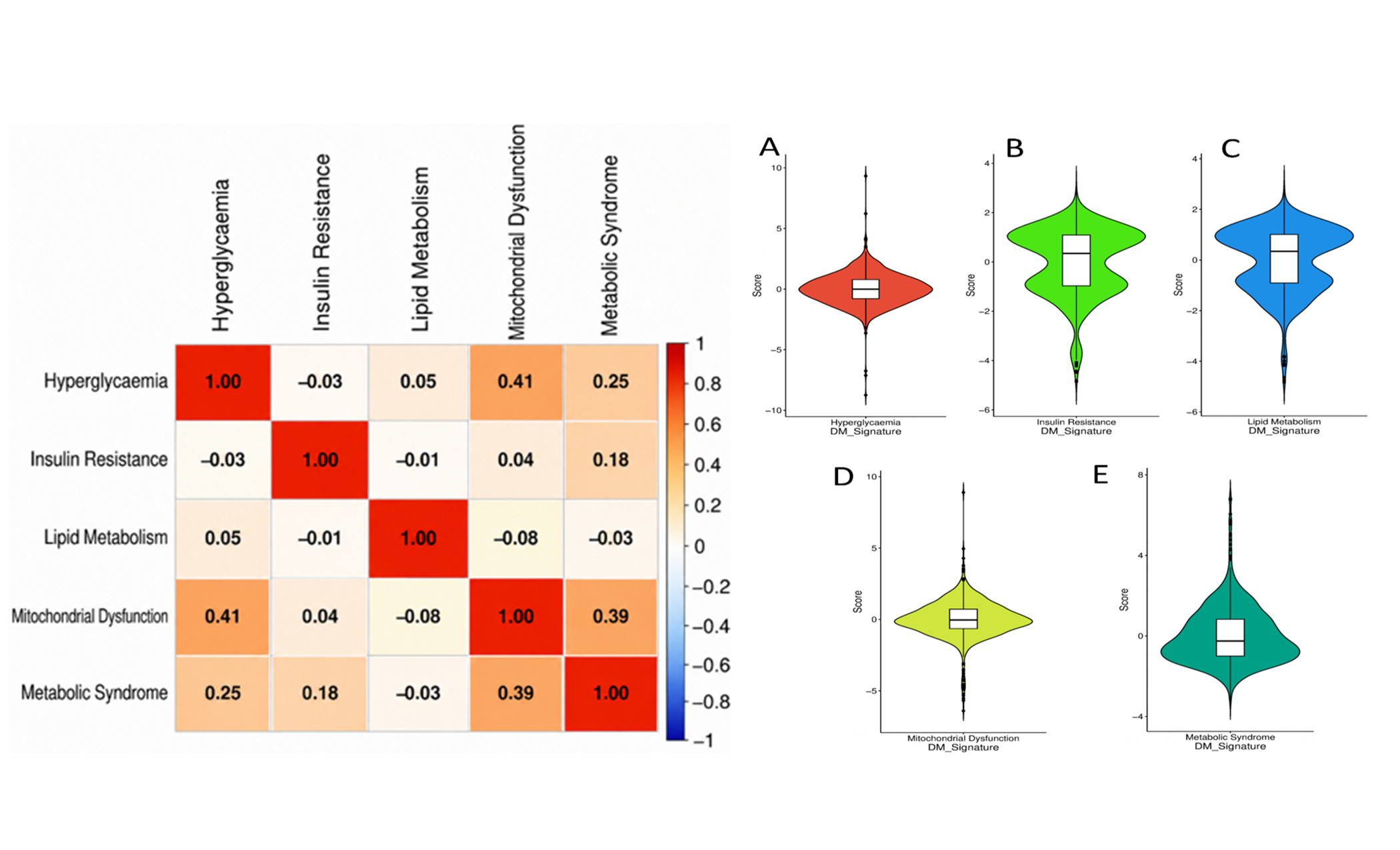
Diabetes mellitus (DM) and colorectal cancer (CRC) share metabolic and signalling alterations, suggesting that CRC transcriptomes may provide a systems-level framework for investigating DM-associated molecular programmes. Transcriptomic data from 988 CRC tumours across TCGA (n=534), CPTAC-2 (n=106), and Sidra-LUMC (n=348) cohorts were integrated. Five DM-related transcriptional signatures were quantified, and hyperglycaemia, insulin resistance, and mitochondrial dysfunction scores were integrated into a core composite DM-like score. Gene set enrichment analysis (GSEA), differential expression analysis, gene ontology enrichment analysis (GOEA), pathway ontology enrichment analysis (POEA), and disease ontology enrichment analysis (DOEA) were used to characterize the DM-like phenotype. CRC tumours exhibited heterogeneous DM-related transcriptional programmes. GSEA independently identified diabetes-associated pathways, including insulin resistance, β-cell destruction, type 1 diabetes, and immune-regulatory programmes. DM-like-high tumours showed enrichment of glucose and insulin signalling, mitochondrial dysfunction, and diabetes-associated clinical features and complications, including atherosclerosis, nephropathy, fatty liver disease, retinopathy, and neuropathy. CRC transcriptomes recapitulate multiple molecular features of DM and provide a systems-level framework for investigating diabetes-associated molecular alterations, biomarkers, and potential therapeutic targets.
Downloads
Article Details

This work is licensed under a Creative Commons Attribution-NonCommercial-NoDerivatives 4.0 International License.
References
Argilés, J.M., Busquets, S., Stemmler, B. and López-Soriano, F.J. (2014). Cancer cachexia. Nature Reviews Cancer, 14: 754–762.
Ashburner, M., Ball, C.A., Blake, J.A., Botstein, D., Butler, H., Cherry, J.M., et al. (2000). Gene ontology: tool for the unification of biology. Nature Genetics, 25: 25–29.
Atkinson, M.A., Eisenbarth, G.S. and Michels, A.W. (2014). Type 1 diabetes. The Lancet, 383: 69–82.
Baracos, V.E., Martin, L., Korc, M., Guttridge, D.C. and Fearon, K.C.H. (2018). Cancer-associated cachexia. Nature Reviews Disease Primers, 4: 17105.
Barbie, D.A., Tamayo, P., Boehm, J.S., Kim, S.Y., Moody, S.E., Dunn, I.F., et al. (2009). Systematic RNA interference reveals that oncogenic KRAS-driven cancers require TBK1. Nature, 462: 108–112.
Beckman, J.A., Creager, M.A. and Libby, P. (2002). Diabetes and atherosclerosis. JAMA, 287: 2570–2581.
Bluestone, J.A., Herold, K. and Eisenbarth, G. (2010). Genetics, pathogenesis and clinical interventions in type 1 diabetes. Nature, 464: 1293–1300.
Bornfeldt, K.E. and Tabas, I. (2011). Insulin resistance, hyperglycemia, and atherosclerosis. Cell Metabolism, 14: 575–585.
Cancer Genome Atlas Network. (2012). Comprehensive molecular characterization of human colon and rectal cancer. Nature, 487: 330–337.
Caturano, A., D'Angelo, M., Pafundi, P.C., Galiero, R., Rinaldi, L., Salvatore, T., Vetrano, E., Cesaro, A., Rinaldi, M., Marfella, R., et al. (2025). Insulin resistance and cancer: molecular links and clinical implications. Cancers, 17: 945.
Cerami, E., Gao, J., Dogrusoz, U., Gross, B.E., Sumer, S.O., Aksoy, B.A., et al. (2012). The cBio cancer genomics portal: an open platform for exploring multidimensional cancer genomics data. Cancer Discovery, 2: 401–404.
Chen, E.Y., Tan, C.M., Kou, Y., Duan, Q., Wang, Z., Meirelles, G.V., et al. (2013). Enrichr: interactive and collaborative HTML5 gene list enrichment analysis tool. BMC Bioinformatics, 14: 128.
Cole, J.B. and Florez, J.C. (2020). Genetics of diabetes mellitus and diabetes complications. Nature Reviews Nephrology, 16: 377–390.
DeFronzo, R.A., Ferrannini, E., Groop, L., Henry, R.R., Herman, W.H., Holst, J.J., et al. (2015). Type 2 diabetes mellitus. Nature Reviews Disease Primers, 1: 15019.
Gao, J., Aksoy, B.A., Dogrusoz, U., Dresdner, G., Gross, B., Sumer, S.O., et al. (2013). Integrative analysis of complex cancer genomics and clinical profiles using the cBioPortal. Science Signaling, 6: pl1.
Gene Ontology Consortium. (2026). The Gene Ontology knowledgebase in 2026. Nucleic Acids Research, 54(D1): D1779–D1792. doi: 10.1093/nar/gkaf1292.
Giovannucci, E., Harlan, D.M., Archer, M.C., Bergenstal, R.M., Gapstur, S.M., Habel, L.A., et al. (2010). Diabetes and cancer: a consensus report. CA: A Cancer Journal for Clinicians, 60: 207–221.
Guinney, J., Dienstmann, R., Wang, X., de Reyniès, A., Schlicker, A., Soneson, C., et al. (2015). The consensus molecular subtypes of colorectal cancer. Nature Medicine, 21: 1350–1356.
Gurung, M., Li, Z., You, H., Rodrigues, R., Jump, D.B., Morgun, A. and Shulzhenko, N. (2020). Role of gut microbiota in type 2 diabetes pathophysiology. EBioMedicine, 51: 102590.
Gutiérrez-Salmerón, M., Lucena, S.R., Chocarro-Calvo, A., García-Martínez, J.M., Martín Orozco, R.M. and García-Jiménez, C. (2021). Metabolic and hormonal remodeling of colorectal cancer cell signalling by diabetes. Endocrine-Related Cancer, 28(6): R191–R206. doi: 10.1530/ERC-21-0092.
Holt, R.I.G., DeVries, J.H., Hess-Fischl, A., et al. (2021). The management of type 1 diabetes in adults. A consensus report by the ADA and the EASD. Diabetologia, 64: 2609–2652.
Hopkins, B.D., Goncalves, M.D. and Cantley, L.C. (2016). Insulin-PI3K signalling: an evolutionarily insulated metabolic driver of cancer. Nature Reviews Endocrinology, 12: 548–561.
Johnson, W.E., Li, C. and Rabinovic, A. (2007). Adjusting batch effects in microarray expression data using empirical Bayes methods. Biostatistics, 8: 118–127.
Kanehisa, M., Furumichi, M., Sato, Y., Matsuura, Y. and Ishiguro-Watanabe, M. (2025). KEGG: biological systems database as a model of the real world. Nucleic Acids Research, 53(D1): D672–D677. doi: 10.1093/nar/gkae909.
Khorana, A.A. (2010). Cancer-associated thrombosis: updates and controversies. Journal of Clinical Oncology, 28: 4839–4847.
Kuleshov, M.V., Jones, M.R., Rouillard, A.D., Fernandez, N.F., Duan, Q., Wang, Z., et al. (2016). Enrichr: a comprehensive gene set enrichment analysis web server 2016 update. Nucleic Acids Research, 44: W90–W97.
Le, D.T., Uram, J.N., Wang, H., Bartlett, B.R., Kemberling, H., Eyring, A.D., et al. (2015). PD-1 blockade in tumors with mismatch-repair deficiency. The New England Journal of Medicine, 372: 2509–2520.
Leek, J.T., Johnson, W.E., Parker, H.S., Jaffe, A.E. and Storey, J.D. (2012). The sva package for removing batch effects and other unwanted variation. Bioinformatics, 28: 882–883.
Li, B. and Dewey, C.N. (2011). RSEM: accurate transcript quantification from RNA-Seq data. BMC Bioinformatics, 12: 323.
Libby, P. (2021). The changing landscape of atherosclerosis. Nature, 592: 524–533.
Llosa, N.J., Cruise, M., Tam, A., Wicks, E.C., Hechenbleikner, E.M., Taube, J.M., et al. (2015). The vigorous immune microenvironment of microsatellite instable colon cancer. Cancer Discovery, 5: 43–51.
Milacic, M., Beavers, D., Conley, P., Gong, C., Gillespie, M., Griss, J., Haw, R., Jassal, B., Matthews, L., May, B., et al. (2024). The Reactome Pathway Knowledgebase 2024. Nucleic Acids Research, 52(D1): D672–D678. doi: 10.1093/nar/gkad1025.
Pavlova, N.N. and Thompson, C.B. (2016). The emerging hallmarks of cancer metabolism. Cell Metabolism, 23: 27–47.
Ritchie, M.E., Phipson, B., Wu, D., Hu, Y., Law, C.W., Shi, W., et al. (2015). limma powers differential expression analyses. Nucleic Acids Research, 43: e47.
Roelands, J., Kuppen, P.J.K., Ahmed, E.I., Mall, R., Masoodi, T., Singh, P., Monaco, G., Raynaud, C., de Miranda, N.F.C.C., Ferraro, L., et al. (2023). An integrated tumor, immune and microbiome atlas of colon cancer. Nature Medicine, 29: 1273–1286.
Saxton, R.A. and Sabatini, D.M. (2017). mTOR signaling in growth, metabolism, and disease. Cell, 168: 960–976.
Sepich-Poore, G.D., Zitvogel, L., Straussman, R., Hasty, J., Wargo, J.A. and Knight, R. (2021). The microbiome and human cancer. Science, 371: eabc4552.
Smyth, G.K. (2004). Linear models and empirical Bayes methods for assessing differential expression. Statistical Applications in Genetics and Molecular Biology, 3: Article 3.
Subramanian, A., Tamayo, P., Mootha, V.K., Mukherjee, S., Ebert, B.L., Gillette, M.A., Paulovich, A., Pomeroy, S.L., Golub, T.R., Lander, E.S. and Mesirov, J.P. (2005). Gene set enrichment analysis: a knowledge-based approach for interpreting genome-wide expression profiles. Proceedings of the National Academy of Sciences of the United States of America, 102: 15545–15550.
Sun, H., Saeedi, P., Karuranga, S., Pinkepank, M., Ogurtsova, K., Duncan, B.B., Stein, C., Basit, A., Chan, J.C.N., Mbanya, J.C., et al. (2022). IDF Diabetes Atlas: global, regional and country-level diabetes prevalence estimates for 2021 and projections for 2045. Diabetes Research and Clinical Practice, 183: 109119.
Tang, D., Chen, M., Huang, X., Zhang, G., Zeng, L., Zhang, G., Wu, S. and Wang, Y. (2023). SRplot: a free online platform for data visualization and graphing. PLoS ONE, 18: e0294236.
Taylor, R. (2013). Type 2 diabetes: etiology and reversibility. Diabetes Care, 36: 1047–1055.
Tsilidis, K.K., Kasimis, J.C., Lopez, D.S., Ntzani, E.E. and Ioannidis, J.P.A. (2015). Type 2 diabetes and cancer: umbrella review of meta-analyses of observational studies. BMJ, 350: g7607.
Vander Heiden, M.G., Cantley, L.C. and Thompson, C.B. (2009). Understanding the Warburg effect: the metabolic requirements of cell proliferation. Science, 324: 1029–1033.
Vasaikar, S., Huang, C., Wang, X., et al. (2019). Proteogenomic analysis of human colon cancer reveals new therapeutic opportunities. Cell, 177: 1035–1049.
Xie, Z., Bailey, A., Kuleshov, M.V., Clarke, D.J.B., Evangelista, J.E., Jenkins, S.L., et al. (2021). Gene set knowledge discovery with Enrichr. Current Protocols, 1: e90.