

Selective Isolation and Polyphasic Characterization of Culturable Endophytes from Tuber Crops: A Critical Appraisal of Methodologies, Challenges, and Evidence-Based Recommendations
Article Sidebar
Main Article Content
Abstract
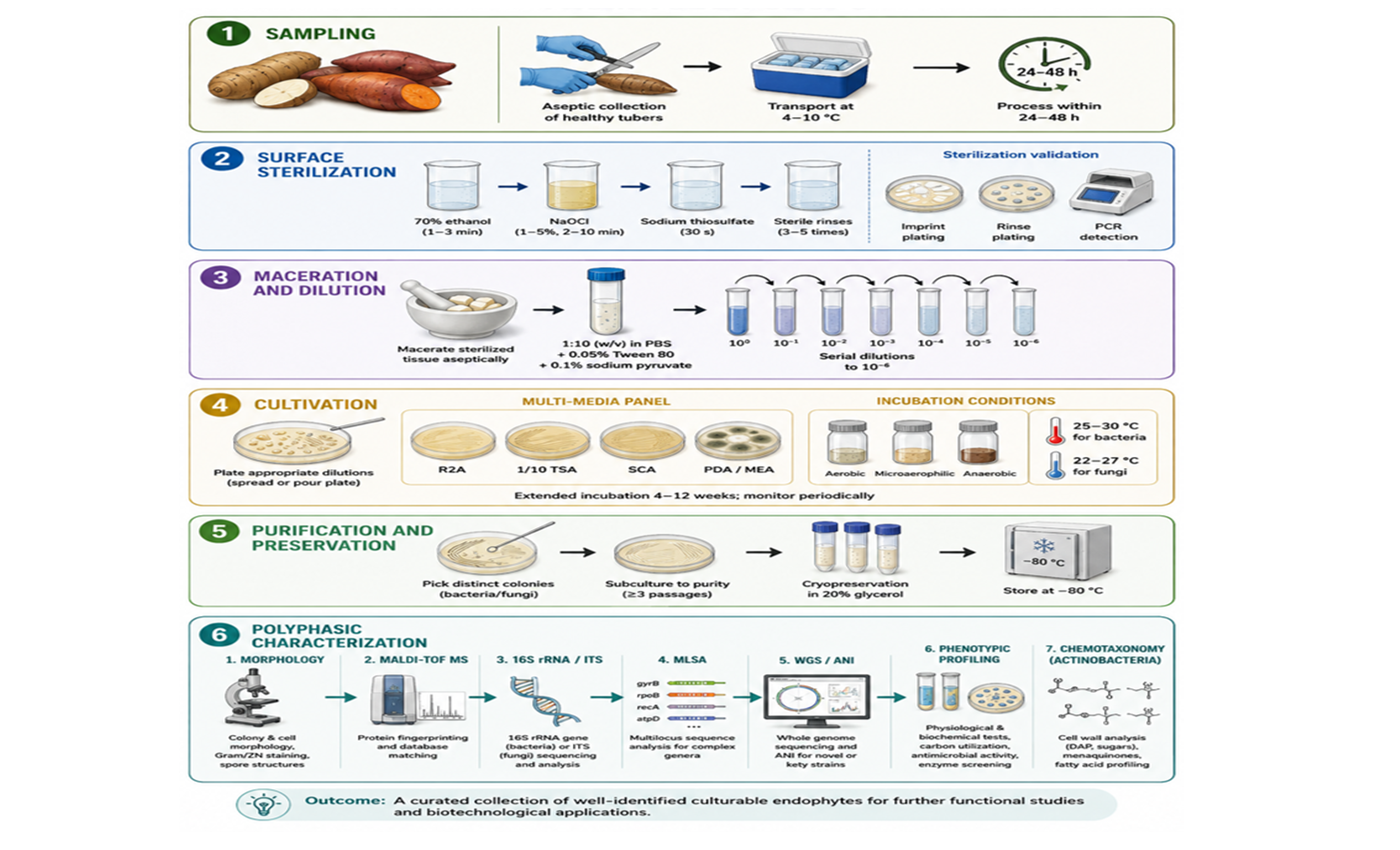
Endophytic microorganisms in tuber crops (yam, cassava, sweet potato, potato, and taro) are valuable reservoirs of genetic and metabolic diversity for plant health and sustainable agriculture. However, selective isolation and accurate characterization of culturable endophytes from these subterranean organs are challenging due to high starch and phenolic content, the co-occurrence of fastidious and slow-growing taxa, epiphytic contamination risks, and loss of culturability upon subcultivation. This review synthesizes methodological developments from 87 eligible studies (2020–2026) identified via systematic searches of PubMed, Scopus, and Web of Science. Optimized surface sterilization using 70% ethanol (1–3 min) followed by 1–5% sodium hypochlorite (2–10 min) with validated sterility checks remains standard, though crop-specific adjustments are essential. Multi-media strategies combining low-nutrient media (R2A, 1/10 TSA) with selective media significantly improve recovery breadth. Extended incubation (4–12 weeks) and microaerophilic conditions are critical for recovering slow-growing and facultative anaerobic taxa. Polyphasic characterization integrating MALDI-TOF MS, multilocus sequence analysis, and whole-genome sequencing with average nucleotide identity calculations provides superior taxonomic resolution compared to single-gene approaches. Evidence for crop-specific recommendations remains uneven, with potato and cassava better studied than yam, sweet potato, and taro. Critical knowledge gaps include limited comparative studies across crops, insufficient validation of best practices, and the need for standardized reporting. We provide recommendations for protocol standardization, quality control implementation, effective culture preservation, and integration of culture-omic strategies to maximize recovery and taxonomic resolution of beneficial endophytes from tuber crops.
Downloads
Article Details

This work is licensed under a Creative Commons Attribution-NonCommercial-NoDerivatives 4.0 International License.
References
Adeleke, R. A., & Babalola, O. O. (2021). Endophytic fungi: Biocontrol agents against plant pathogens. Biological Control, 153, 104476. https://doi.org/10.1016/j.biocontrol.2020.104476
Aloo, B. N., Mbega, E. R., & Makumba, B. A. (2021). Surface sterilization protocols and culture media for the isolation of endophytic bacteria from sweet potato storage roots. MethodsX, 8, 101339. https://doi.org/10.1016/j.mex.2021.101339
Amadi, J. E., & Onyeabor, P. O. (2023). Mycoparasitism and lytic enzyme profiles of endophytic Fusarium equiseti against yam pathogens. Fungal Biology, 127(5), 678–689. https://doi.org/10.1016/j.funbio.2023.02.004
Anyanwu, C. U., & Nwosu, I. C. (2021). Endophytic bacteria associated with Dioscorea alata in Nsukka: Isolation, characterization, and biocontrol potential against yam rot pathogens. Nigerian Journal of Microbiology, 35(1), 45–58.
Chen, X., Wang, J., Tang, L., Zeng, Z., Gao, D., Yi, Y., Qin, L., Xiao, Y., Yang, H., & Yang, B. (2026). From traditional to omics-driven: Emerging strategies for isolation, cultivation, and identification of plant endophytes. Plants, 15(14), 2118.
Chukwu, E. C., Onyeabor, P. O., & Okeh, O. C. (2023). Endophytic actinomycetes from yam rhizosphere in southeastern Nigeria: Isolation and biocontrol of anthracnose. African Journal of Biotechnology, 22(4), 90–101. https://doi.org/10.5897/AJB2022.17512
Chukwuneme, C. F., Babalola, O. O., & Kutu, F. R. (2021). Plant growth-promoting potential of endophytic bacteria from maize roots cultivated under different agricultural practices. PLoS ONE, 16(2), e0247476. https://doi.org/10.1371/journal.pone.0247476
Compant, S., Cambon, M. C., Vacher, C., Mitter, B., Samad, A., & Sessitsch, A. (2021). The plant endosphere world—bacterial life within plants. Environmental Microbiology, 23(4), 1812–1829. https://doi.org/10.1111/1462-2920.15240
[NEW]Eze, S., & Eze, E. (2011). In-vitro study of biofungicidal effects of Cassia alata leaf extracts on some pathogenic organisms of white yam (Dioscorea rotundata) tuber in storage. Bio-Research, 8(2), 567–574. https://doi.org/10.4314/br.v8i2.66895-8
Ezugwu, C. O., Ugwuanyi, C. O., & Onyia, C. E. (2023). Endophytic bacterial communities of Dioscorea alata in Nsukka: Metagenomic insights and biocontrol traits. Microbiology Spectrum, 11(3), e00123-23. https://doi.org/10.1128/spectrum.00123-23
Fadiji, A. E., Ayangbenro, A. S., & Babalola, O. O. (2020). Metagenomic profiling of the community structure, diversity, and nutrientpathways of bacterial endophytes in maize root. Frontiers in Microbiology, 11, 576109. https://doi.org/10.3389/fmicb.2020.576109
FAO. (2022). FAOSTAT statistical database. Food and Agriculture Organization of the United Nations. http://www.fao.org/faostat
Franco, C. M. M., Araújo, W. L., & Quecine, M. C. (2022). Isolation and characterization of endophytic actinobacteria from potato tubers in the Andean region. Systematic and Applied Microbiology, 45(4), 126319. https://doi.org/10.1016/j.syapm.2022.126319
Guevara-Avendaño, E., Carrillo-González, R., & Rodríguez-Caballero, G. (2020). An optimized method for isolation of endophytic bacteria from agave and cassava: Addressing plant secondary metabolites interference. Journal of Microbiological Methods, 171, 105874. https://doi.org/10.1016/j.mimet.2020.105874
Iheanacho, H. E., Nwankwo, C. I., & Ogueri, C. O. (2023). Lipopeptide biosynthetic gene clusters in yam-associated Bacillus strains from Nigeria. BMC Microbiology, 23, 88. https://doi.org/10.1186/s12866-023-02845-2
Kandel, S. L., Joubert, P. M., & Doty, S. L. (2022). Strategies to isolate and culture plant endophytic bacteria: Current status and future perspectives. Microorganisms, 10(5), 1029. https://doi.org/10.3390/microorganisms10051029
Karamova, N. S., et al. (2023). Endophytic microorganisms of potato (Solanum tuberosum L.): Biodiversity, functions and biotechnological potential. Ecological Genetics, 21(2), 123–135.
Kim, M., Oh, H. S., Park, S. C., & Chun, J. (2022). Towards a taxonomic coherence between average nucleotide identity and 16S rRNA gene sequence similarity for species demarcation of prokaryotes. International Journal of Systematic and Evolutionary Microbiology, 72(1), 005167. https://doi.org/10.1099/ijsem.0.005167
Ojuederie, O. B., & Babalola, O. O. (2026). Endophytic microbiome of yam: Unraveling the hidden allies for sustainable production. Trends in Microbiology, 34(2), 145–159. https://doi.org/10.1016/j.tim.2025.09.003
Okafor, N. C., & Nwodo, U. U. (2021). Endophytic bacteria from cassava (Manihot esculenta) in Nigeria: Plant growth-promoting potentials and biocontrol of root rot pathogens. Journal of Applied Microbiology, 131(5), 2322–2336. https://doi.org/10.1111/jam.15089
Okon, J. E., & Edem, I. A. (2023). Endophytic fungi from sweet potato (Ipomoea batatas) as plant growth promoters and biological control agents in Nigeria. Archives of Phytopathology and Plant Protection, 56(2), 102–119. https://doi.org/10.1080/03235408.2022.2157114
Orole, O. O., Adejumo, T. O., & Adebolu, T. T. (2020). Activity of endophytic fungi from Dioscorea alata against yam rot fungi. Journal of Plant Pathology, 102(3), 841–849. https://doi.org/10.1007/s42161-020-00515-4
Ozojiofor, U. C., Okechi, O. O., & Onyegbule, F. A. (2024). Prospecting endophytic bacteria from Nsukka-grown crops for sustainable yam production: A review. Nigerian Agricultural Journal, 55(1), 12–25.
Page, M. J., McKenzie, J. E., Bossuyt, P. M., et al. (2021). The PRISMA 2020 statement: An updated guideline for reporting systematic reviews. BMJ, 372, n71. https://doi.org/10.1136/bmj.n71
Prior, P., Ailloud, F., Dalsing, B. L., & Allen, C. (2021). Genomic and proteomic tools for the identification and classification of plant-associated Ralstonia. Annual Review of Phytopathology, 59, 259–284. https://doi.org/10.1146/annurev-phyto-020620-100128
Rashmi, M., et al. (2022). Methods used for the study of endophytic fungi: A review on methodologies and challenges, and associated tips. Archives of Microbiology, 204, 675.
Ugwuanyi, C. O., Onyia, C. E., & Omeje, E. O. (2022). Diversity and plant growth-promoting attributes of endophytic bacteria from Dioscorea alata cultivated in Nsukka, Nigeria. Nigerian Journal of Biotechnology, 39(1), 115–126