

Effect of Therapeutic Caffeine Doses on the Histology of Lung Tissue in Experimental Animal Models
Article Sidebar
Main Article Content
Abstract
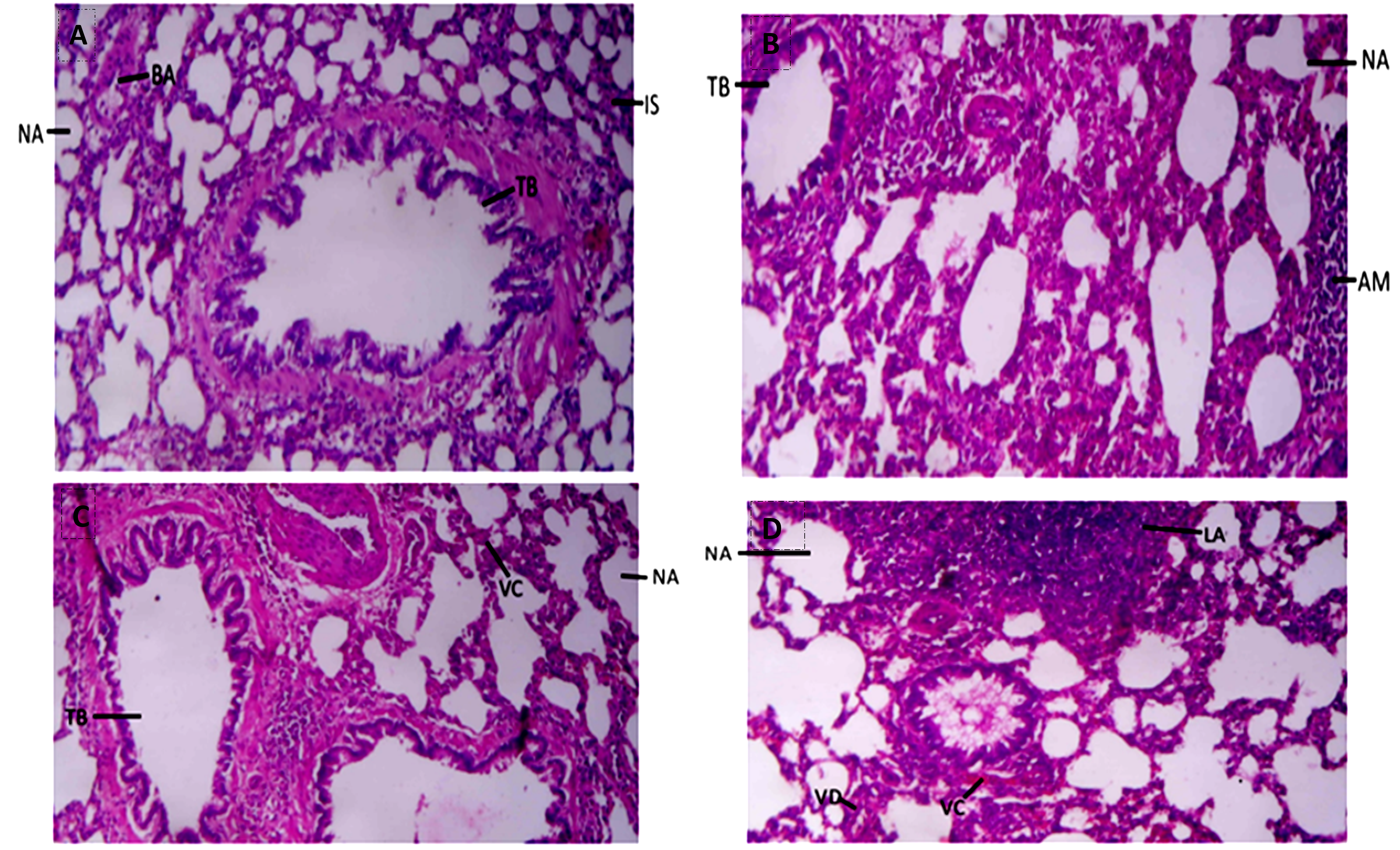
Caffeine is a widely used stimulant found in coffee and tea, mostly consumed as a beverage for alertness and enhanced intellectual performance but in excess can lead to dysfunction in normal body metabolism and toxicity on body organs. The Study evaluated the potential effect of caffeine as a specific pulmonary toxicant on the histological status in adult Wistar rat. Twenty rats were assigned into four groups at random. The standard control group, Group A, did not receive any caffeine. The caffeine-intoxicated groups B, C, and D received doses of 50, 100, and 200 mg/kg body weight respectively. For twenty-one days, animals in groups B–D were given caffeine orally every day. The oral treatment continued for twenty-one days. The rats were humanly sacrificed on day twenty-two, and their lungs were carefully removed, weighed, and preserved in 10% formal saline for histological analysis. Data were presented as mean ± SEM, and one-way ANOVA was used to determine statistical significance at p < 0.05. The results showed a significant increase (p < 0.0) in body weight and lungs weight when compare to the control group. Histological slides of caffeine intoxicated rats showed histopathological changes, including alveolar congestion, dilated terminal bronchiole, activated mononuclear phagocyte cell, and inflammatory cell infiltration. These damages increase in severity with ascending doses of caffeine across the groups. The results obtained from this study suggest that caffeine induces lungs toxicity in ascending manner of dose-dependent pattern in adult Wistar rats.
Downloads
Article Details

This work is licensed under a Creative Commons Attribution-NonCommercial-NoDerivatives 4.0 International License.
References
Abdel-Daim, M. M., Abuzead, S. M. M. and Halawa, S. M. (2015). Protective role of Spirulina platensis against acute caffeine-induced toxicity in rats. Environmental Toxicology and Pharmacology, 40(2), 701–709.
Ashihara, H. and Crozier, A. (1999). Distribution and biosynthesis of caffeine in plants. Plant Physiology, 120(1), 1–10.
Cappelletti, S., Piacentino, D., Fineschi, V., Frati, P., Cipolloni, L., and Aromatario, M. (2018). Caffeine-related deaths: Manner of deaths and categories at risk. Nutrients, 10(5), 611. https://doi.org/10.3390/nu10050611.
Centers for Disease Control and Prevention. (2017). Energy drink consumption among deployed U.S. military personnel. Morbidity and Mortality Weekly Report, 66(14), 373–377.
Chen, X., Ghribi, O. and Geiger, J. D. (2019). Caffeine protects against disruptions of the blood-brain barrier in animal models. Journal of Alzheimer’s disease, 20(Suppl. 1), S127–S141.
Chow, S. H., Yen, C. K. and Chen, J. K. (1994). Isolation and identification of caffeine in coffee, tea, and soft drinks by high-performance liquid chromatography. Journal of Food Protection, 57(11), 978–980.
Duarte, J. M. N., Carvalho, R. A., Cunha, R. A. and Gruetter, R. (2012). Caffeine consumption attenuates neurochemical modifications in the hippocampus of diabetic rats. Journal of Neurochemistry, 111(2), 368–378.
Eyong, E. U., Ikegbulam, N. C. and Eteng, M. U. (2008). Haematological changes following administration of alcohol and caffeine in albino Wistar rats. Bio-Research, 6(1), 290–292.
Fredholm, B. B. (1995). Adenosine, adenosine receptors and the actions of caffeine. Pharmacology & Toxicology, 76(2), 93–101.
Fredholm, B. B., Bättig, K., Holmén, J., Haglund, A. C. and Kaléy, T. E. (2011). Actions of caffeine in the brain with special reference to factors that contribute to the widespread use of caffeine. Pharmacological Reviews, 63(4), 1079–1103.
Fredholm, B. B., Bättig, K., Holmén, J., Nehlig, A. and Zvartau, E. E. (1999). Actions of caffeine in the brain with special reference to factors that contribute to its widespread use. Pharmacological Reviews, 51(1), 83–133.
Goldstein, E. R., Jacobs, P. L., Whitehurst, G. T. and Arent, S. M. (2010). Caffeine: Physiological effects and clinical use in performance-enhancing dietary supplements. Current Sports Medicine Reports, 9(3), 177–184.
Hossain, M. Z., Rashid, M. H. and Alam, A. H. (2017). Toxicological effects of high-dose caffeine administration on liver and kidney of mice. Bangladesh Pharmaceutical Journal, 20(2), 195–201.
Lee, C., Song, Y. and Park, J. (2017). Role of inflammation in respiratory diseases. Journal of Inflammation Research, 10, 1–12.
National Center for Complementary and Integrative Health. (2014). Energy drinks: What you need to know (NIH Publication No. 14-AT-04870).
Nehlig, A. (2018). Interindividual differences in caffeine metabolism and factors driving caffeine consumption. Pharmacological Reviews, 70(2), 384–411.
Nehlig, A., Daval, J. L. and Debry, G. (1992). Caffeine and the central nervous system: Mechanisms of action, biochemical, metabolic and psychostimulant effects. Brain Research Reviews, 17(2), 139–170.
Obidoa, O., Eirewele, E., Eseanyika, L. U. S. and Shoyinka, S. V. O. (2003). Effects of nominal exposure to petrol on organ pathogenesis and histopathology of rats. Bio-Research, 1(1), 75–82
Onyeije, B. P. and Innih, S. O. (2024). Effects of caffeine on cardiovascular toxicity in adult Wistar rats. Journal of Applied Sciences and Environmental Management, 26(9), 2797–2802.
Pauwels, B., Neven, F. and Gremmels, C. M. L. (2001). Caffeine: Occurrence in the environment and toxicological effects on aquatic organisms. Food and Chemical Toxicology, 39(2), 163–172.
Rehfeldt, A. L. and Aydin, M. A. (2017). Theophylline and caffeine in asthma: Is there a future? Journal of Asthma, 54(6), 555–562.
Rottlaender, D., Leon, S. and Paul. J. R. (2012). Cardiac arrest and myocardial infarction in a young male following ingestion of an energy drink: Case report and review of the literature. The American Journal of Emergency Medicine, 30(6), 1010.e1–1010.e3.
Substance Abuse and Mental Health Services Administration. (2012). Update on emergency department visits involving energy drinks: A final report.
Tarka, S. M., Stacewicz-Sapuntzakis, M. and Theis, C. R. (1998). A review of the toxicological effects of caffeine. Regulatory Toxicology and Pharmacology, 27(2), 157-209.
Wadhwa, P. and Seth, R. K. (2015). Effect of chronic caffeine consumption on immune organs of Wistar rats. International Journal of Research in Medical Sciences, 3(11), 3121–3127.